
What Is a Client Acquisition System? A Practical Framework for Online Coaches Who Already Have Attention
A practical client acquisition system framework for online coaches who already have attention, DMs, content, ads, or referrals but need a cleaner path from interest to qualified conversations, booked calls, and clients.
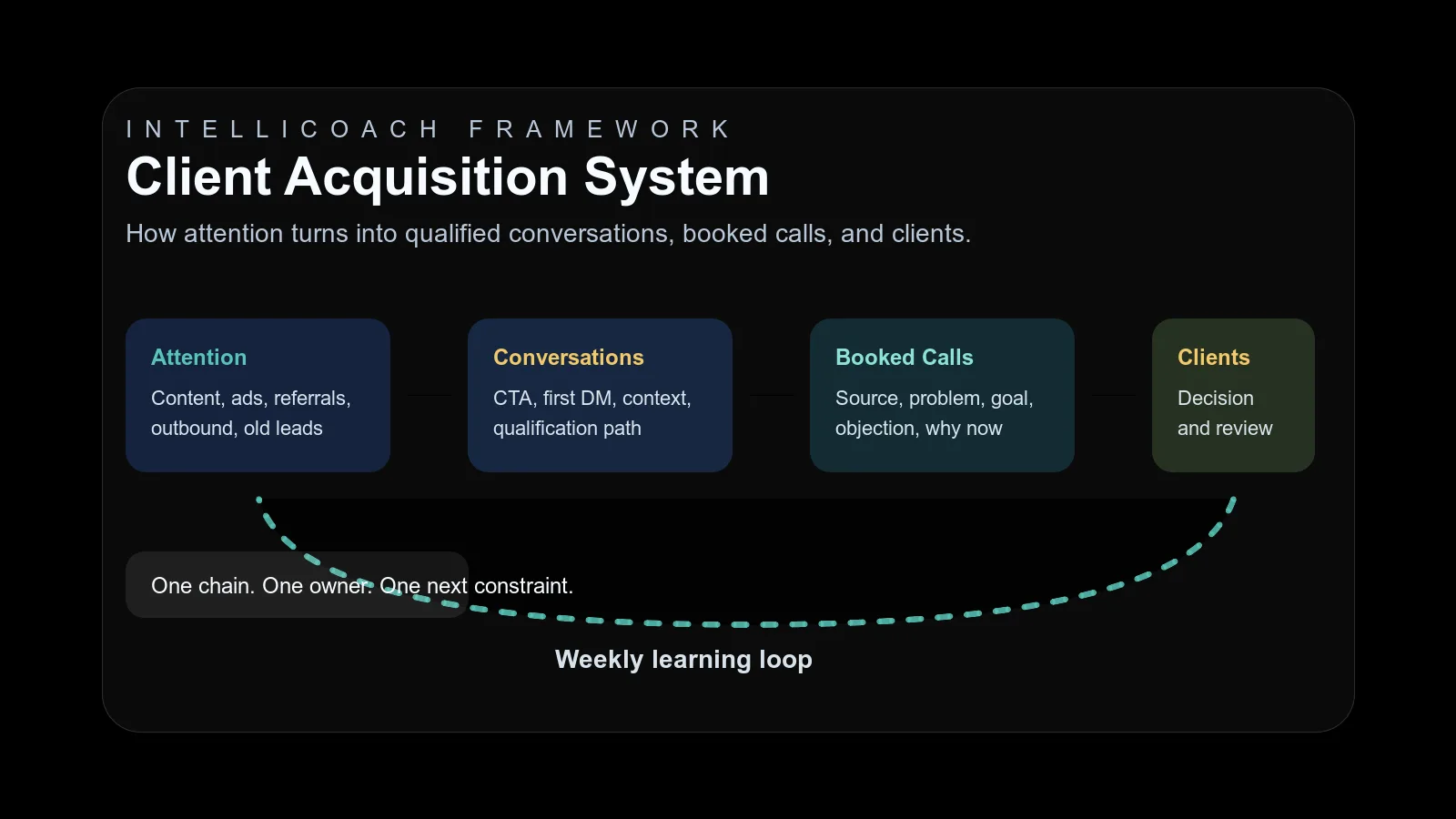
Most online coaches do not have a "get leads" problem in the way beginners talk about it.
They have attention.
They have DMs.
They have referrals, story replies, ad conversations, old leads, podcast listeners, ManyChat opt-ins, or people quietly watching for months.
And still, the month can feel unpredictable.
That is the difference between having lead flow and having a client acquisition system. Lead flow means people are showing signs of interest. A client acquisition system means interest has a clear path from first signal to qualified conversation, booked call, sales decision, and follow-up.
If your coaching business already has attention but the pipeline still feels messy, the answer is usually not "post more" or "hire another setter" by default. The better question is: where does the acquisition chain break?

The short definition
A client acquisition system is the repeatable path that turns attention into qualified conversations, booked calls, clients, and learning.
For online coaches, that system usually includes:
- source creation
- a conversion bridge
- qualification
- booking and sales-call handoff
- sales decision tracking
- weekly review
It is bigger than lead generation and more practical than a theoretical funnel diagram. It is the operating path your team uses when someone moves from "I am interested" to "I am ready to talk about coaching."
That matters because most coaching businesses do not lose sales at one obvious point. They leak across the chain. A post gets engagement but no clear CTA. A story reply starts a DM but loses context. A lead is warm but gets the booking link too early. A call books but the coach has no idea what was said in the DMs. A no-show disappears because nobody owns the follow-up.
None of those are separate problems when they keep repeating.
They are signs that the acquisition system is loose.
Client acquisition vs lead generation vs a sales funnel
These terms get used interchangeably, but they do different jobs.
| Term | What it means | What coaches usually miss |
|---|---|---|
| Lead generation | Creating interest, opt-ins, replies, inquiries, or new conversations | More leads do not automatically mean more qualified sales conversations |
| Sales funnel | The broad journey from awareness to buyer decision | A funnel can look good on paper while the live DM workflow stays messy |
| Client acquisition system | The repeatable operating path that turns attention into qualified conversations, booked calls, clients, and learning | It needs ownership, context, follow-up, handoff, and review, not just traffic |
Lead generation is one part of acquisition.
A funnel is the map.
The acquisition system is what actually happens on a Tuesday when your Reel hits, your VA is answering DMs, three leads ask for details, two people need follow-up, and one booked call has no context attached.
HubSpot's overview of lead generation is useful for understanding how businesses create interest. For online coaches with real DM volume, the harder question is often what happens after the interest exists.
The 6-part client acquisition chain
The cleanest way to diagnose client acquisition is to stop looking at it as one big funnel.
Look at it as a chain.
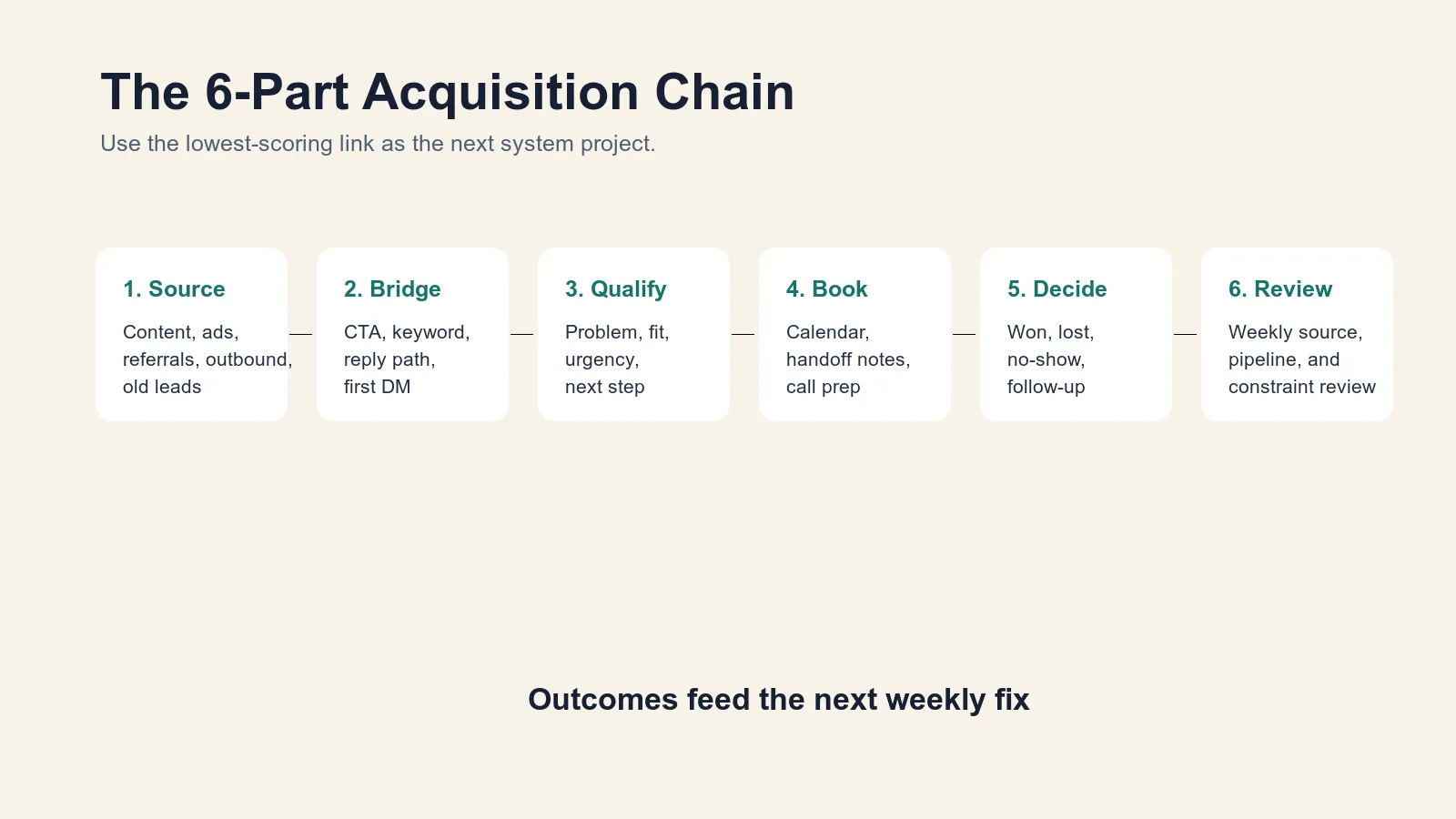
1. Source creation
This is where attention comes from.
For an online coaching business, sources might include:
- organic Reels, carousels, and stories
- DM ads
- follower ads
- ManyChat keyword flows
- outbound DMs
- referrals
- podcasts
- webinars
- community posts
- old leads reactivating
- current clients referring friends
The first mistake is judging sources only by volume.
The source channel and the relationship channel do not always need to be the same. For example, a coach may create attention through Instagram and continue a lead's requested one-to-one exchange on WhatsApp. The WhatsApp Business vs Instagram DMs guide explains how to make that choice without treating an Instagram interaction as blanket permission for WhatsApp follow-up.
A source can create a lot of replies and still be weak if those replies do not become qualified conversations. Another source can create fewer DMs but consistently bring in people who understand the offer, have urgency, show up to calls, and are a good fit after they buy.
That is why lead source tracking for online coaches matters. Not because you need perfect attribution. Because you need to know which sources create serious sales movement, not just noise.
The question to ask:
Which sources create conversations that are worth continuing?
2. The conversion bridge
The conversion bridge is the step between attention and a real conversation.
It might be:
- a Story reply prompt
- a Reel CTA
- a comment-to-DM flow
- a keyword
- a lead magnet
- a booking application
- an outbound opener
- a referral intro
- a question at the end of an email
This is where good content often fails.
The post gets saves. The story gets taps. The ad gets clicks. People agree with the message. But there is no specific next step that makes replying feel natural.
"DM me if you want help" can work when demand is very warm, but it often puts too much emotional risk on the lead. A better bridge gives them a useful reason to reply.
Weak:
"DM me READY."
Stronger:
"DM me PLAN and I will send the 3 questions I use to find the real bottleneck before someone books a coaching call."
The stronger version does not just ask them to raise their hand. It gives them a reason to start a conversation.
If this is your weak link, read The Content-to-DM Handoff. That post goes deeper on how attention becomes an actual DM without making the whole thing feel forced.
The question to ask:
When someone feels interested, is the next action obvious and low-friction?
3. Qualification
Qualification is not interrogation.
It is the process of figuring out whether the person should keep moving toward a sales call, needs more context first, should be nurtured, or is clearly not a fit.
For high-ticket coaching, qualification usually needs answers to some version of:
- What problem are they trying to solve?
- Why now?
- What have they tried?
- What is the cost of staying where they are?
- Are they able and willing to invest?
- Are they a fit for the offer and delivery model?
- Do they understand what the call is for?
This is where a lot of coaches either under-qualify or over-qualify.
Under-qualification looks like sending a booking link as soon as someone says "how much?" or "I'm interested." That can fill the calendar, but it often creates weak calls, no-shows, or people who were never ready for the conversation.
Over-qualification looks like making the DM feel like an application process with no warmth. The lead feels processed instead of understood.
The balance is simple: learn enough to protect the sales call without making the lead feel like they are being dragged through a script.
The booking link rule for online coaches is useful here because it separates "ask more in DMs" from "send the link now." The goal is not to delay every lead. The goal is to send the link when the call is actually the right next step.
The question to ask:
Do we know enough to decide whether this lead should book, be nurtured, or be disqualified?
4. Booking and handoff
Booking is not just "calendar link sent."
Booking is the moment the conversation changes from live DM to sales-call prep.
If the handoff is weak, the coach starts the call with missing context:
- where the lead came from
- what they responded to
- what problem they named
- what they want
- what objections showed up
- what the setter or AI already said
- why the call was booked
- what needs to be addressed first
This is one of the most expensive places to lose context because it makes the sales call feel generic.
The prospect already had a conversation. If the coach starts from zero, trust quietly drops.
Your acquisition system should make booked-call context easy to see before the call starts. That might be in your CRM, calendar notes, DM system, or sales dashboard. The location matters less than the rule: nobody should need to reread an entire Instagram thread five minutes before a call just to understand why the person booked.
If your team is involved, pair this with a DM lead handoff SLA. It defines owner, response window, required context, and next action so leads do not float between people.
The question to ask:
Can the coach see the lead's context before the call without hunting for it?
5. Sales decision tracking
Client acquisition does not end when the call happens.
The system needs to learn from outcomes.
At minimum, track:
- showed
- no-showed
- bought
- did not buy
- needs follow-up
- bad fit
- timing issue
- money objection
- partner or decision-maker issue
- offer mismatch
- unclear next step
This is not about making your business feel like a spreadsheet.
It is about seeing patterns.
If one source creates a lot of calls but most no-show, the issue may be source quality, expectation-setting, or booking timing. If many calls are good fit but not buying, the issue may be sales process, offer clarity, pricing, or urgency. If people are interested but keep needing follow-up, the issue may be call structure or post-call ownership.
The mistake is treating every lost sale as a personal failure or every won sale as proof the system works.
You need patterns.
The question to ask:
What are sales outcomes teaching us about the acquisition chain?
6. The weekly review loop
A client acquisition system is not set once.
It gets tuned.
Weekly review is where the whole chain becomes visible. This does not need to be a massive reporting meeting. For most coaching businesses, the review can be simple:
- Which sources created serious conversations?
- Where did conversations stall?
- Which leads were booked too early?
- Which leads should have been followed up sooner?
- Which calls lacked context?
- Which objections repeated?
- Which follow-ups are overdue?
- What is the one weak link to fix this week?
That last question matters.
Do not fix the whole system every Monday. Pick the constraint.
If attention is low, fix the source. If attention is high but DMs are weak, fix the bridge. If DMs are strong but calls are weak, fix qualification and booking. If calls are strong but close rate is inconsistent, review sales decision patterns. If everything depends on memory, fix ownership and visibility.
This is where a weekly sales dashboard for online coaches becomes useful. It should not be a vanity dashboard. It should tell you what to fix next.
The question to ask:
What is the one acquisition constraint we are fixing this week?
The acquisition scorecard
Use this scorecard when the pipeline feels busy but unpredictable.
Give each area a score from 1 to 5.
- 1 means it is mostly manual, unclear, inconsistent, or owned by memory.
- 3 means it works sometimes but breaks under volume.
- 5 means it is clear, owned, visible, and reviewed.
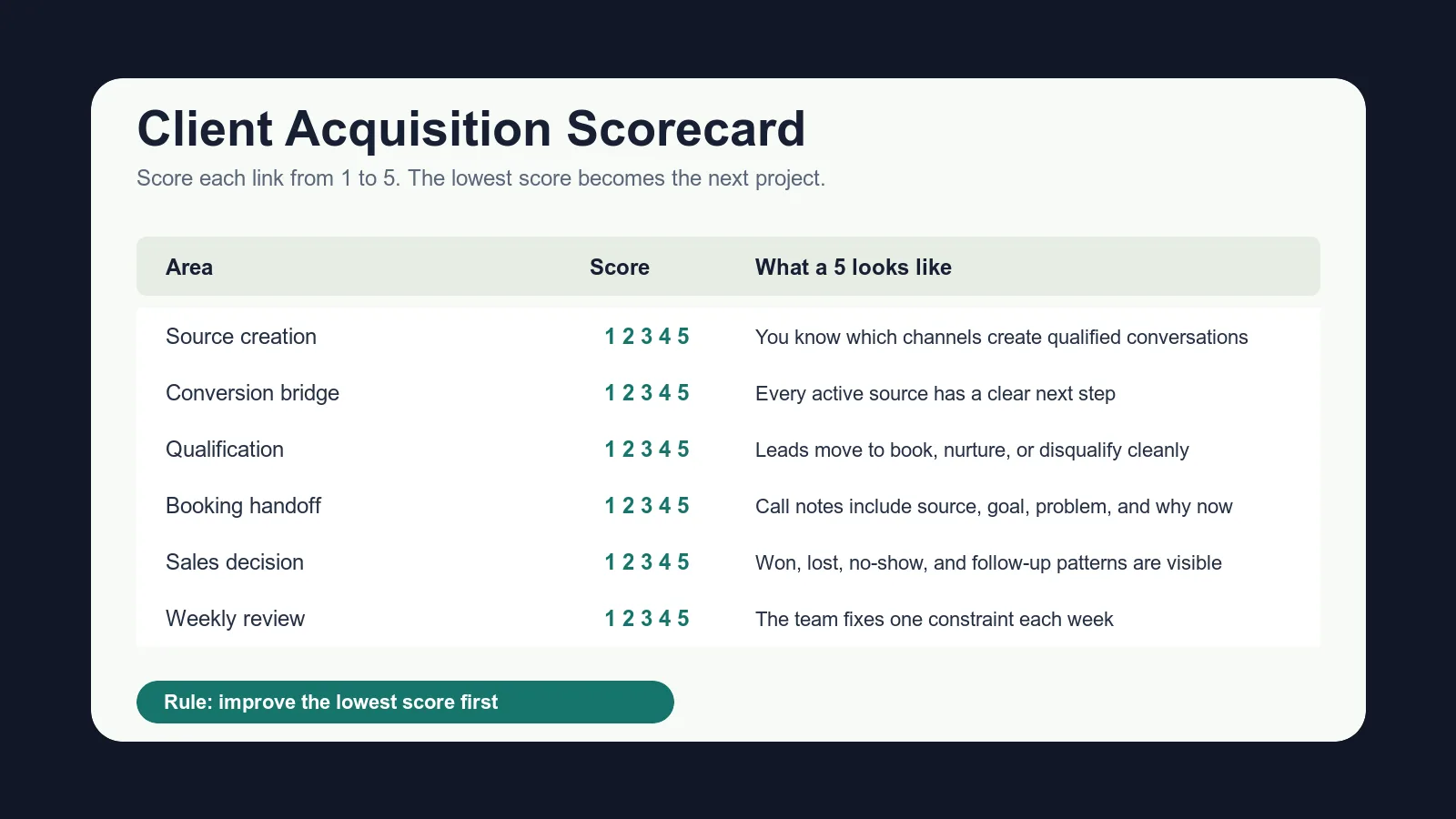
| Acquisition area | Score | What a 5 looks like |
|---|---|---|
| Source creation | 1 to 5 | You know which channels create qualified conversations, not just replies |
| Conversion bridge | 1 to 5 | Every major content, ad, referral, or outbound lane has a clear next step |
| Qualification | 1 to 5 | Leads are moved to book, nurture, or disqualify based on clear criteria |
| Booking and handoff | 1 to 5 | The coach can see source, problem, goal, objections, and next action before the call |
| Sales decision tracking | 1 to 5 | Won, lost, no-show, bad-fit, and follow-up patterns are recorded cleanly |
| Weekly review | 1 to 5 | The team reviews the chain and fixes one constraint each week |
The lowest score is your next project.
That is the whole point.
Most coaches do not need 14 new tactics. They need to stop improving the wrong part of the chain.
Where automation fits
Automation is powerful when there is already demand.
It is a bad substitute for demand.
If no one is interested, automation will not create a real acquisition system for you. You probably need sharper positioning, better content, a stronger offer, better sources, or more consistent outreach.
But if your coaching business already has DMs, replies, source volume, or a team touching conversations, automation can reduce the parts that break under volume:
- slow first response
- dropped follow-ups
- lost context
- scattered lead notes
- inconsistent qualification
- unclear ownership
- weak booked-call handoff
- no easy view of who needs attention
This is the lane where AI can actually help. Not as a magic closer. As a system layer that keeps the conversation path from depending entirely on someone's memory.
That is also why the DM operating system idea matters. Once DMs become a real acquisition channel, the business needs more than an inbox, a spreadsheet, and good intentions.
The right automation should support the acquisition chain. It should not flatten your voice, skip qualification, or send everyone the same booking link.
The common failure modes
When a client acquisition system is weak, the symptoms usually sound familiar.
"We are getting engagement, but not enough calls"
Look at the conversion bridge.
Are CTAs specific? Are replies easy? Does the first DM carry context from the content? Is there a clear next step after someone shows interest?
"We are getting DMs, but they are not qualified"
Look at source quality and qualification.
Are the sources attracting the right people? Are your DMs learning enough before sending the booking link? Are bad-fit leads being moved out of the active lane?
"The calendar is full, but calls are weak"
Look at booking criteria and expectation-setting.
The problem may not be call volume. It may be that the call is being offered before the lead understands the problem, offer, investment range, or reason to talk now.
"Calls are decent, but follow-up is messy"
Look at ownership.
Who owns no-shows? Who owns post-call follow-up? Who owns old leads who said "not right now"? Where does the next action live?
"I do not know what is working"
Look at tracking.
Start with the minimum fields from the online coach CRM fields checklist: source, stage, fit, next action, owner, and outcome. You do not need a bloated CRM to make better decisions. You need clean enough context to see patterns.
A simple build order
If your acquisition system feels loose, build it in this order.
Step 1: Write down your real sources
Do not write what you wish worked.
Write what actually creates interest right now:
- story replies
- DM ads
- referrals
- outbound
- comments
- email replies
- webinar attendees
- old leads
- content replies
- application forms
Then mark which sources create serious conversations versus low-quality noise.
Google's Campaign URL Builder can help if you use links and UTM tracking. For DM-heavy coaching businesses, also keep a simple source field inside the sales workflow because many important conversations never start with a clean website click.
Step 2: Pick one bridge per source
Each active source needs one obvious bridge.
For example:
| Source | Bridge |
|---|---|
| Story replies | Reply prompt plus first DM question |
| Reel | Comment or DM keyword tied to a useful resource |
| DM ad | First response that references the ad promise |
| Referral | Warm intro question plus call-fit check |
| Old lead | Contextual reactivation message |
| Reply prompt tied to a specific bottleneck |
The bridge should feel like a useful next step, not a trapdoor into a pitch.
Step 3: Define the booking rule
Write the conditions that need to be true before someone gets the calendar link.
For example:
- They named a specific problem.
- They understand what the call is for.
- There is enough urgency to justify a sales conversation.
- They are not clearly outside the offer fit.
- The coach or setter has enough context to prepare.
This does not have to be complicated.
It just has to be consistent.
Step 4: Create a call handoff note
Before every booked call, the coach should see:
- source
- what they responded to
- current problem
- desired outcome
- why now
- likely objection
- offer fit notes
- next action if they no-show or do not buy
If that information exists only inside the DM thread, it is too fragile.
Step 5: Review the weakest link weekly
Do not review everything forever.
Review the chain until the weak link is obvious. Then fix that one part.
Sometimes the fix is a better CTA. Sometimes it is a stronger qualification question. Sometimes it is a cleaner handoff. Sometimes it is faster no-show follow-up. Sometimes it is admitting that one source creates bad-fit leads and should not get more budget.
The weekly review turns acquisition from "we are trying a bunch of stuff" into "we know what the next constraint is."
What this looks like in a real coaching business
Imagine a coach who gets leads from four places:
- Instagram Stories
- a DM ad
- referrals
- old leads from the last launch
Without a system, each source gets handled differently depending on who is online, how busy the day is, and how much context the person remembers.
With a client acquisition system, each source has a path:
| Source | Bridge | Qualification | Handoff |
|---|---|---|---|
| Stories | Reply to a specific prompt | Goal, bottleneck, why now | Source and Story topic attached to call notes |
| DM ad | First reply references the ad promise | Problem, prior attempts, fit | Ad angle and objection attached |
| Referral | Warm intro message | Need, timeline, fit | Referrer context and expectation attached |
| Old lead | Reactivation based on last known issue | What changed, current priority | Old objection and new trigger attached |
This is not a complicated funnel.
It is a cleaner operating path.
The coach still needs a good offer, good content, strong conversations, and a real sales process. The system just stops qualified interest from getting lost between those pieces.
The standard you are aiming for
A strong client acquisition system should answer these questions quickly:
- Where did this lead come from?
- What did they respond to?
- What do they want?
- Why are they considering coaching now?
- Are they qualified for a call?
- Who owns the next action?
- What should happen if they do not reply?
- What should happen if they no-show?
- What did we learn from the outcome?
If those answers are scattered across Instagram, a setter's memory, a CRM note, a call recording, and a Slack message, the system is not really a system yet.
It may still work when volume is low.
It will wobble when volume increases.
The takeaway
Client acquisition is not just "get more leads."
For an online coach who already has attention, client acquisition is the discipline of turning that attention into the right conversations, moving those conversations toward the right calls, and learning from the outcomes every week.
The best system is not always the most complicated one.
It is the one where every serious lead has a source, a next step, an owner, a qualification path, a clean handoff, and a review loop.
That is what makes growth feel less random.
And once your DMs are already creating real demand, this is where Intellicoach becomes useful: keeping context, qualification, follow-up, and handoff visible enough that your acquisition system can hold up at scale without adding more manual chaos.
Frequently asked questions
What is a client acquisition system for online coaches?
A client acquisition system is the repeatable path that turns attention into qualified conversations, booked calls, clients, and learning. For online coaches, it usually includes source creation, a conversion bridge, qualification, booking, sales-call handoff, and weekly review.
How is a client acquisition system different from lead generation?
Lead generation creates interest or conversations. A client acquisition system includes lead generation but also covers what happens after interest appears: DM handoff, qualification, follow-up, booked calls, sales outcomes, and feedback loops.
What should online coaches fix first in client acquisition?
Fix the weakest link in the chain. If attention is low, fix source creation. If attention is high but DMs are weak, fix the content-to-DM bridge. If DMs are strong but calls are weak, fix qualification, booking, and handoff.
Do online coaches need automation for client acquisition?
Automation helps when the business already has consistent demand and the bottleneck is speed, follow-up, context, or handoff. If there is no lead flow, the first priority is source quality and offer clarity, not automation.
Ready to Try Intellicoach?
Built for online coaches with real DM volume who want to automate follow-ups and qualification without losing their voice.