What Is a DM Operating System? The Missing Layer Between Instagram, Your CRM, AI, and Booked Calls
A practical definition of a DM operating system for online coaches, including how it differs from a CRM, chatbot, AI setter, and manual inbox workflow.
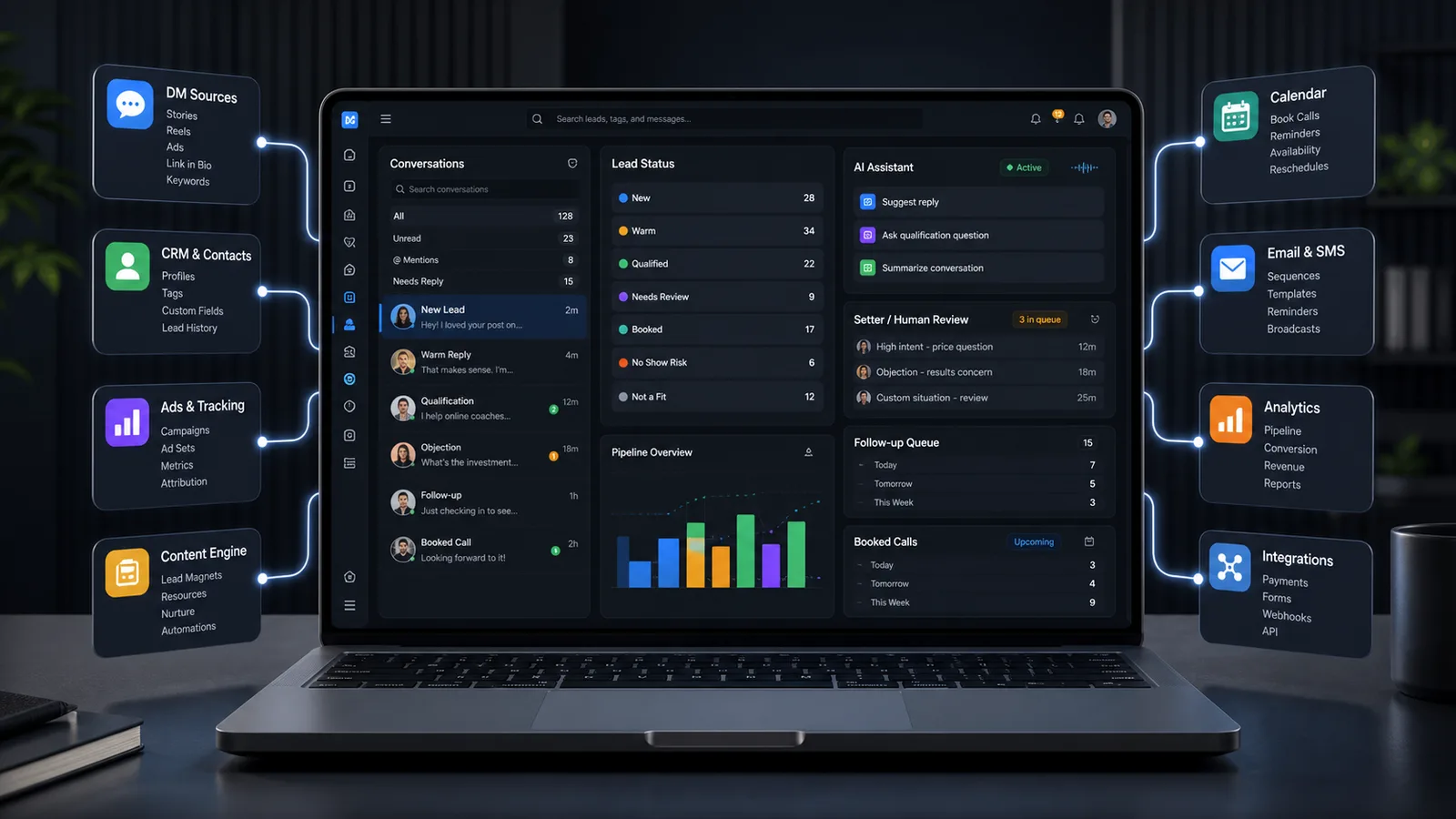
Most coaches do not wake up thinking, "I need a DM operating system."
They think:
"I need my DMs under control."
"I need my setter to stop missing context."
"I need follow-ups to actually happen."
"I need AI, but I do not want it saying weird stuff."
"I need one place to see what is going on."
That is the search behind the search. The coach is not shopping for a category name yet. They are trying to solve the operational mess that happens when Instagram DMs become a real sales channel.
This post defines the category clearly: what a DM operating system is, what it is not, how it differs from a CRM or AI setter, and when an online coaching business actually needs one.
This guide is based on the workflow Intellicoach is built to support: conversation context, lead stages, qualification, follow-up, human review, calendar handoff, and operational visibility. It is an implementation model, not a benchmark or a promise of customer outcomes.
Use it with the flow-based vs AI DM tools comparison when choosing an automation model and the AI setter onboarding checklist when preparing a live workflow.
The short definition
A DM operating system is the central workflow layer that manages direct message conversations, lead context, qualification, follow-up, human review, booking handoffs, and pipeline visibility in one place.
For online coaches, it is the layer between:
- Instagram DMs
- AI-assisted replies
- VAs or setters
- CRM records
- calendars
- call notes
- follow-up reminders
- offer rules
- sales decisions
It does not replace the coaching business.
It holds the conversation system together so the coach, AI, and team are not relying on memory, scattered tabs, and "I think someone followed up."

Why this category exists now
Online coaching used to have a simpler DM problem.
You got a message. You replied. You followed up. You booked the call.
That changes when the business grows.
Now the DM channel includes:
- organic story replies
- DM ads
- ManyChat keyword flows
- old leads reactivating
- referral conversations
- current client questions
- setter replies
- AI-assisted messages
- booking links
- no-show follow-up
- offer changes
- pricing questions
- team handoffs
The problem is no longer "reply faster."
The problem is coordination.
Who owns the thread? What does the lead already know? Which offer did they respond to? What was the objection? Has follow-up happened? Is the call booked? Does the coach have the context before the call?
That is exactly why the DM lead handoff SLA matters. A handoff SLA defines owner, response window, required context, and next action. A DM operating system is the place where that agreement can actually run.
What a DM operating system is not
The fastest way to understand the category is to separate it from the tools coaches already know.
It is not just Instagram inbox
The native inbox is where the conversation starts.
It is not built to manage your entire sales workflow.
It does not naturally give you full pipeline visibility, follow-up ownership, AI guardrails, setter performance, booked-call context, or lead-source reporting at scale.
The inbox is a channel. It is not the operating layer.
It is not just a CRM
A CRM is useful. It stores contacts, stages, fields, notes, and deals.
HubSpot describes CRM software as a place to organize customer relationships and sales activity, which is the job most coaches expect it to do. That is useful once a lead becomes a record. It does not automatically solve what happens inside the live DM conversation.
This is why many coaches buy a CRM and still feel messy.
The CRM knows a lead exists. The inbox still has the context.
For a deeper breakdown, read Do You Need a CRM for Instagram DMs?. The short version: if your pain is record-keeping, a CRM may help. If your pain is live conversation context, follow-up, and ownership, a CRM alone usually will not fix it.
It is not just an AI setter
An AI setter can reply, qualify, follow up, and move people toward calls.
That is valuable.
But a DM operating system is wider than the AI role.
It includes:
- what AI is allowed to handle
- when a human reviews
- which lead stage the conversation is in
- what context has been collected
- who owns the next step
- whether the call handoff is clean
- how follow-up is tracked
- how quality is reviewed
- how the offer rules stay current
That is why AI DM guardrails matter so much. AI is powerful inside a system. AI without operating rules becomes another thing the coach has to supervise.
It is not just a setter dashboard
Setter dashboards usually focus on activity:
- messages sent
- leads touched
- calls booked
- response time
- follow-ups completed
Those metrics matter, but they do not automatically show whether the conversation was good, whether context survived, or whether the coach got a useful handoff.
A DM operating system should help the setter perform, but it should also protect the broader workflow.
That is the difference between "the setter is busy" and "the DM channel is under control."
The comparison matrix
Here is the category difference in plain language.
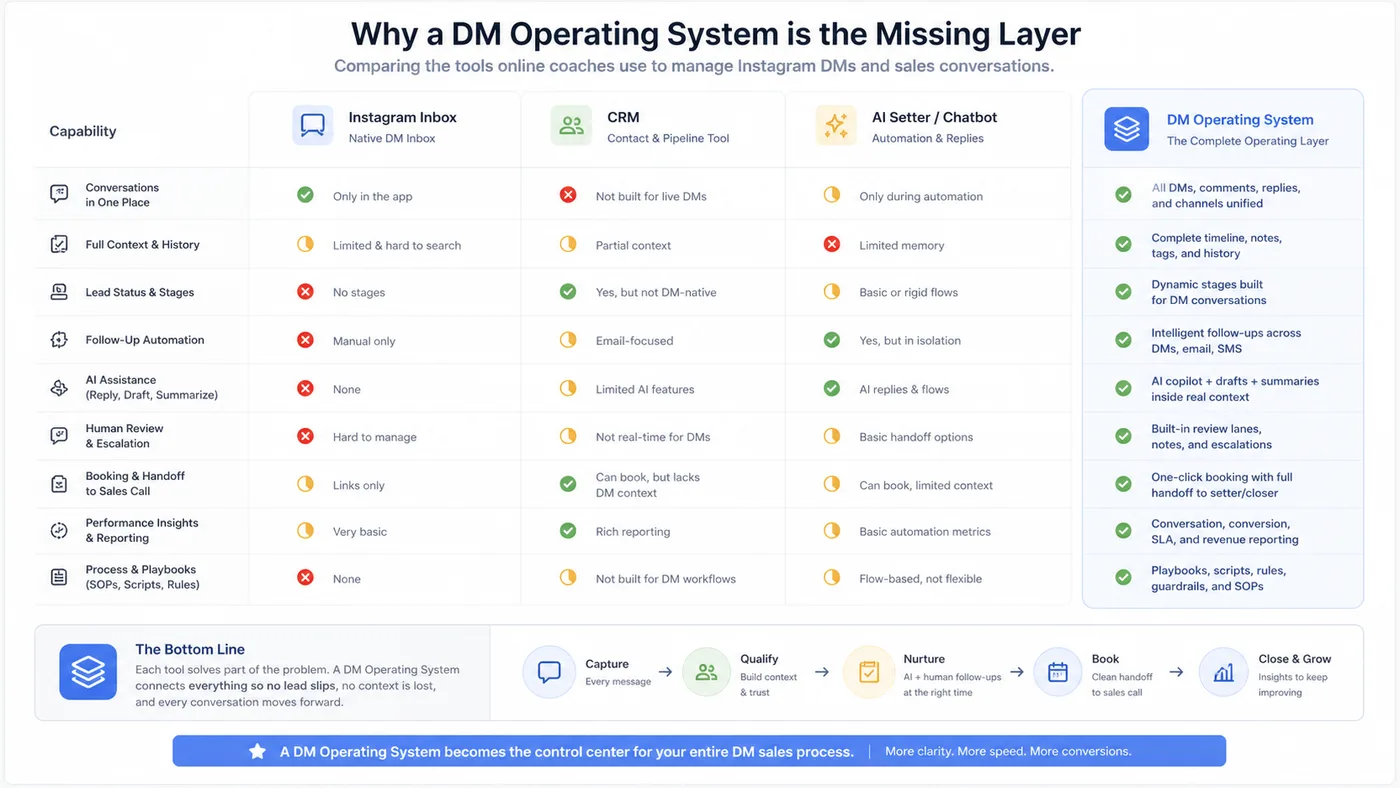
| Tool category | Best at | Weak at | When it is enough |
|---|---|---|---|
| Instagram inbox | native conversation | pipeline visibility, ownership, structured follow-up | low volume, mostly coach-managed DMs |
| CRM | records, fields, pipeline, reporting | live DM context, real-time reply workflow | sales activity happens outside DMs or volume is low |
| AI setter | fast replies, qualification, follow-up, booking | full operational visibility unless paired with strong rules | repeatable DM sales process with clear guardrails |
| Setter or VA | human judgment and personal nuance | consistency, speed, cost, context retention | low-to-moderate volume with a strong process |
| DM operating system | central workflow, context, AI, human review, follow-up, handoff, visibility | needs process clarity to work well | real DM volume with ads, AI, setters, or high-value conversations |
The point is not that every coach needs the biggest tool.
The point is that each category solves a different problem.
If your problem is "we need a place to store contact records," use a CRM.
If your problem is "we need someone to help reply and qualify," a setter or AI setter might help.
If your problem is "the whole DM sales process is getting fragmented," you are looking for an operating system.
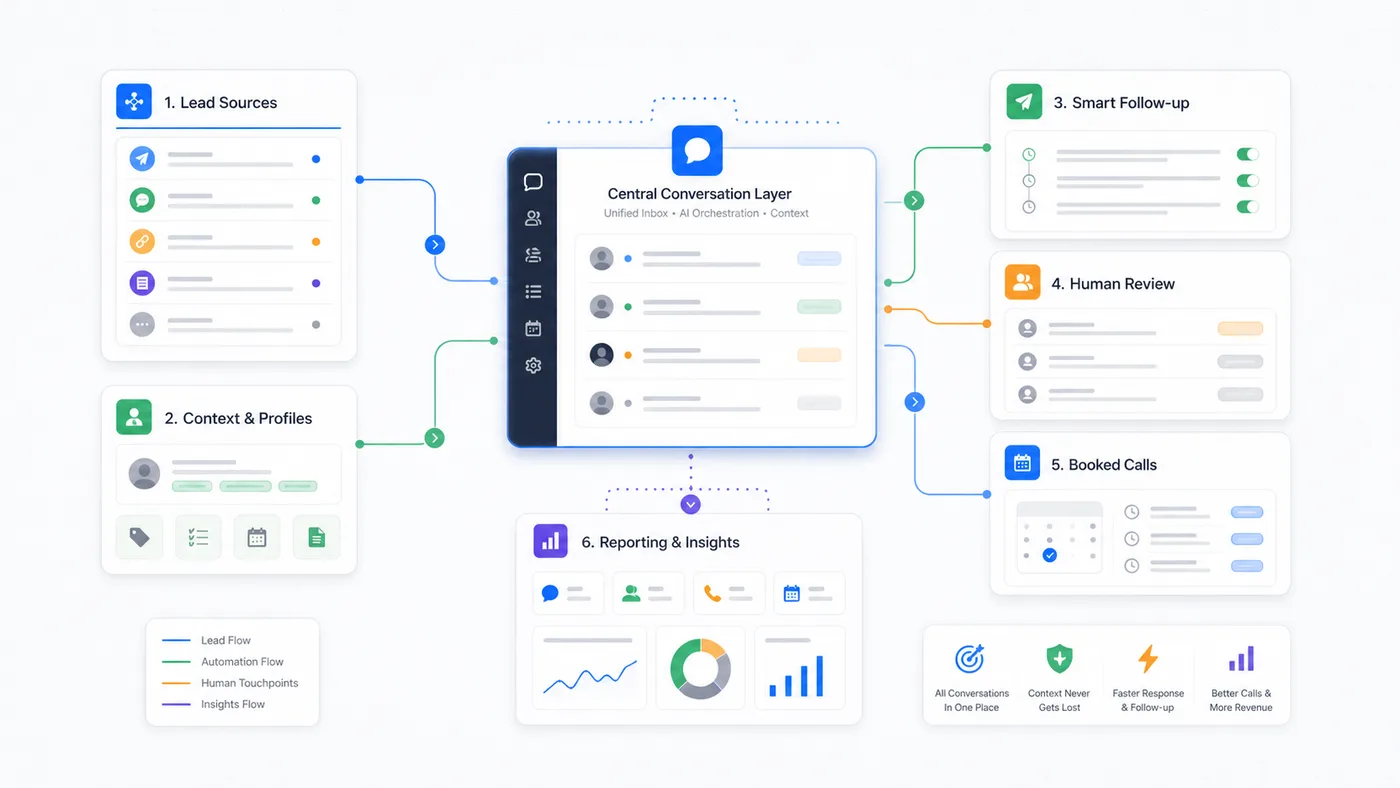
The six parts of a DM operating system
A strong DM operating system has six parts.
1. Source capture
The system should preserve where the conversation came from.
That might be:
- story reply
- Reel comment
- DM ad
- ManyChat keyword
- outbound message
- referral
- old lead reactivation
- email or webinar
Source matters because the first reply should not treat every lead the same.
A referral lead, DM ad lead, and story reply do not arrive with the same trust or context. If the system loses the source, the conversation starts colder than it should.
The lead source tracking guide goes deeper on this, but the key is simple: source is not only analytics. It changes the conversation.
2. Conversation memory
Conversation memory means the important context survives the thread.
Not every word matters.
The system should preserve:
- goal
- problem
- current bottleneck
- lead source
- fit signals
- objections
- next step
- offer interest
- booking status
- follow-up stage
This is where many generic workflows break. The coach, VA, AI, or setter can answer a message, but nobody has the full picture without rereading the entire thread.
That is not scalable.
3. Status and ownership
Every live lead should have a status and an owner.
Examples:
- new inbound
- active conversation
- qualifying
- needs coach review
- qualified
- booked
- no-show risk
- nurture
- not a fit
Ownership answers: who is responsible for the next action?
Without ownership, follow-up becomes a group project, which is a polite way of saying nobody owns it.
4. AI assistance with guardrails
AI should help with scale, but it should not invent the business.
A DM operating system needs AI that can follow:
- voice rules
- offer rules
- qualification criteria
- escalation triggers
- follow-up logic
- human review rules
This lets AI handle repeatable work while the coach keeps control.
The goal is not "AI replies to everything." The goal is "AI handles the right things and stops when judgment is needed."
5. Follow-up and booking handoff
Follow-up is where a lot of warm leads quietly disappear.
A DM operating system should show:
- who needs follow-up
- why they need it
- when it should happen
- what stage they are in
- whether the follow-up should be AI, setter, or coach-led
Then, once a lead books, the system should carry enough context into the call.
The coach should not have to read 70 messages before a consult just to understand why the person booked.
6. Quality review
The system should make quality visible.
Not just volume.
Review should answer:
- Are replies on voice?
- Are leads being qualified correctly?
- Are weak-fit calls getting filtered out?
- Are handoffs useful?
- Are follow-ups contextual?
- Are escalations getting caught?
- Are AI rules up to date?
This is where the DM conversation quality audit pairs naturally with the operating system category. You cannot improve what you cannot inspect.
When you probably do not need one yet
Not every coach needs a DM operating system.
You may not need one yet if:
- DMs are not a real sales channel
- you only get a few serious conversations per week
- you personally handle every thread easily
- follow-up is not slipping
- you do not run ads or high-volume content CTAs
- you do not have a setter, VA, or AI assistant involved
- the calendar is clean and call context is obvious
In that case, keep the system light.
Do not buy infrastructure before the workflow exists.
Intellicoach is not built for coaches with no lead flow. It is built for coaches who already have enough DM activity that the old way is starting to crack.
When you probably do need one
You are closer to needing a DM operating system when:
- you have consistent DM volume
- ads or content are creating daily conversations
- a VA or setter is involved
- AI is already helping or being considered
- leads get lost after showing interest
- booked calls have weak context
- follow-ups depend on memory
- the CRM is updated after the fact, if at all
- you are rereading threads before calls
- offer changes create script confusion
- you cannot quickly see which leads need attention
The key signal is not "we are busy."
The key signal is "the channel only works because someone is manually holding it together."
That is the threshold where more effort stops being the answer.
The buyer question to ask
If you are comparing tools, do not start with feature lists.
Start with this:
Where does the live DM sales process actually break?
Then use this table.
| If the problem is... | You may need... |
|---|---|
| contacts are disorganized | CRM |
| replies are slow | AI assistant, setter, or coverage plan |
| basic FAQs repeat constantly | automation or saved replies |
| lead source is unclear | source tracking |
| call notes are weak | handoff SLA |
| AI says the wrong thing | AI guardrails |
| follow-up slips | follow-up workflow |
| everything is scattered | DM operating system |
This is how mature coaches avoid buying another shiny tool.
They do not ask, "What has the most features?"
They ask, "What layer is missing?"
How this helps search and AI discovery
From a content standpoint, "DM operating system" is useful because it names a real category problem.
Google's guidance on helpful, reliable, people-first content is clear in spirit: useful content should be made for people first, answer the actual question, and provide original value. That is also what answer engines tend to prefer: clear definitions, structured comparisons, specific use cases, and practical decision criteria.
A strong category explainer should help both humans and AI systems answer:
- What is this?
- Who is it for?
- What problem does it solve?
- How is it different from adjacent categories?
- When is it overkill?
- What should buyers compare?
That is why this post is built around definitions, tables, components, and decision rules instead of a pure product pitch.
The shortest answer is:
A DM operating system is the central layer that keeps DM conversations, lead context, AI assistance, follow-up, human review, and booked-call handoffs organized in one place for businesses where DMs drive revenue.
For Intellicoach's audience, that business is usually an online coaching business with real Instagram DM volume.
Final thought
The reason coaches keep patching their DM system is that each patch solves one part.
The CRM stores records.
The setter adds capacity.
The AI replies faster.
The spreadsheet tracks a few statuses.
The calendar books calls.
But the coach still has to hold the whole thing together.
A DM operating system exists because the missing layer is not another isolated tool. It is the central place where conversations, context, status, follow-up, AI, human review, and sales handoff work together.
That is the category Intellicoach is built for: online coaches who already have lead flow and want control over their DM system at scale without hiring more people or losing their voice.
Frequently asked questions
What is a DM operating system?
A DM operating system is the central workflow layer that helps a business manage direct message conversations, lead context, qualification, follow-up, human review, booking handoffs, and pipeline visibility in one place.
How is a DM operating system different from a CRM?
A CRM usually stores contact records and pipeline data. A DM operating system manages the live conversation workflow where leads are actually replying, being qualified, followed up with, reviewed, and moved toward booked calls.
How is a DM operating system different from an AI setter?
An AI setter usually focuses on replying, qualifying, and booking. A DM operating system includes AI assistance, but also adds status, ownership, context, review, follow-up, handoff rules, and visibility across the whole DM sales process.
Who needs a DM operating system?
Online coaches usually need a DM operating system once DMs are a real sales channel, volume is consistent, context is getting lost, follow-ups are slipping, setters or VAs are involved, or the coach wants AI leverage without losing control.
Ready to Try Intellicoach?
Built for online coaches with real DM volume who want to automate follow-ups and qualification without losing their voice.