
Instagram DM Setting: How AI Setters, DM Automation, and Appointment Setting Work for Online Coaches
A practical guide to Instagram DM setting for online coaches, including AI setters, DM automation, appointment setting, qualification, booking links, follow-up, and safe implementation.
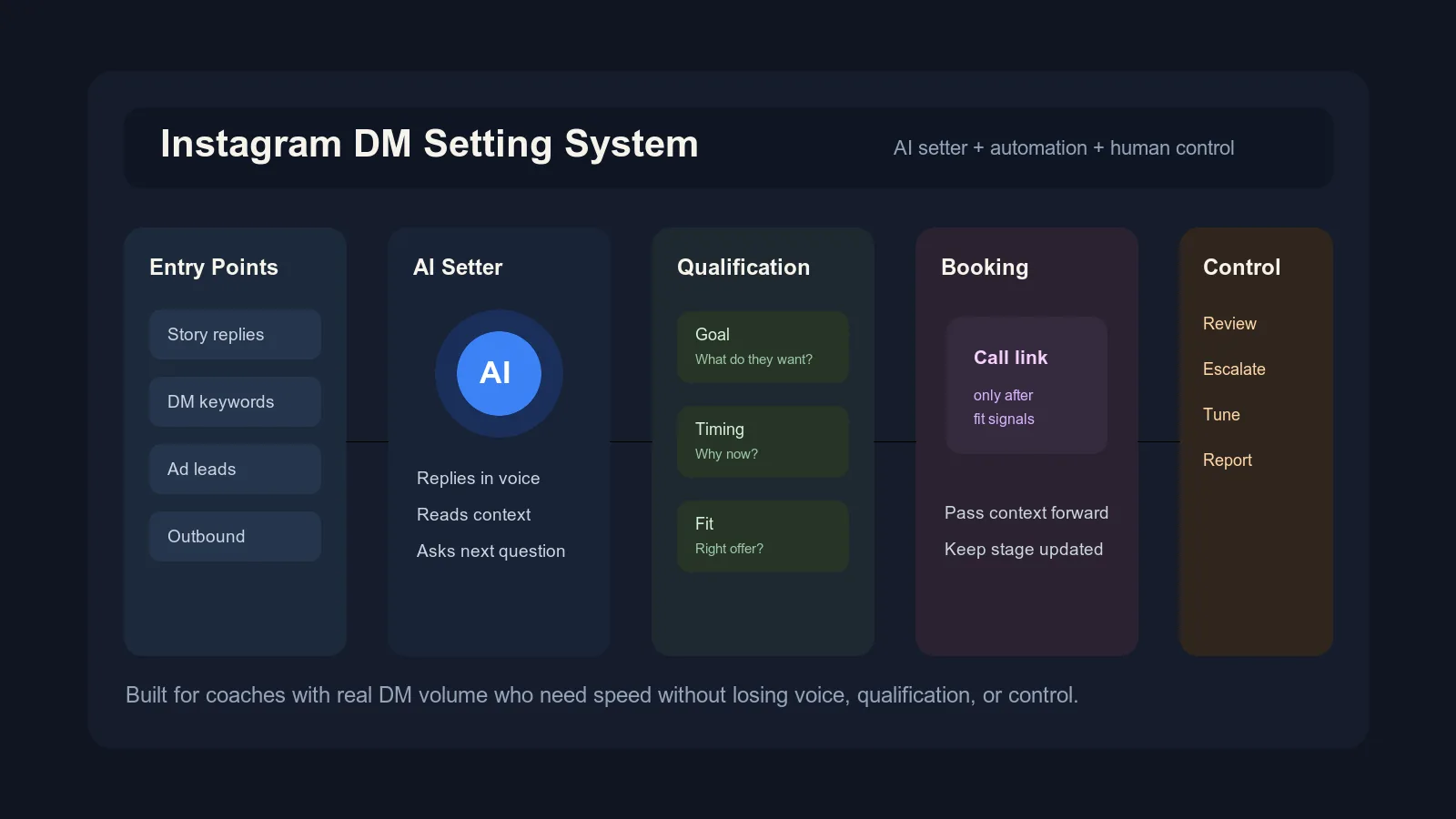
If you are searching for "Instagram DM setting," you are probably not looking for a cute chatbot.
You are trying to make your DMs hold up when volume increases.
More story replies. More comment triggers. More ad leads. More people asking "how does it work?" More warm conversations that can turn into booked calls if someone handles them well.
For online coaches, Instagram DM setting sits right in the middle of sales, operations, automation, and trust. Get it right and your inbox feels organized. Get it wrong and the same DMs that create revenue become the place where context disappears, follow-ups slip, booking links get sent too early, and your team starts guessing.
This guide breaks down what coaches usually mean by Instagram DM setting, how AI setters fit into it, where DM automation helps, where it can hurt, and how to build a system that moves qualified leads toward appointments without losing your voice.

What coaches mean by Instagram DM setting
Instagram DM setting is the process of managing direct message conversations so qualified prospects move toward the right next step.
For a coach selling a high-touch offer, that usually means:
- replying quickly when someone raises their hand
- understanding why they reached out
- asking the right qualification questions
- answering basic questions without sounding robotic
- handling common objections calmly
- following up when the conversation stalls
- sending the booking link at the right time
- passing context to the sales call
- keeping the coach, setter, or VA clear on who owns the next move
That is why "DM setting" is not just "responding to messages." It is a sales workflow.
Some coaches search this as "AI setting," but what they usually mean is AI appointment setting, an AI setter, or AI that can help qualify and book from Instagram DMs. The wording varies, but the job is the same: keep real conversations moving without making every reply depend on the coach being inside Instagram all day.
The important part is that Instagram DM setting only works when it respects the nature of DMs. People do not message you like they fill out a perfect form. They ask half-questions. They reply to a story with two words. They disappear for three days. They ask about price before they explain their goal. They mention a problem in casual language and expect you to understand the context.
So the system has to be built for conversation, not just automation.
AI setter vs DM automation vs appointment setting
These terms get used together, but they are not identical.
| Term | What it means | Best use for online coaches |
|---|---|---|
| Instagram DM automation | Tools or workflows that automate parts of the Instagram message process | Keywords, comment triggers, follow-up reminders, routing, source tracking, simple replies |
| AI setter | AI that can help reply, qualify, follow up, and move prospects toward booking | Context-heavy DM conversations where the lead gives messy human answers |
| DM appointment setting | The sales process of moving good-fit DM leads toward a booked call or application | Qualification, booking criteria, call-link timing, handoff context |
| AI appointment setting | AI-assisted appointment setting across DMs, chat, or other channels | Scaling the setter function without hiring another person for every increase in volume |
If you already use a tool like ManyChat for keywords or comment-to-DM, that is DM automation. It can be valuable. But keyword flows are usually best at predictable entry points, not nuanced sales conversations.
An AI setter is different because it should understand context inside the thread. It should know what the person asked for, what they already answered, whether they are qualified, whether the call link should be sent, and when a human should review.
The mistake is treating every term as interchangeable.
If you only want to send a lead magnet after someone comments a word, flow-based automation may be enough. If you want to qualify, follow up, protect your voice, and book good-fit calls from messy Instagram conversations, you need a fuller DM setting system.
For a deeper category comparison, read what an AI setter is for online coaches and flow-based vs AI DM tools.
The real job: reduce DM chaos at scale
Most coaches do not look for Instagram DM setting software when the inbox is calm.
They look when something is already straining:
- ads are creating more conversations
- content is finally getting replies
- a VA or setter is missing context
- ManyChat flows are starting conversations but not closing the loop
- leads are asking real questions that do not fit a branch
- the coach is still jumping into Instagram to rescue important threads
- booked calls are showing up without enough context
- follow-ups are happening, but not in the right stage or tone
That is the real problem.
It is not that coaches need "more automation" in the abstract. It is that the DM system starts losing context as volume grows.
One lead asked for pricing, then replied to a story two days later. Another came from a comment trigger, got the free resource, then asked if coaching would work with their schedule. Another is warm but needs one more question before booking. Another should not be sent a call link yet. Another needs a human because the objection is sensitive.
If those conversations all live as a flat inbox, the team starts operating from memory. That works for a while. Then volume rises and memory becomes the bottleneck.
Good Instagram DM setting gives the business a cleaner operating layer:
- where did the conversation come from?
- what did the lead ask for?
- what stage are they in?
- what has already been answered?
- what needs to happen next?
- should AI reply, should a human review, or should the coach step in?
That is why the best setup is not "AI replies to everything." The best setup is: the right message, from the right lane, at the right time.
The Instagram DM setting workflow
A strong Instagram DM appointment setting system has six parts.
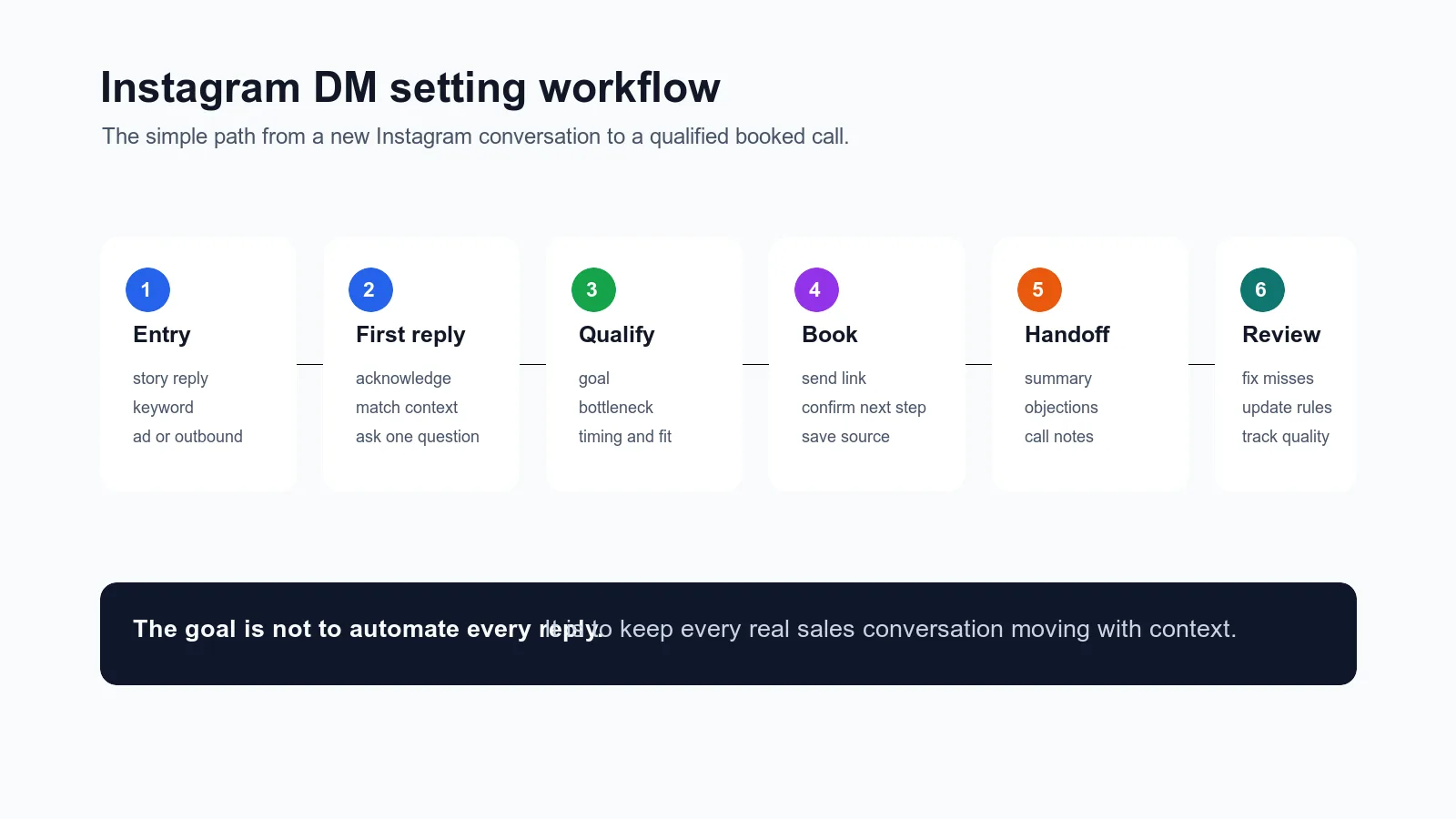
1. Entry point
The entry point is how the conversation starts.
Common entry points include:
- story replies
- keyword DMs
- comment-to-DM prompts
- DM ads
- follower ads
- outbound messages
- referrals
- warm inbound questions
- old leads re-engaging
Each entry point carries different intent. Someone who replies "guide" to a lead magnet is not the same as someone who asks, "Do you have coaching spots open?" Someone replying to a personal story may need a softer first message than someone clicking a direct sales CTA.
Your DM setting system should know the source. Otherwise every lead gets treated like the same lead.
2. First reply
The first reply should do three things:
- acknowledge why the person is there
- sound like the coach or brand
- ask one useful next question
This is where a lot of automation goes wrong. It sends too much text, asks three questions at once, or makes the lead feel like they entered a funnel instead of a conversation.
Better first replies are simple and contextual.
If the lead replied to a story about struggling with consistency, the reply should not say, "Thanks for your interest in our program." It should connect to the thing they actually responded to.
That is one reason voice matters so much. The reply can be technically correct and still feel wrong if it sounds nothing like you. If this is your biggest concern, use the AI setter onboarding checklist before turning automation loose on live conversations.
3. Qualification
Qualification is where the system decides whether the lead should move toward a call, keep talking, or be routed somewhere else.
For online coaches, qualification usually includes:
- what the person wants
- what they have tried
- why they are looking now
- whether the offer fits their situation
- whether they understand the next step
- whether there are obvious red flags
- whether enough context exists to make a call useful
The key is not to interrogate people.
The key is to avoid sending booking links based on interest alone.
"Sounds good, here is my calendar" is fast, but it can create weak calls if the person has not shared enough. Good DM appointment setting protects speed and call quality at the same time.
4. Booking
Booking is not just dropping a Calendly link.
The system needs rules for when the link should be sent.
For example:
- send the link when the lead has shared a clear goal and the offer seems relevant
- ask one more question if the lead asks for the link but has not shared any context
- do not send the link if the lead is asking for something the offer does not provide
- escalate if pricing, medical, legal, refund, or unusual payment questions need human judgment
- include a short reason for the call so the lead understands the next step
This is exactly where coaches need control. Automation that books too aggressively may look productive on the calendar, but it can waste the team's time.
For a narrower breakdown, read the booking link rule for online coaches.
5. Handoff
The handoff is what happens after the call is booked.
This part is easy to ignore until a closer or coach gets on the call and realizes they have no idea what happened in the DMs.
A useful handoff includes:
- lead source
- stated goal
- current pain or bottleneck
- relevant history
- objections mentioned
- why they booked now
- what resource or campaign brought them in
- any sensitive context the team should know
The DM thread should make the sales call warmer, not force the closer to restart from zero.
That is why call booking and pipeline stages belong together. If your team is already managing a higher-volume inbox, pair this with DM sales pipeline stages and the DM lead handoff SLA.
6. Review and tuning
No DM automation system should be treated as "set it and forget it."
Your offer changes. Your ads change. Your content angles change. Your team changes. Your qualification standards may get stricter or looser. The way leads ask questions also changes as the market gets more familiar with AI, coaching offers, and DM funnels.
Review is where the system gets better.
Look weekly at:
- replies that sounded off-brand
- conversations where the AI booked too early
- conversations where it waited too long
- leads that should have been escalated
- repeated objections
- missed source context
- follow-ups that felt generic
- booked calls without enough notes
This is how you keep the system sharp instead of letting it drift.
What AI should handle and what humans should own
AI can do a lot inside Instagram DMs. It should not own everything.
The premium move is defining lanes before the volume spikes.
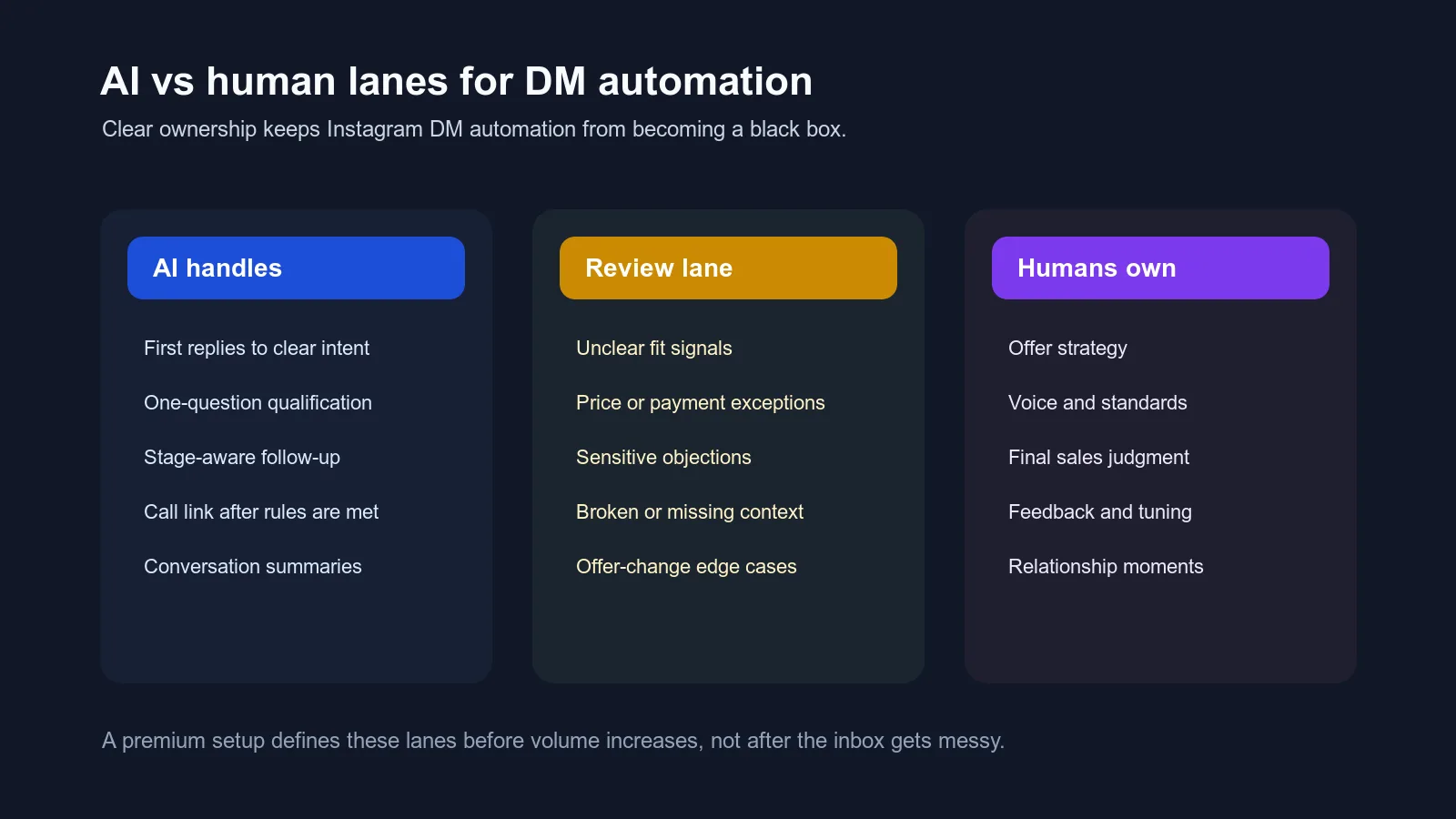
| Lane | Good fit | Examples |
|---|---|---|
| AI handles | Repetitive, contextual work with clear rules | first replies, single-question qualification, stage-aware follow-up, summaries, sending the call link after criteria are met |
| Review lane | Situations where judgment may be needed | unclear fit, pricing exceptions, sensitive objections, missing context, angry replies, edge cases after an offer change |
| Humans own | Strategy, standards, and relationship moments | offer positioning, sales judgment, final voice standards, feedback, team training, high-stakes conversations |
This is where coaches with real DM volume should be careful.
If AI handles too little, you still have a manual bottleneck. If AI handles too much, the business can lose voice, context, and trust. The goal is not maximum automation. The goal is maximum useful leverage.
That means AI should move common conversations forward, while humans keep control over the standards that protect the brand.
Meta's Instagram messaging platform documentation is useful context here because it reinforces that Instagram messaging automation exists inside specific platform rules and features, not an anything-goes environment. You can review Meta's Instagram messaging docs on the Messenger Platform for Instagram when thinking through what your tools can support.
The setup checklist before you turn on DM automation
Before you let AI or automation touch live leads, build this source of truth.
If the account will not connect, events are missing, or multiple tools are competing for replies, use the Instagram DM automation permissions checklist before changing voice or qualification rules.
| Setup area | What to define | Why it matters |
|---|---|---|
| Entry points | story replies, keywords, ads, outbound, referrals, lead magnets | prevents contextless first replies |
| Offer rules | who it is for, who it is not for, pricing rules, inclusions, exclusions | stops old or wrong offer details from spreading |
| Voice rules | message length, tone, phrases to use, phrases to avoid, examples of good and bad replies | keeps replies from sounding generic |
| Qualification | fit criteria, red flags, required context, buying signals | protects call quality |
| Booking rules | when to send the link, when to ask more, when to pause | prevents premature booking |
| Follow-up | timing, stage, stop rules, tone | avoids needy or irrelevant nudges |
| Escalation | messages that need human review | keeps judgment with the team |
| Handoff | what context must be saved before the call | makes sales calls warmer |
| Review rhythm | who audits conversations and how often rules are updated | prevents drift |
This checklist is where AI setting becomes real appointment setting.
Without these rules, AI can still reply. But it will be operating from incomplete context. That is how coaches end up with "automation" that creates more cleanup than leverage.
Google's guidance on helpful, people-first content is written for public content, but the principle applies to your internal sales system too: useful output depends on useful source material. If your scripts, offers, and rules are vague, your automated replies will feel vague.
Common mistakes that make Instagram DM automation feel robotic
The problem is rarely that the coach used automation.
The problem is usually how the automation was set up.
Mistake 1: sending the same first reply to every lead
A keyword lead, story reply, and DM ad lead do not need the exact same first message.
They entered from different intent. Treating them the same is what makes automation feel cold.
Mistake 2: asking too many questions at once
Coaches often want qualification to be thorough, so the system asks a stack of questions in one message.
That creates friction.
In DMs, one strong question usually beats five decent questions.
Mistake 3: sending the booking link too early
Fast booking feels good until the calendar fills with weak calls.
The link should come after fit signals, not just excitement.
Mistake 4: not saving source context
If the system does not know whether the lead came from an ad, story, keyword, or outbound message, follow-up gets generic fast.
Source context changes the temperature of the conversation.
Mistake 5: treating AI like a finished employee
AI needs management.
That does not mean babysitting every reply forever. It means reviewing samples, fixing patterns, and updating rules when the business changes.
Mistake 6: automating around a messy offer
If your offer details, pricing, bonuses, and qualification rules are scattered, automation will multiply the mess.
Clean the source of truth before scaling the replies.
If you are already moving from keyword flows into more flexible AI conversations, read how to move from ManyChat flows to AI DM automation. Migration is easier when you keep the entry points that work and move the context-heavy work into AI.
How to choose an Instagram DM setting system
If you are comparing DM automation tools, AI setters, or Instagram appointment setting software, do not start with the flashiest feature list.
Start with control.
Ask:
- Can the system use real conversation context, or does it only follow fixed paths?
- Can it preserve lead source and campaign context?
- Can you define when AI is allowed to send a booking link?
- Can it escalate conversations that need human review?
- Can it summarize the thread before a call?
- Can it support your voice rules instead of forcing generic sales language?
- Can it work with your existing process instead of making you rebuild everything?
- Can your team see stage, ownership, and follow-up in one place?
- Can you tune it when the offer changes?
For coaches with real DM volume, the best tool is not simply the one that automates the most messages.
The best tool is the one that keeps the sales process organized while still making every important message feel like it belongs in your business.
That is why a dedicated DM operating system matters more than a generic AI chat widget. Coaches do not just need answers. They need conversation state, pipeline movement, booking logic, review lanes, and human override.
For the bigger operating model, read the DM operating system guide. To see these controls in a product, look at how the Intellicoach Instagram AI appointment setter handles entry points, qualification, and handoff.
Quick answers coaches search for
What is the best Instagram DM automation for coaches?
The best Instagram DM automation for coaches depends on the job. If you need simple keyword triggers and lead magnet delivery, flow-based automation may be enough. If you need qualification, follow-up, booking rules, and real conversation context, you should look for an AI setter or DM automation system built for sales conversations.
Can an AI setter replace my VA or human setter?
Sometimes AI can reduce the need for extra manual coverage, but the better frame is leverage, not replacement. AI can handle repetitive conversation work, organize context, and keep follow-up moving. Humans should still own judgment, standards, and edge cases.
Is Instagram DM appointment setting only for fitness coaches?
No. Fitness coaches are a common fit because many sell through Instagram DMs, but the same system applies to business coaches, health coaches, mindset coaches, relationship coaches, and other online coaching businesses with consistent DM volume.
Do I need ManyChat and an AI setter?
Not always, but they can work together. ManyChat-style flows can handle clean entry points like keywords and lead magnets. An AI setter can take over the more nuanced work after the person starts asking real questions or needs qualification.
How do I stop AI DMs from sounding robotic?
Give the system real voice examples, bad examples, message-length rules, words to avoid, and clear escalation rules. Then review live conversations weekly. Voice quality is not a toggle. It is a setup and tuning process.
When should the AI send the booking link?
Only after your booking criteria are met. At minimum, the lead should have shared enough context for the call to make sense, the offer should seem relevant, and there should be no obvious reason a human needs to review first.
The bottom line
Instagram DM setting is not one feature.
It is the system that connects your Instagram conversations to your sales process.
For coaches with real volume, the goal is not to make DMs less human. The goal is to make the important parts less fragile: first replies, qualification, follow-up, booking, handoff, and review.
AI setters and DM automation can help a lot, but only when they are connected to clear rules, your real voice, your current offer, and a human review process. Otherwise, they just create faster confusion.
If your Instagram DMs are already part of how your coaching business grows, build the system before the inbox gets heavier.
Frequently asked questions
What is Instagram DM setting?
Instagram DM setting is the process of managing direct message conversations so qualified prospects are replied to, followed up with, and moved toward the right next step, often a booked call or application. For online coaches, it usually includes first replies, qualification, objection handling, booking links, follow-up, and sales-call handoff context.
Is an AI setter the same as DM automation?
No. DM automation is the broader category of tools and workflows that automate or organize messages. An AI setter is a specific type of AI-assisted system that helps qualify leads, reply in context, follow up, and move good-fit prospects toward booking.
Can AI book appointments from Instagram DMs?
Yes, but coaches should define booking rules first. AI should only send a call link after the lead meets the coach's qualification criteria and the system has enough context to create a useful handoff for the sales call.
What should coaches set up before using Instagram DM automation?
Coaches should set up voice rules, offer details, qualification criteria, booking criteria, escalation rules, follow-up logic, source tracking, and a weekly review process before putting AI or automation into live Instagram DM conversations.
Ready to Try Intellicoach?
Built for online coaches with real DM volume who want to automate follow-ups and qualification without losing their voice.