
The AI Setter Onboarding Checklist: What Online Coaches Should Set Up Before Letting AI Reply to Leads
A practical AI setter onboarding checklist for online coaches setting up voice rules, offer details, qualification criteria, follow-up logic, escalation, and booked-call handoffs before AI replies to real leads.
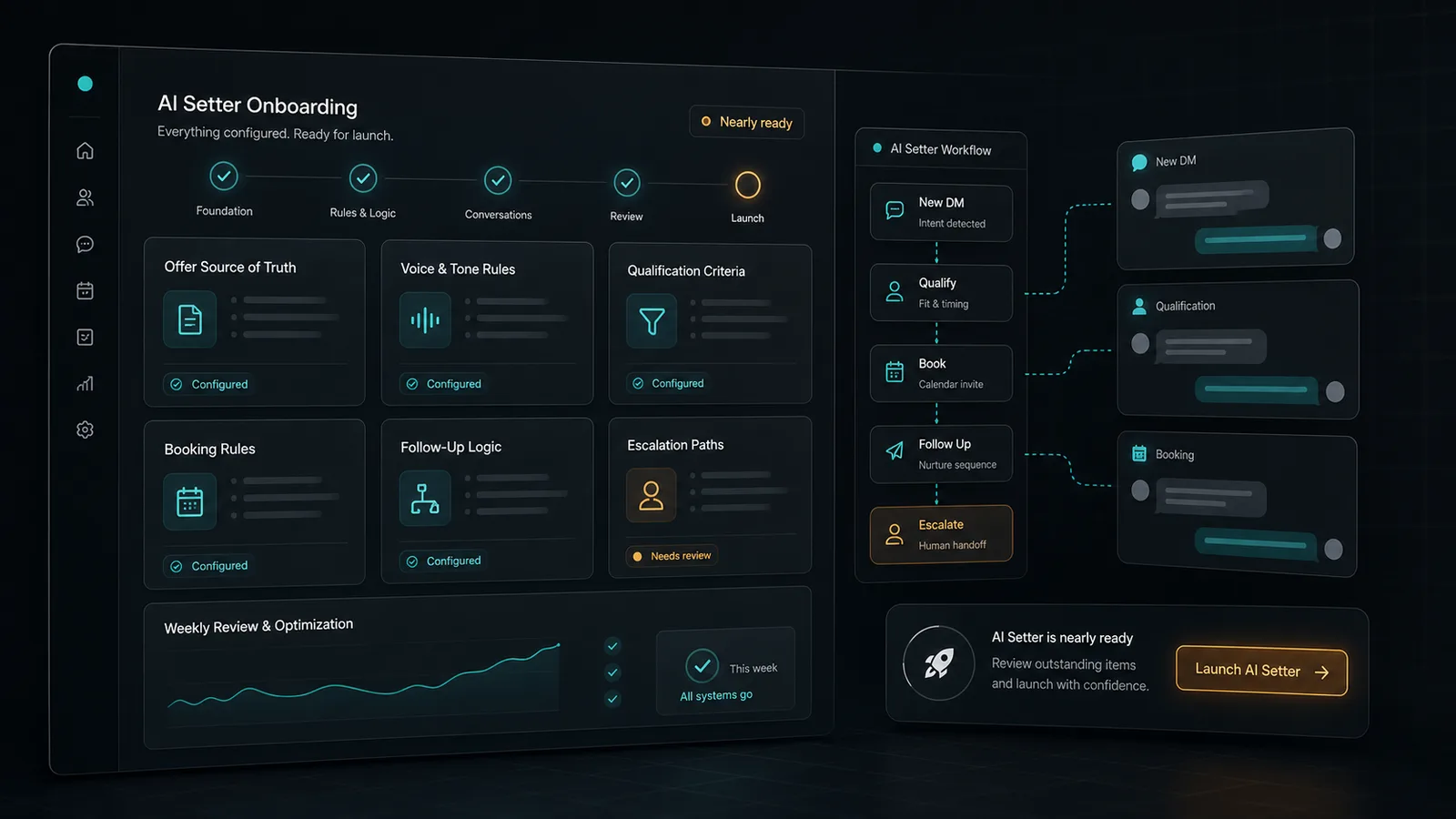
An AI setter does not fail only because the AI is bad.
It usually fails because the business hands it a messy system.
Old offer details. Half-written scripts. A booking link with no qualification rule. A voice guide that says "sound like me" but gives no examples. A follow-up process that lives in the coach's head. A setter or VA who knows the nuance, but nothing written down clearly enough for software to follow.
Then the AI goes live and everyone acts surprised when it replies too fast, books too early, misses context, or sounds like a polite stranger wearing your brand voice.
That is not an AI problem first.
That is an onboarding problem.
If you are an online coach with real DM volume, the question is not just "which AI setter should I use?" A better question is: what does the AI need to know before it is allowed to touch real leads?
This checklist answers that.
What AI setter onboarding actually means
AI setter onboarding is the setup work you do before AI starts replying to real prospects in your Instagram DMs or sales inbox.
It is different from normal software setup.
Normal setup is things like connecting an account, adding a booking link, or turning on a workflow. Useful, yes. But not enough.
AI setter onboarding is about teaching the system how your business sells:
- who your offer is for
- how you qualify leads
- how you sound in DMs
- what you say about price
- when a lead should get a booking link
- when a lead should get more questions
- when a human should step in
- how follow-up should happen
- what context should land on the sales call
That is why this topic sits next to, but is not the same as, what an AI setter is. A definition helps you compare categories. Onboarding helps you avoid launching a category into a messy sales process.

The mistake coaches make before launch
The mistake is treating AI like a smarter VA who will "figure it out."
Human setters can sometimes survive messy onboarding because they can ask questions, infer context, listen to sales calls, and pick up patterns from the coach over time. That does not make messy onboarding good. It just means humans are good at absorbing chaos.
AI needs a clearer source of truth.
If your team does not have one current place for offer details, qualification rules, booking criteria, voice examples, and escalation rules, the AI will pull from whatever you give it. If that input is vague, old, or contradictory, the output will be vague, old, or contradictory.
Google's guidance on helpful, reliable, people-first content is written for publishers, but the same idea applies to your internal sales material: useful output starts with useful source material. If the source is thin or confusing, the final experience feels thin or confusing.
For AI in sales conversations, that matters because leads are not asking sterile FAQ questions. They are asking human questions in messy language:
- "I tried coaching before and it didn't work."
- "What's the price?"
- "Do you work with people like me?"
- "I want to start, but I'm nervous."
- "Can I do this with my schedule?"
- "How is this different from what I already bought?"
The AI setter needs more than a feature toggle. It needs your sales reality.
The 8-block AI setter onboarding checklist
Use this as your pre-launch checklist before AI starts replying to real leads.
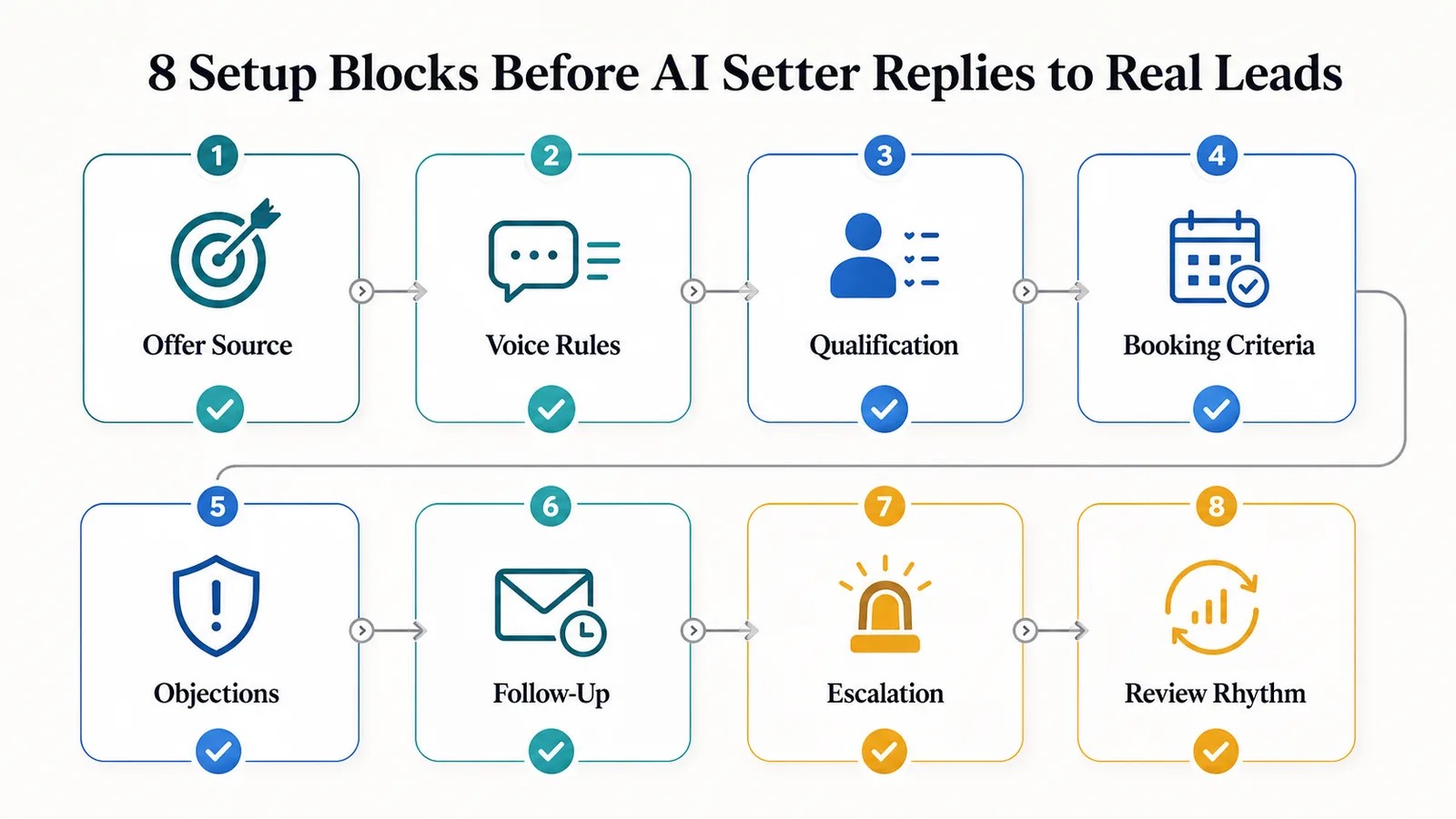
| Setup block | What to document | Why it matters |
|---|---|---|
| Offer source of truth | Current offer, audience, price rules, inclusions, exclusions, bonuses, and payment options | Prevents outdated or improvised offer replies |
| Voice rules | Good replies, bad replies, tone rules, message length, language to use and avoid | Keeps AI from sounding generic |
| Qualification | Fit criteria, red flags, buying signals, required context | Stops AI from booking anyone who shows interest |
| Booking criteria | When to send the link, what must be known first, what context must be passed forward | Protects call quality |
| Objections | Common objections, approved responses, when to ask more context | Keeps replies calm and consistent |
| Follow-up | Timing, tone, stage-specific nudges, stop rules | Prevents needy or irrelevant follow-up |
| Escalation | Messages AI should pause on or send to human review | Keeps judgment with the business |
| Review rhythm | Weekly audit, correction process, owner for updates | Prevents drift as the offer changes |
If any of these are missing, the system may still reply. It just will not be ready to represent the business at scale.
1. Build the offer source of truth
Start here because everything else depends on it.
Your AI setter should not learn your offer from five different places: an old sales page, a Notion doc, a setter script, a pricing voice note, and three random Slack messages.
Create one current source of truth that includes:
- who the offer is for
- who it is not for
- the main problem it solves
- the transformation or outcome language you actually use
- what is included
- what is not included
- current price rules
- payment options
- application or call requirements
- start dates or enrollment windows
- refund or cancellation language
- guarantee language, if any
- bonuses, if they are current
- legacy exceptions that should not be offered to new leads
This is especially important if you recently changed pricing, bonuses, offer structure, or positioning. An AI setter with old offer context is not harmless. It can confidently create confusion.
If you have changed anything recently, pair this step with the offer change rollout checklist. Automation makes old details travel faster.
2. Give the AI real voice examples
"Sound like me" is not an instruction.
It is a wish.
Your AI setter needs examples of what your voice actually sounds like in the moments that matter.
Pull examples from real conversations where you liked the reply:
- first response to a warm inbound lead
- response to "how much is it?"
- response to "I need to think about it"
- response to "I tried this before"
- response to a vague answer
- follow-up after someone goes quiet
- message before sending the booking link
- message when someone is not a fit
Then add examples of what you do not want.
This part is underrated. If you only give the AI good examples, it may still drift into generic coaching-sales language. Bad examples tell it where the edge is.
Your voice rules should answer:
| Voice question | Example rule |
|---|---|
| How long should replies be? | Short and clear, usually 1 to 3 sentences |
| How direct should it be? | Calm and direct, not pushy |
| Should it use emojis? | Rarely, and never to soften serious qualification |
| How should it ask questions? | One question at a time |
| What language should it avoid? | Hype, fake urgency, bro marketing, therapy-sounding language |
| What should it mirror? | The lead's own words about the problem |
The Sounds Like Me test goes deeper on this. Use that if voice is the thing you are most afraid of losing.
3. Define qualification before booking
Interest is not qualification.
This is where AI setters can create calendar clutter if you are not careful.
A lead can be excited, responsive, and still not ready for your offer. A lead can ask for the price and still need context. A lead can say "send me the link" and still be missing key fit signals.
Before AI can send a booking link, define what must be true.
For example:
- The lead has stated a clear goal or problem.
- The offer is relevant to that goal.
- The lead is actively trying to solve the problem now.
- The lead understands the next step is a sales call or application call.
- The lead has not shown a clear red flag.
- The AI has enough context to create a useful booked-call handoff.
You can make this stricter or looser depending on your model, but do not leave it undefined.
Weak rule:
"If they seem interested, send the link."
Better rule:
"Before sending the link, confirm their goal, current bottleneck, and whether they are looking for help now. If they ask for the link before sharing context, ask one clarifying question first unless they are already clearly qualified from earlier in the thread."
That is the difference between speed and control.
For more on call-quality handoffs, read the DM lead handoff SLA. A booked call is only useful if the person taking the call knows what happened before it.
4. Write objection guidance that keeps the conversation human
Objection handling is not a library of clever comebacks.
It is a way of staying useful when the lead hesitates.
Your AI setter should know how to handle the objections you actually hear:
- price
- time
- spouse or partner
- "I tried coaching before"
- fear of failing again
- not sure if they are ready
- wanting more information before a call
- comparing you to another coach or program
For each objection, write three things:
- What the objection usually means.
- What the AI can say.
- When the AI should stop and escalate.
Example:
| Objection | AI can do | Escalate when |
|---|---|---|
| "How much is it?" | Give a brief range or positioning if approved, then return to fit | The lead asks for custom pricing or wants a payment exception |
| "I need to think about it" | Ask what part they are unsure about | They are upset, confused, or asking for a guarantee outside the policy |
| "I tried this before" | Acknowledge it and ask what did not work last time | The story involves medical, legal, or emotional complexity outside the sales lane |
The NIST AI Risk Management Framework is broader than a coaching business needs day to day, but the useful principle is simple: AI systems need human accountability and risk-aware controls. In your DMs, that means the assistant can support objection handling, but the business still owns sensitive judgment.
5. Set follow-up rules by stage
Bad follow-up usually has two problems.
It is either too generic or too aggressive.
Your AI setter should not follow up every lead the same way. Someone who asked for a free guide is not the same as someone who answered qualification questions and then disappeared before booking.
Define follow-up by stage:
| Stage | Follow-up goal | Example tone |
|---|---|---|
| New resource request | Restart the conversation naturally | "Did you get a chance to look at it?" |
| Warm but vague | Get one useful piece of context | "What are you trying to change most right now?" |
| Qualified but unbooked | Remove friction around the next step | "Want me to send the call link so we can see if it is a fit?" |
| Booked call | Confirm context and reduce no-show risk | "Perfect, I added the context from here so the call can stay focused." |
| Not a fit | Close cleanly or route elsewhere | "Totally fair. Based on what you shared, this probably is not the right next step yet." |
Also define stop rules.
AI should know when not to keep nudging:
- the lead clearly says no
- the lead is outside the offer
- the lead asks not to be messaged
- the thread becomes a support issue
- the message is sensitive
- platform timing or consent makes follow-up inappropriate
Follow-up should feel like memory, not pressure.
6. Create escalation rules before the edge case happens
Escalation is not a failure.
Escalation is what keeps AI useful.
The problem is that many coaches only define escalation after something awkward happens. A lead asks a sensitive question. A current client jumps into the sales inbox. Someone asks for a refund. Someone wants custom pricing. The AI replies because nobody told it not to.
Create escalation rules before launch.
Escalate or pause for human review when:
- the lead is angry or upset
- the message involves refund, chargeback, or payment issues
- the lead asks for medical, legal, tax, or therapy advice
- the person is a current client with a support issue
- the person asks for custom pricing or a special deal
- the person wants a partnership, affiliate deal, or speaking opportunity
- the AI does not have enough approved context to answer
- the message could damage trust if answered poorly
This overlaps with the AI DM guardrails framework, but onboarding makes it operational. Guardrails tell you the boundaries. Onboarding puts those boundaries into the system before real traffic hits.
7. Decide what a booked-call handoff must include
If AI books the call but the coach has to reread the whole thread before the call, the system is incomplete.
A good booked-call handoff should summarize:
- lead source
- why they reached out
- the problem or goal they described
- relevant context from qualification
- objections raised
- price sensitivity, if discussed
- what the AI promised or did not promise
- why the call was offered
- any red flags or notes for the closer
This is where a lot of AI setter setups quietly break. They can get someone to the calendar, but they do not preserve the conversation context.
That creates two bad outcomes:
- The call starts from scratch.
- The lead feels like nobody listened.
Neither one is premium.
If you already have a setter or VA involved, define who owns the handoff. The AI should not create another place where context disappears. This is why the DM operating system model matters: source, stage, follow-up, ownership, and handoff should live together instead of being scattered across DMs, sheets, notes, and memory.
8. Test with archived threads before live leads
Do not test the AI setter only with clean prompts you invent on the spot.
Use real archived threads.
Pick conversations that represent your actual inbox:
- a strong lead who booked
- a lead who ghosted
- a lead who asked price early
- a lead who gave vague answers
- a lead who had a real objection
- a lead who was not a fit
- a lead who should have been escalated
- a lead who came from a lead magnet or comment trigger
Then ask:
- Did the AI understand the stage?
- Did it sound like us?
- Did it ask the right next question?
- Did it book too early?
- Did it miss a red flag?
- Did it preserve useful context?
- Did it know when to stop?
This is the part where you find the gaps before a real lead does.
For an ongoing review process, use the DM conversation quality audit. The first test gets you launched. The audit keeps quality from drifting.
A controlled launch plan
Once the checklist is complete, do not flip AI on across every conversation at once.
Launch in phases.
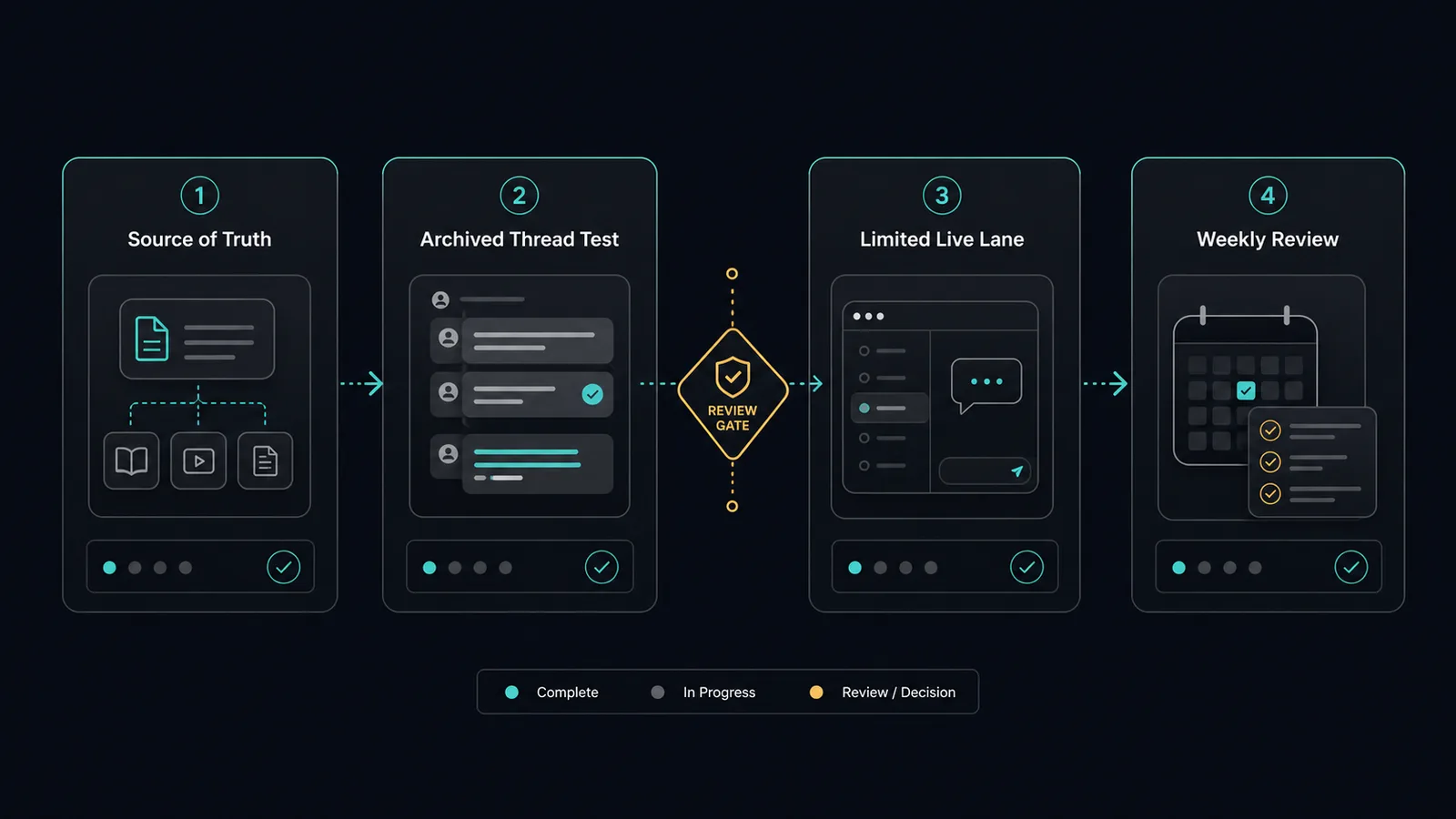
| Phase | What happens | What to watch |
|---|---|---|
| Source of truth | Offer, voice, qualification, booking, follow-up, and escalation rules are documented | Conflicting details or missing rules |
| Archived thread test | AI is tested against real past conversations | Voice misses, booking too early, weak escalation |
| Limited live lane | AI handles one lead source, campaign, or conversation type | Real replies, human review load, handoff quality |
| Weekly review | The team reviews samples and updates rules | Repeated misses and offer drift |
The safest first live lane is usually narrow:
- one lead magnet
- one campaign
- one story reply prompt
- one inbound conversation type
- one section of follow-up
That lets you see how the system behaves without turning the whole inbox into a test environment.
The launch-readiness scorecard
Before launch, score each area from 1 to 3.
| Area | 1 means | 2 means | 3 means |
|---|---|---|---|
| Offer source | Details are scattered | Mostly documented | One current source of truth |
| Voice | Vague tone notes | Some examples | Clear good and bad examples |
| Qualification | Interest equals fit | Basic criteria | Clear fit, red flags, and booking rules |
| Objections | Ad hoc replies | Common objections listed | Approved responses and escalation rules |
| Follow-up | Generic nudges | Some timing rules | Stage-specific follow-up and stop rules |
| Escalation | Human review is unclear | Some edge cases listed | Clear pause and escalate triggers |
| Handoff | Calendar link only | Some notes captured | Source, context, objections, and next step captured |
| Review | No owner | Occasional checking | Weekly review and update rhythm |
If most scores are 1s, do not launch yet.
If most scores are 2s, test with archived threads and fix the obvious gaps.
If most scores are 3s, launch in a limited lane and review weekly.
The goal is not perfection. The goal is enough clarity that the AI can help without becoming another thing you have to constantly rescue.
Quick answers coaches search for
What should I prepare before using an AI setter? Prepare your offer source of truth, voice examples, qualification rules, booking criteria, objection guidance, follow-up logic, escalation rules, and review process.
How do I train an AI setter to sound like me? Use real DM examples. Give replies you like, replies you dislike, tone rules, message length rules, words to use, words to avoid, and examples of how you handle price, objections, and booking.
Can an AI setter send my booking link? Yes, but only when booking criteria are clear. The AI should know what must be true before sending the link and what context needs to be captured for the call.
Should I let AI handle every DM? No. AI should handle the repeatable lanes you have rules for. Sensitive, unclear, emotional, or high-judgment messages should pause for review or escalate to a human.
Final thought
An AI setter can make your DM system feel lighter.
But only if you give it a system worth scaling.
If the offer is unclear, the voice is undocumented, the booking rule is fuzzy, and the handoff lives in someone's memory, AI will not magically clean that up. It will just move faster inside the mess.
Build the source of truth first. Give the AI real examples. Define qualification. Protect the booking link. Write the escalation rules. Test with archived threads. Launch in a narrow lane. Review weekly.
That is how AI starts becoming infrastructure instead of another tool you have to babysit.
CTA: Before you let an AI setter reply to real leads, run the onboarding checklist against your last 20 sales conversations. If the gap is not just replies, but keeping offer context, voice, follow-up, qualification, and handoffs organized in one place, see how Intellicoach is built for online coaches with real DM volume.
More questions coaches ask
Should AI setters send booking links automatically?
Only after the coach has defined booking criteria. The AI should know what must be true before a call link is sent, what context must be captured, and when a human should review before booking.
How often should coaches review AI setter conversations?
Review a small sample weekly when the AI is live, and do a deeper review when the offer, pricing, ads, qualification rules, or team handoffs change.
Ready to Try Intellicoach?
Built for online coaches with real DM volume who want to automate follow-ups and qualification without losing their voice.