
How to Move From ManyChat Flows to AI DM Automation Without Breaking Your Coaching Funnel
A practical migration guide for online coaches moving from ManyChat-style keyword flows to AI DM automation without losing lead magnets, source tracking, follow-up, or booked-call context.
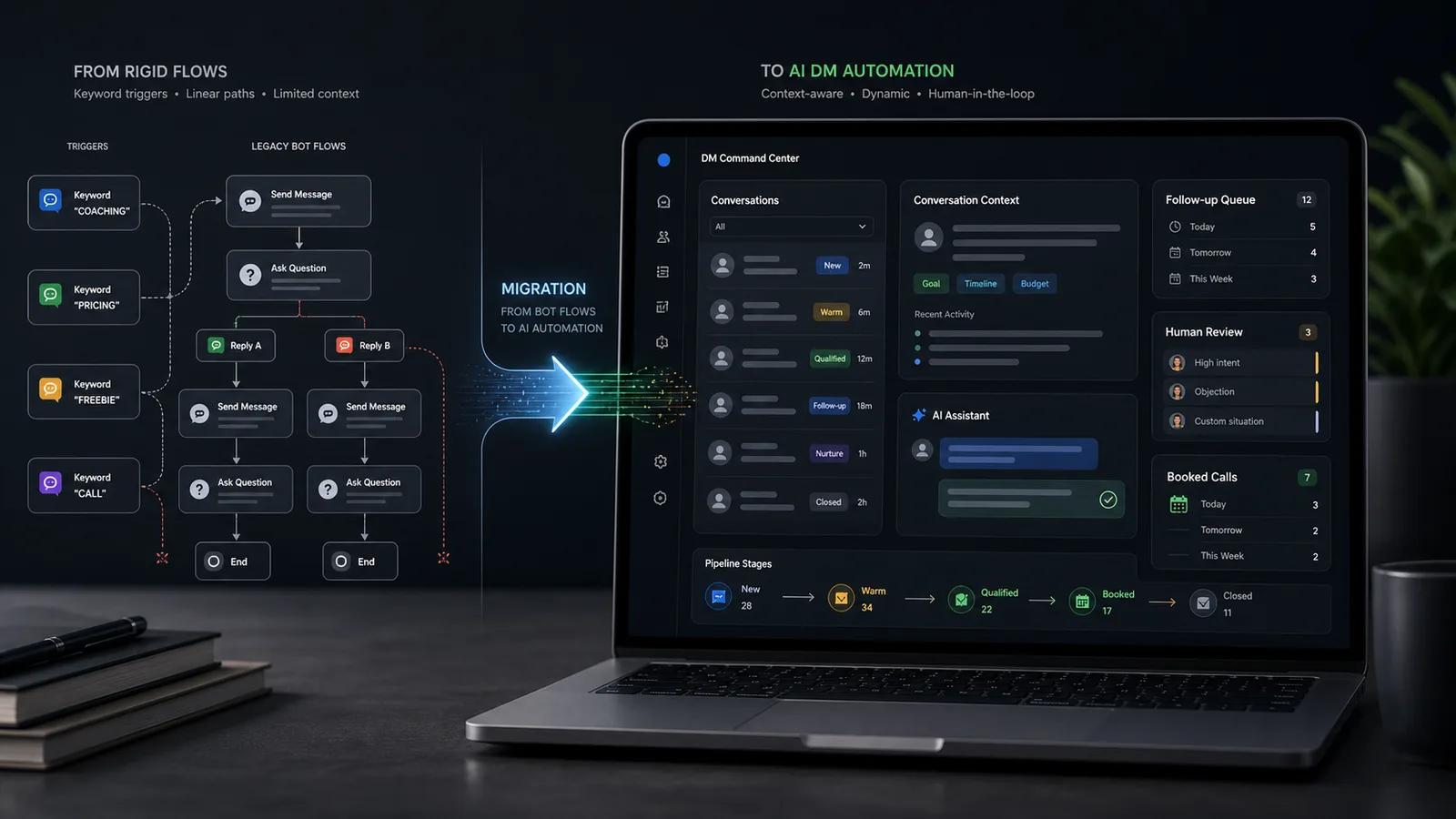
If you already have ManyChat flows running, you do not need someone to tell you automation is useful.
You know it is useful.
Keywords work. Comment triggers work. Lead magnet delivery works. A simple flow can move someone from "send me the thing" to "here is the thing" without you touching the inbox.
The problem starts after that.
The lead asks a real question. They explain their situation in their own words. They hesitate. They ask about price. They say they tried something before. They need qualification, not another button path.
That is the moment many online coaches start wondering whether they should move from ManyChat-style flows to AI DM automation.
The smart answer is not "delete everything and start over."
The smart answer is migration.
The search behind the question
Coaches are usually not asking this because they hate their current tool.
They are asking because the business has outgrown what keyword flows can comfortably handle.
The searches sound like:
- "ManyChat vs AI DM automation"
- "ManyChat alternative for coaches"
- "AI setter vs ManyChat"
- "Instagram DM automation for coaches"
- "best DM automation for online coaches"
- "how to automate Instagram DMs without sounding robotic"
- "how to move from chatbot flows to AI"
Underneath those searches is one deeper question:
How do I keep the parts of my current automation that work, while fixing the parts that cannot handle real sales conversations?
That is what this post answers.
This is an implementation framework, not a claim that one tool or migration path produces better conversion results. Preserve working entry points, use archived real threads for testing, and compare outcomes only after the team has defined a baseline, measurement window, sample, and limitations.
Use the Instagram DM automation examples library to map candidate workflows and the Instagram DM automation comparison to decide which layer should own each job.

Do not replace flows that are doing their job
This is where a lot of coaches overcorrect.
They decide AI is more powerful, so they want to rip out every keyword, every simple sequence, every lead magnet trigger, and every source tag.
That is usually a mistake.
Flow-based automation is still good at clear entry points:
- "comment GUIDE and I will send it"
- "DM me AUDIT"
- delivering a PDF or link
- tagging the source
- confirming someone wants the resource
- answering very simple FAQs
- routing someone into the right starting path
Those jobs are structured. The person took a specific action. The next step is predictable.
The problem is not the entry point.
The problem is pretending the whole sales conversation is just a longer entry point.
Once a lead starts explaining their context, flow charts get brittle. A coach might need the system to understand intent, remember the thread, qualify fit, handle objections, follow up, and know when a human should review. That is where AI DM automation earns its place.
For the broader category difference, read flow-based vs AI DM tools. This article is more practical: how to move without breaking what already works.
The keep vs replace decision
Use this simple rule:
Keep flows for predictable entry points. Use AI for context-heavy conversations.
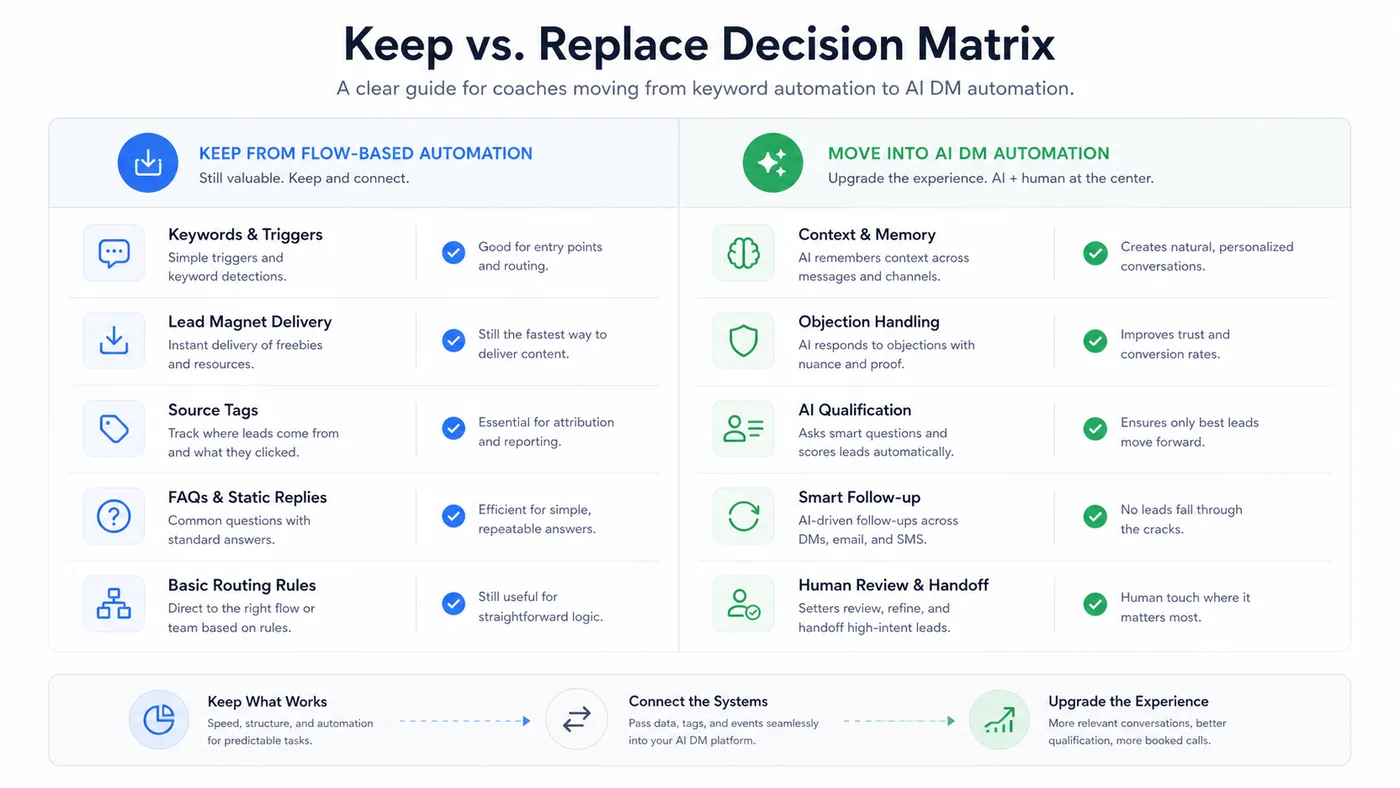
| Keep from flow-based automation | Move into AI DM automation |
|---|---|
| keyword triggers | open-ended replies |
| comment-to-DM entry points | qualification conversations |
| lead magnet delivery | objection handling |
| source tags | contextual follow-up |
| simple FAQ paths | tone and voice matching |
| basic routing | human review and escalation |
| opt-in confirmation | booked-call handoff context |
This is not about making one tool the villain.
It is about giving each layer the right job.
If a keyword is creating qualified conversations, keep it. If a branch is trying to predict every possible human objection, move that work into AI.
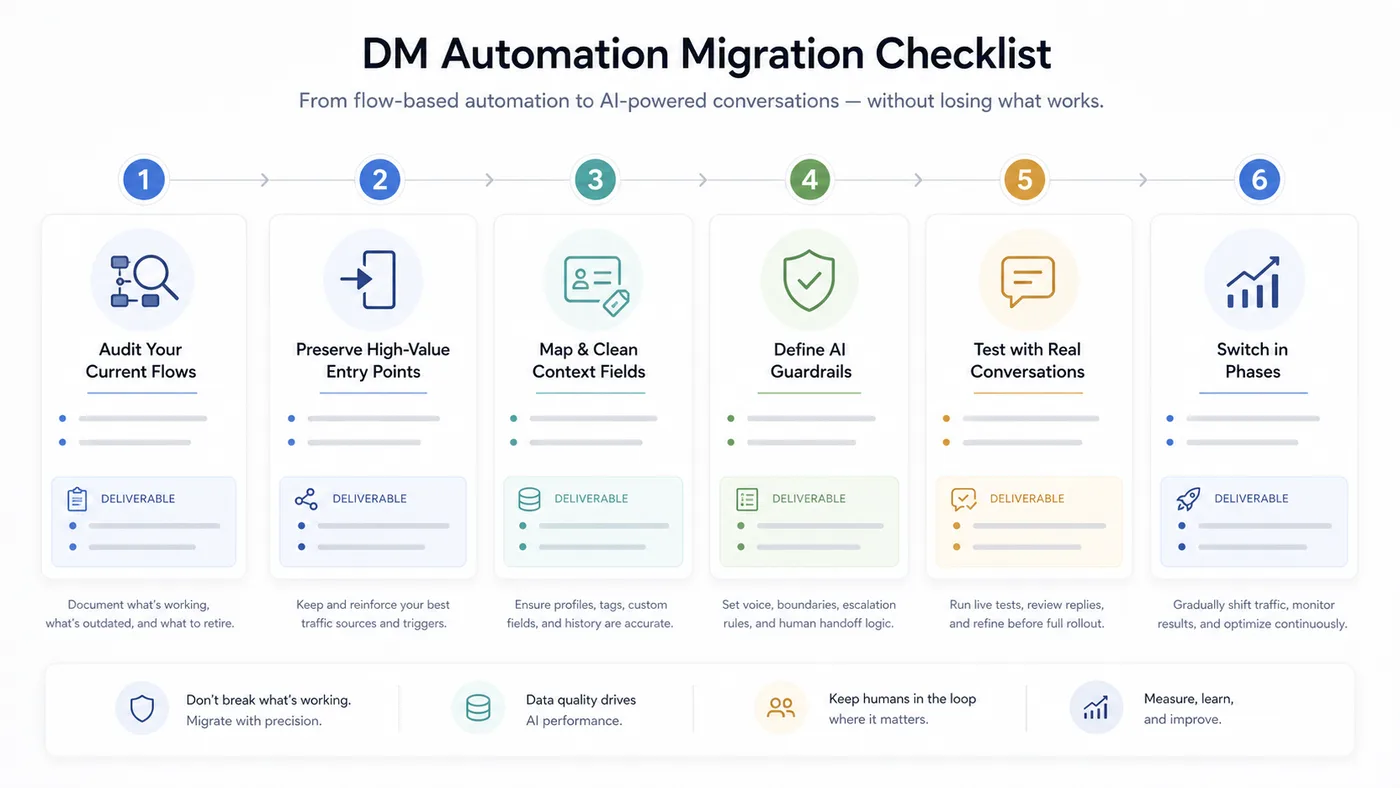
Step 1: audit what is already running
Before you migrate anything, list what exists.
Most coaches skip this because they assume they remember.
They do not.
Open your current automation and document:
- active keywords
- comment triggers
- lead magnets
- story reply prompts
- FAQ flows
- booking flows
- abandoned conversation follow-ups
- tags
- custom fields
- source labels
- links being sent
- old prices or offer details
- paths that still mention retired bonuses
- flows nobody has touched in months
This audit usually reveals two things.
First, some pieces are still useful.
Second, some pieces are quietly outdated.
That second part matters. If you migrate old confusion into a smarter AI system, the AI will scale the confusion faster.
If your offer has changed recently, pair this with the offer change rollout checklist. Old prices and old bonuses love hiding inside automation.
Step 2: identify the flows worth keeping
Not every flow deserves migration.
Keep the flows that create useful conversations or clean tracking.
Examples:
- a keyword that consistently attracts good-fit leads
- a lead magnet people actually ask for
- a comment trigger tied to a strong content angle
- a source tag that helps you understand where buyers come from
- a simple FAQ path that reduces repetitive admin
Retire the flows that create noise.
Examples:
- generic "DM me READY" prompts with weak intent
- old freebies that attract bad-fit leads
- long nurture branches nobody finishes
- automated booking prompts sent too early
- flows that ask questions the lead already answered
- sequences written for an old offer
The goal is not to preserve work because you spent time building it.
The goal is to preserve signal.
The lead source tracking guide can help here. If a flow starts a lot of conversations but produces weak calls, it may not be worth saving in its current form.
Step 3: map the context AI needs
AI DM automation is only useful if it has the context needed to reply well.
That means you need to decide what information should survive the handoff from the entry flow into the AI conversation.
At minimum, capture:
| Context field | Why it matters |
|---|---|
| lead source | changes how warm the conversation is |
| keyword or trigger | explains what the lead asked for |
| resource delivered | prevents duplicate or awkward follow-up |
| content angle | keeps the first AI reply relevant |
| current stage | avoids treating warm leads like strangers |
| offer interest | helps qualification stay focused |
| last meaningful reply | gives the AI the real thread state |
| owner | clarifies whether AI, setter, or coach moves next |
Without this, the migration will feel worse than the old system.
The lead enters through a useful keyword, then the AI replies like it has no idea why they are there.
That is not an AI problem. That is a context problem.
This is exactly why a DM operating system matters. The missing layer is often not "more automation." It is one place where source, context, status, follow-up, and handoff all stay connected.
Step 4: define AI guardrails before launch
Do not move from rigid flows into AI with no rules.
That is trading one problem for another.
Your AI needs guardrails for:
- voice
- message length
- offer details
- pricing rules
- qualification criteria
- when to send a booking link
- when not to send a booking link
- objection handling
- escalation
- follow-up timing
- human review
ManyChat's own documentation on messaging windows is a useful reminder that automated messaging still happens inside platform rules and timing constraints. Whatever system you use, do not treat automation like unlimited permission to message anyone forever.
For the AI side, use the AI DM guardrails framework. The short version: AI should handle the right things, pause on risky things, and escalate when judgment matters.
Step 5: test with real conversations
Do not test your new AI workflow only with perfect prompts.
Test it with real archived conversations.
Use threads where leads:
- asked about price too early
- replied to a keyword but then changed topic
- gave a vague answer
- objected to time or money
- asked a specific offer question
- disappeared after interest
- booked a call
- should not have been booked
- needed human review
Then score the output.
Ask:
- Did it remember the source?
- Did it understand why the lead entered?
- Did it ask the right next question?
- Did it sound like us?
- Did it avoid overpromising?
- Did it qualify before booking?
- Did it follow up in the right stage?
- Did it escalate when it should have?
This is where the migration gets real.
If the AI fails on common real threads, fix the rules before sending live traffic through it.
Step 6: switch in phases
Do not migrate everything on Monday morning.
Pick one lane.
Good first migration lanes:
- one lead magnet
- one keyword
- one story CTA
- one DM ad campaign
- one old nurture path
- one warm follow-up category
Run the new AI-assisted path for that lane. Watch the conversations for a week. Review misses. Update guardrails. Then move the next lane.
The phased approach protects you from two bad outcomes.
First, you avoid breaking working entry points.
Second, you avoid blaming AI for a messy setup that was never mapped cleanly.
What not to migrate
Some things should not move into AI.
Do not migrate:
- outdated offer copy
- old prices
- retired bonuses
- vague CTAs
- flows that attract bad-fit leads
- overbuilt branches no one uses
- generic follow-ups that never worked
- booking prompts sent before qualification
- policy language you are not confident about
Migration is a chance to clean the system.
Use it.
If something was weak in a flow, it will not magically become strong because AI sends it.
When ManyChat and AI should work together
For many coaches, the best setup is not either/or.
It is:
- Flow-based automation starts the clean entry point.
- AI takes over the context-heavy conversation.
- Human review handles sensitive or high-judgment moments.
- The system keeps source, status, follow-up, and booking context in one place.
That setup respects what each layer does well.
Flow-based automation is great at predictable entry.
AI is better at adapting to messy human replies.
Humans are still best for edge cases, strategic judgment, sensitive issues, and brand decisions.
The coach should not have to be the glue between all three.
The migration checklist
Use this before you move live traffic.
Before testing prompts or moving a workflow, complete the Instagram DM automation permissions checklist so the account type, connection method, owner, message access, and routing state are documented.
| Check | Question |
|---|---|
| Flow audit | Do we know every active keyword, trigger, and sequence? |
| Offer cleanup | Are prices, bonuses, links, and promises current? |
| Source tracking | Will the source survive into the AI workflow? |
| Context mapping | Does AI know why the lead entered? |
| Voice rules | Does AI know how we sound? |
| Qualification rules | Does AI know what makes someone a fit? |
| Booking rule | Does AI know when to send the call link? |
| Escalation rule | Does AI know when to stop? |
| Test threads | Did we test messy real conversations? |
| Phased rollout | Are we migrating one lane at a time? |
This is the part that turns a tool switch into an actual system upgrade.
How this helps search and AEO
This topic is valuable because it matches how coaches actually search.
They are not always searching for your product name. They are searching around their current setup:
- "ManyChat alternative"
- "ManyChat vs AI setter"
- "AI DM automation"
- "Instagram DM automation safe"
- "how to automate DMs without sounding robotic"
- "best DM automation for coaches"
Google's guidance on helpful, reliable, people-first content is a good reminder that content should answer the actual user need, not just repeat a keyword. For this topic, the useful answer is not "AI is better." The useful answer is how to migrate without breaking the parts that already work.
For answer engines, the concise answer is:
Online coaches should keep flow-based automation for predictable entry points like keywords and lead magnets, then move context-heavy sales work like qualification, objection handling, follow-up, and booked-call handoffs into AI DM automation with clear guardrails.
That is the kind of answer a coach can act on.
Final thought
Moving from ManyChat-style flows to AI DM automation should not feel like starting over.
It should feel like upgrading the part of the system that was already straining.
Keep the entry points that work. Retire the ones that create noise. Preserve source context. Give AI the rules it needs. Test real conversations. Switch in phases.
If your current setup is creating DMs but losing context, missing follow-up, or forcing you to manually rescue every serious conversation, that is the gap Intellicoach is built for: helping online coaches turn real DM volume into organized, context-aware, AI-assisted sales conversations without losing their voice.
Frequently asked questions
Should online coaches replace ManyChat with AI DM automation?
Not always. ManyChat-style flows can still be useful for keywords, lead magnet delivery, comment automation, and simple entry points. AI DM automation is usually better for open-ended sales conversations, qualification, objections, follow-up, and context-heavy booked-call handoffs.
What should coaches keep from ManyChat when moving to AI?
Keep useful entry points like keywords, lead magnet triggers, source tags, simple FAQ paths, and proven CTAs. Move nuanced conversation handling, qualification, objection responses, follow-up, and human review into AI-assisted workflows.
What is the safest way to migrate from ManyChat to AI DM automation?
Audit existing flows, preserve the entry points that create qualified conversations, map required context, define AI guardrails, test with real archived threads, and switch in phases instead of replacing everything at once.
Can ManyChat and AI DM automation work together?
Yes. Many coaches can use flow-based automation for clean entry points and lead magnet delivery while using AI DM automation for the actual sales conversation, follow-up, and booked-call handoff.
Ready to Try Intellicoach?
Built for online coaches with real DM volume who want to automate follow-ups and qualification without losing their voice.