
The AI DM Guardrails Framework: How Online Coaches Use Automation Without Losing Control
A practical AI DM guardrails framework for online coaches who want faster replies, better follow-up, cleaner escalation, and more control over automated Instagram conversations.
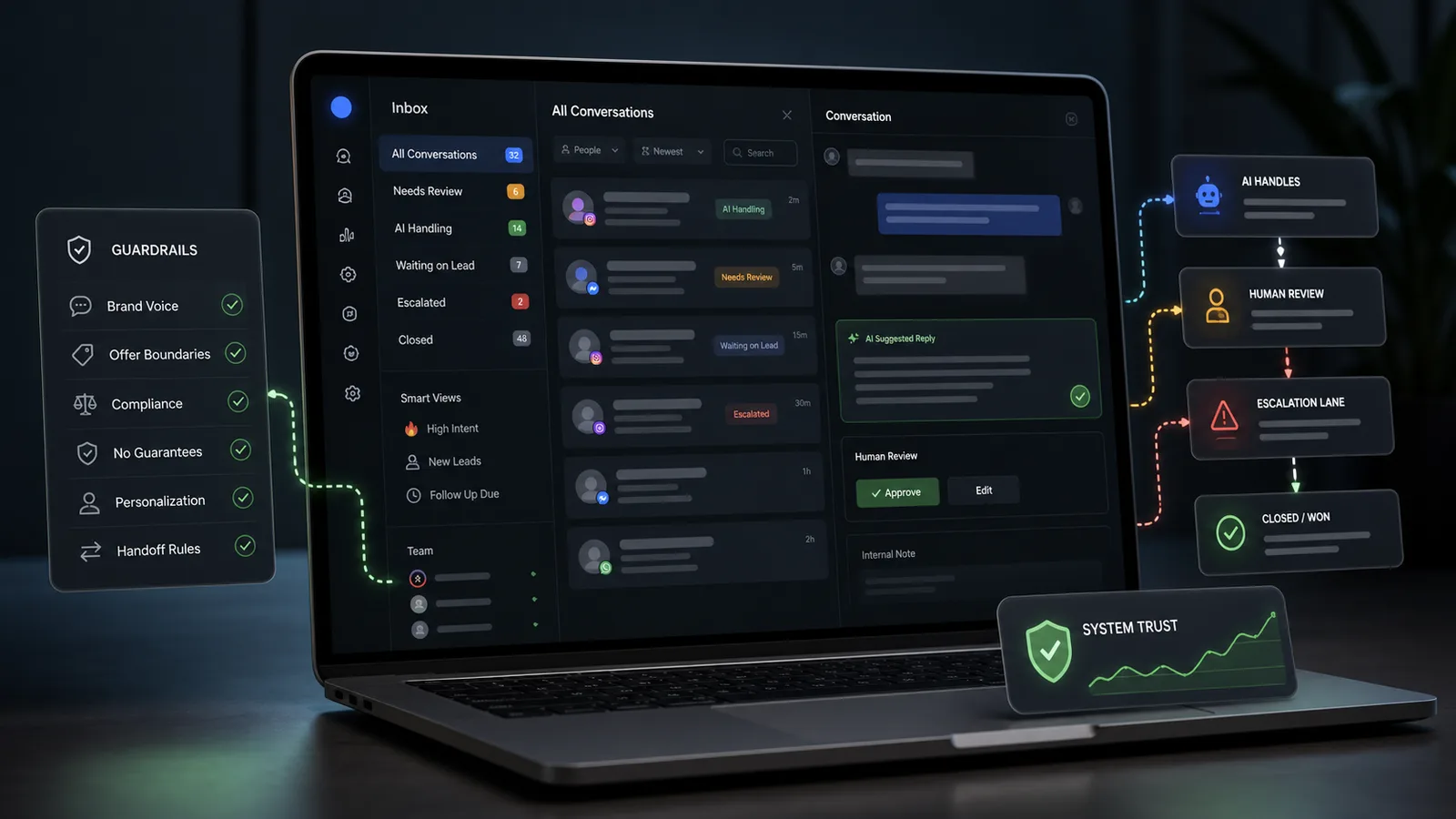
AI in your DMs is only useful if you still feel in control.
Not "kind of" in control.
Not "I hope it is saying the right thing."
Actually in control: your voice, your offer rules, your qualification process, your follow-up logic, and your judgment when a conversation gets weird.
That is where a lot of coaches get stuck. They want faster replies and cleaner follow-up, but they do not want a black-box assistant turning every lead into a generic sales conversation. They want leverage without sounding robotic. They want automation without giving up the parts of selling that require taste.
The answer is not to avoid AI. The answer is to build guardrails.
AI needs rules before it needs volume
Most online coaches think about AI DM automation in the wrong order.
They ask:
- How many messages can it send?
- How fast can it reply?
- Can it book calls?
- Can it follow up?
- Can it sound like me?
Those are fair questions, but they are not the first questions.
The first question is: what is the AI allowed to decide?
That question changes everything. A good AI DM assistant does not need unlimited freedom. It needs a clear lane. It needs to know what it can answer, what it should ask, what it should never promise, and when the coach needs to step in.
This is not corporate overkill. It is practical control for a coaching business where one wrong reply can damage trust, confuse an offer, book a bad-fit call, or make a strong lead feel like they are being processed.
The NIST AI Risk Management Framework describes trustworthy AI in terms like validity, reliability, safety, accountability, transparency, explainability, privacy, and fairness. You do not need to run your coaching business like a government agency, but the underlying idea is useful: AI systems work better when people define the risks, manage them, and keep humans accountable.
For a coach, that becomes simpler:
The AI can help, but the business still owns the conversation.

The five guardrails every AI DM system needs
An AI DM system for a serious coaching business needs five layers of control:
- Voice guardrails
- Offer and policy rules
- Qualification rules
- Escalation rules
- Review and override rules
If one layer is missing, the system may still reply quickly. It just will not be trustworthy at scale.
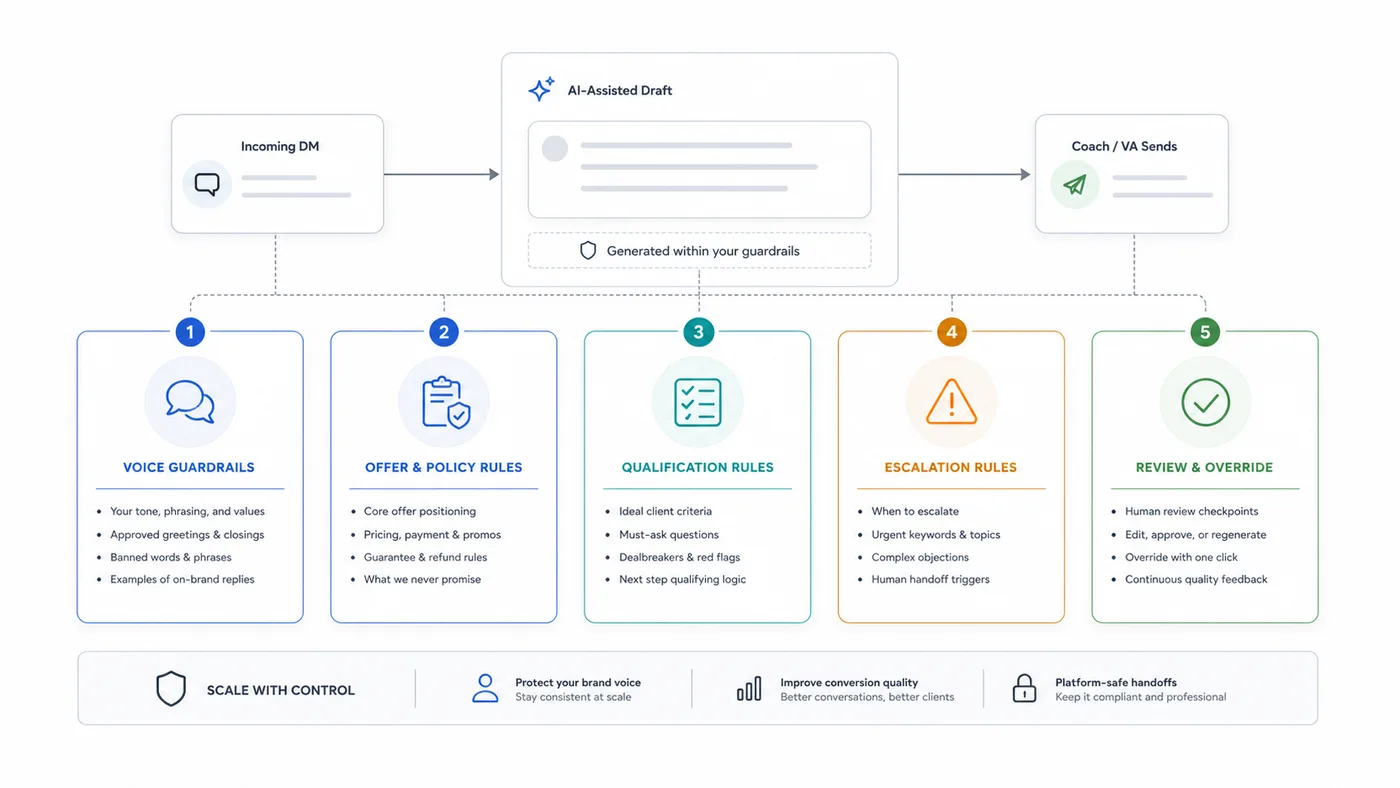
This framework is not about making AI timid. It is about making it precise.
The more clearly you define the boundaries, the more confidently the assistant can handle the repeatable parts of the inbox without turning every edge case into a guess.
Guardrail 1: Voice rules
Voice is not just "make it sound casual."
For coaches, voice is part of trust. It is how a lead decides whether this conversation feels like the person they followed, the content they liked, and the offer they are considering.
Your AI needs voice rules that explain:
- how direct you are
- how warm you are
- how much slang you use
- whether you use emojis
- how you handle hesitation
- how you ask qualifying questions
- how you talk about price
- how you avoid sounding needy
- how you move someone to a call
Weak voice rules sound like:
"Be friendly and professional."
Strong voice rules sound like:
"Use short, clear messages. Sound calm and confident. Do not over-explain. Avoid hype. Ask one question at a time. Mirror the lead's language when they describe their problem. Do not pressure someone into a call if they have not shared enough context."
That difference matters.
If you want a deeper voice-specific audit, the Sounds Like Me test is still one of the best ways to evaluate whether a DM automation tool can actually match your style instead of just sounding "AI friendly."
Guardrail 2: Offer and policy rules
AI should never improvise your offer.
That sentence alone would prevent a lot of messy DM conversations.
Your assistant needs a current, specific source of truth for:
- who the offer is for
- who it is not for
- what the program includes
- what it does not include
- current pricing rules
- payment options
- application requirements
- booking criteria
- guarantees or no-guarantee language
- bonus rules
- start dates
- refund or cancellation policies
- legacy client exceptions
This is where coaches get into trouble after changing pricing, changing bonuses, adding a premium tier, or tightening qualification. The AI might be responding from old copy, old scripts, old FAQs, or old team memory.
If your offer just changed, use the offer change rollout checklist before you let AI handle sales conversations at volume. Automation makes inconsistencies travel faster.
The rule is simple: if you would not want a setter promising it, do not let the AI imply it.
Guardrail 3: Qualification rules
The goal of AI in DMs is not to book every possible person.
The goal is to move the right people forward and keep the wrong people from consuming the calendar.
Your AI needs qualification rules that define:
- what makes someone a good fit
- what makes someone not ready
- what information must be collected before a call
- what buying signals matter
- what red flags should pause the booking path
- what questions should be asked first
- when to stop qualifying and offer the next step
Without this, AI will often do one of two things.
It either books too fast because it sees interest and assumes interest equals fit, or it asks too many questions because it treats qualification like a form instead of a conversation.
Neither is ideal.
A better rule might be:
"Before offering the call link, confirm the lead's goal, current bottleneck, whether they are actively trying to solve it now, and whether the offer is relevant. If they ask for price before sharing context, answer briefly and bring the conversation back to fit."
That is the kind of instruction that gives AI useful judgment without pretending it owns the sales process.
For a broader quality check, pair this with the DM conversation quality audit, because qualification only matters if it shows up cleanly inside real threads.
Guardrail 4: Escalation rules
This is the layer most coaches underbuild.
They either expect AI to handle everything, which is risky, or they jump into every thread, which defeats the point.
You need a middle system.
Create three lanes:
| Lane | Meaning | Examples |
|---|---|---|
| AI can handle | Safe, repeatable, already covered by your rules | basic FAQs, first replies, normal qualification, standard follow-up |
| Needs review | Not urgent, but judgment would improve the reply | unusual objection, unclear fit, strong buyer with missing context |
| Escalate now | Sensitive, risky, emotional, or outside the approved process | refund issue, angry lead, medical or legal question, custom pricing, partnership request |
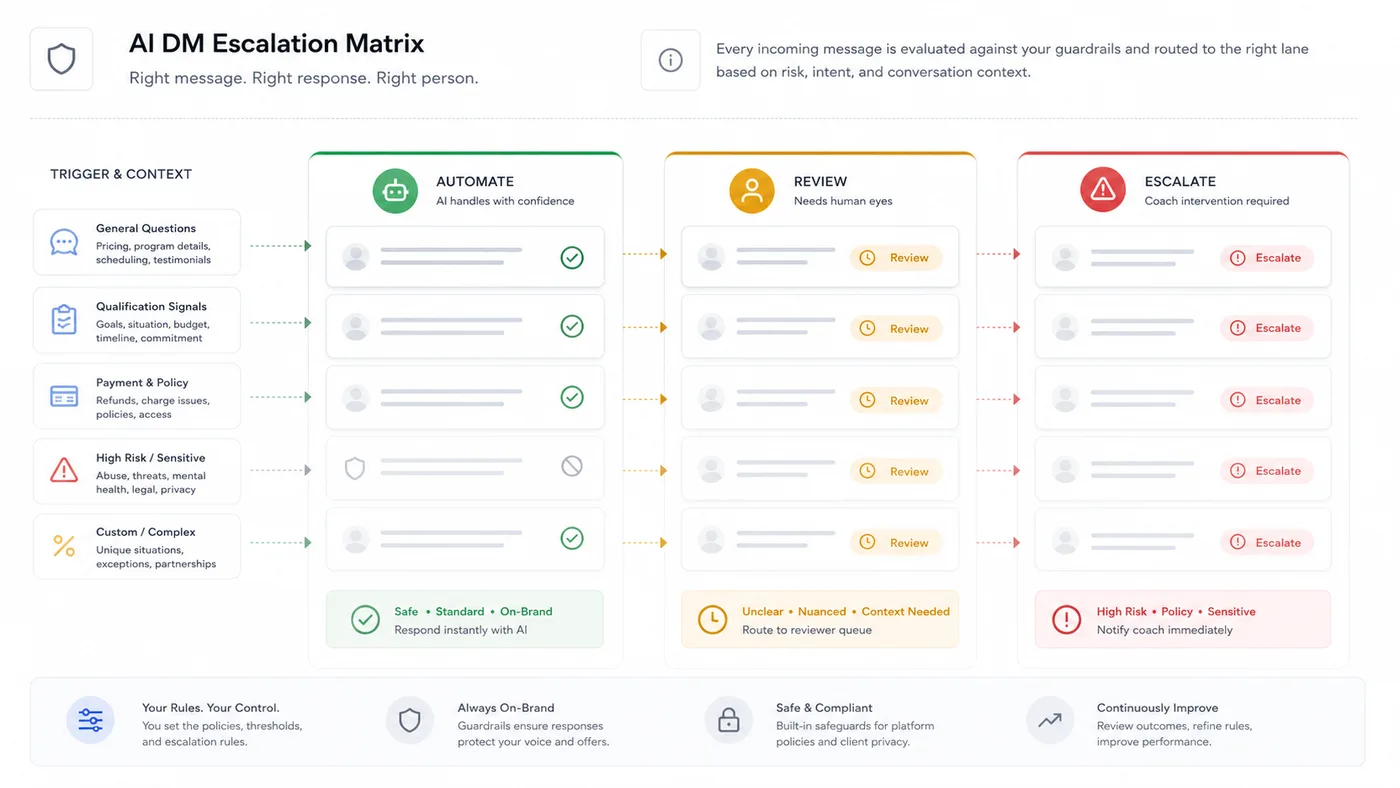
The best escalation rules are specific enough that your team, setter, and AI assistant all understand them.
Escalate when:
- the person is angry
- the person mentions a refund, chargeback, or payment issue
- the person asks for medical, legal, tax, or therapy advice
- the person wants a custom deal
- the person is a current client with a support issue
- the person is a referral partner or creator
- the person asks about something not covered in the approved offer rules
- the AI is not confident from available context
This is not about fear. It is about respect for the conversation.
AI should handle scale. Humans should still handle sensitive judgment.
Guardrail 5: Review and override rules
If you cannot review, correct, and improve the system, you do not have control.
You have a guessing machine.
Review rules answer:
- who checks conversations
- how often conversations are reviewed
- what gets scored
- how corrections are saved
- when scripts are updated
- when offer rules are updated
- when escalation rules are tightened
- what the AI should learn from overrides
For most coaching businesses, a weekly review is enough to start.
Pull 10 to 20 conversations and ask:
- Did the AI use the right context?
- Did it sound like us?
- Did it qualify correctly?
- Did it avoid overpromising?
- Did it follow up at the right stage?
- Did it escalate when it should have?
- Did it book the right people?
- Did it avoid booking the wrong people?
This does not need to become a giant QA department. It just needs to become a rhythm.
If you already have setters or VAs in the mix, connect this to the setter scorecard. The same principle applies: speed is not quality unless the conversation moves the right person forward in the right way.
The guardrails worksheet
Use this table before turning AI loose on more conversations.
| Guardrail | Question to answer | What to document |
|---|---|---|
| Voice | How should it sound? | tone, message length, words to use, words to avoid |
| Offer | What can it promise? | price, inclusions, exclusions, policies, current offer version |
| Qualification | Who should move forward? | fit criteria, red flags, required context, call-link rules |
| Escalation | When should a human step in? | sensitive topics, unclear cases, current client issues, custom requests |
| Review | How do we improve it? | weekly sample, scoring rules, overrides, script updates |
Do not keep this scattered across random docs, Slack messages, and memory.
Put it in one place.
If you do not already have a reliable source of truth for your coaching business processes, the SOP guide for online coaches is a good companion. Your AI rules are only as good as the process they are built from.
What AI should not decide by itself
Here is a useful test:
If a decision would make you uncomfortable when delegated to a brand-new setter, do not delegate it to AI without a guardrail.
AI should not independently decide:
- whether to discount
- whether to change the offer
- whether someone qualifies for an exception
- whether to promise a result
- whether to give medical, legal, or financial advice
- whether to handle an angry client
- whether to create a custom payment arrangement
- whether to ignore a red flag because the lead seems warm
That does not mean AI cannot help gather context, draft a careful reply, or organize the thread. It means the final decision belongs to the business.
Good AI-assisted DM systems are not built around blind trust.
They are built around controlled trust.
Platform guardrails matter too
AI guardrails are not only about tone and sales judgment.
They also have to respect the platform you are selling inside.
Meta's official Instagram messaging documentation makes clear that professional messaging workflows operate inside defined product features and permissions. For coaches, the practical point is straightforward: use tools that work with supported messaging behavior, and be careful with anything that sounds like scraping, mass outbound, or bypassing platform rules.
For a current source-backed breakdown of the claims coaches are hearing about AI tools, outbound DMs, links, and comment automation, use the Instagram AI automation rules and restriction guide.
Your DM system should be built around real user engagement, compliant messaging paths, and clear human oversight.
Avoid tools or workflows that promise:
- mass messaging people who never engaged
- scraping followers or profiles
- pretending to be a human while hiding automation
- sending messages outside allowed platform behavior
- using fake accounts to scale outreach
That kind of shortcut might sound aggressive, but it creates business risk you do not need.
You are building a premium coaching business. The DM system should feel premium too.
The weekly AI DM control loop
The best AI DM systems improve because the coach reviews reality.
Use this weekly loop:
- Pull a mixed sample of conversations.
- Score voice, qualification, escalation, and follow-up.
- Identify the repeated miss.
- Update one guardrail.
- Let the system run with the new rule.
- Review again next week.
That loop is simple, but it prevents drift.
Drift is what happens when the offer changes, the content angle changes, the ads change, the setter changes, or the business gets busier, but the AI rules stay frozen.
This is why a coaching tech stack audit should look at more than which tools you pay for. It should ask whether the tools still reflect how the business actually sells today.
What a premium AI DM system feels like
A premium AI DM system does not feel like chaos with faster typing.
It feels calm.
You can see what is happening. You know what the assistant is allowed to answer. Your offer details are current. Your qualification rules are clear. Sensitive conversations do not get guessed through. Your team knows when to step in. You can review, tune, and override without rebuilding the whole system every week.
That is the difference between "AI replies to my DMs" and "my DM system can hold up at scale."
One is a feature.
The other is infrastructure.
Final thought
If you already have DM volume, your next bottleneck is probably not speed alone.
It is control.
Who knows the current offer? Who decides fit? Who catches weird edge cases? Who reviews quality? Who updates the rules when the business changes? Who makes sure AI sounds like the coach instead of a generic assistant?
Intellicoach is built for that reality: online coaches who want AI leverage without losing the voice, context, follow-up, and human judgment that make their sales process work.
Use AI for scale.
Use guardrails for control.
Frequently asked questions
What are AI DM guardrails?
AI DM guardrails are the rules, review points, escalation triggers, voice guidelines, and offer boundaries that keep an AI assistant from replying outside the coach's sales process or brand voice.
Why do online coaches need AI DM guardrails?
Online coaches need guardrails because DMs are high-context sales conversations. Without clear rules, AI can answer quickly but miss fit, tone, offer details, objections, or moments that should go to a human.
What should an AI DM assistant escalate to a coach?
Escalate unusual objections, refund or payment issues, medical or legal questions, angry prospects, unclear fit, custom pricing requests, partnership requests, and any message the assistant cannot answer confidently from the coach's approved process.
How often should coaches review AI-assisted DMs?
Coaches with active DM volume should review a small sample weekly and do a deeper monthly review when ads, scripts, pricing, setters, or qualification rules change.
Ready to Try Intellicoach?
Built for online coaches with real DM volume who want to automate follow-ups and qualification without losing their voice.