
The DM Lead Handoff SLA: How Online Coaches Stop Warm Leads From Slipping Between DMs, Setters, and Sales Calls
A practical DM lead handoff SLA for online coaches, including a copy-ready booked-call brief. Set response windows, ownership rules, qualification context, and booked-call handoffs that hold up at scale.
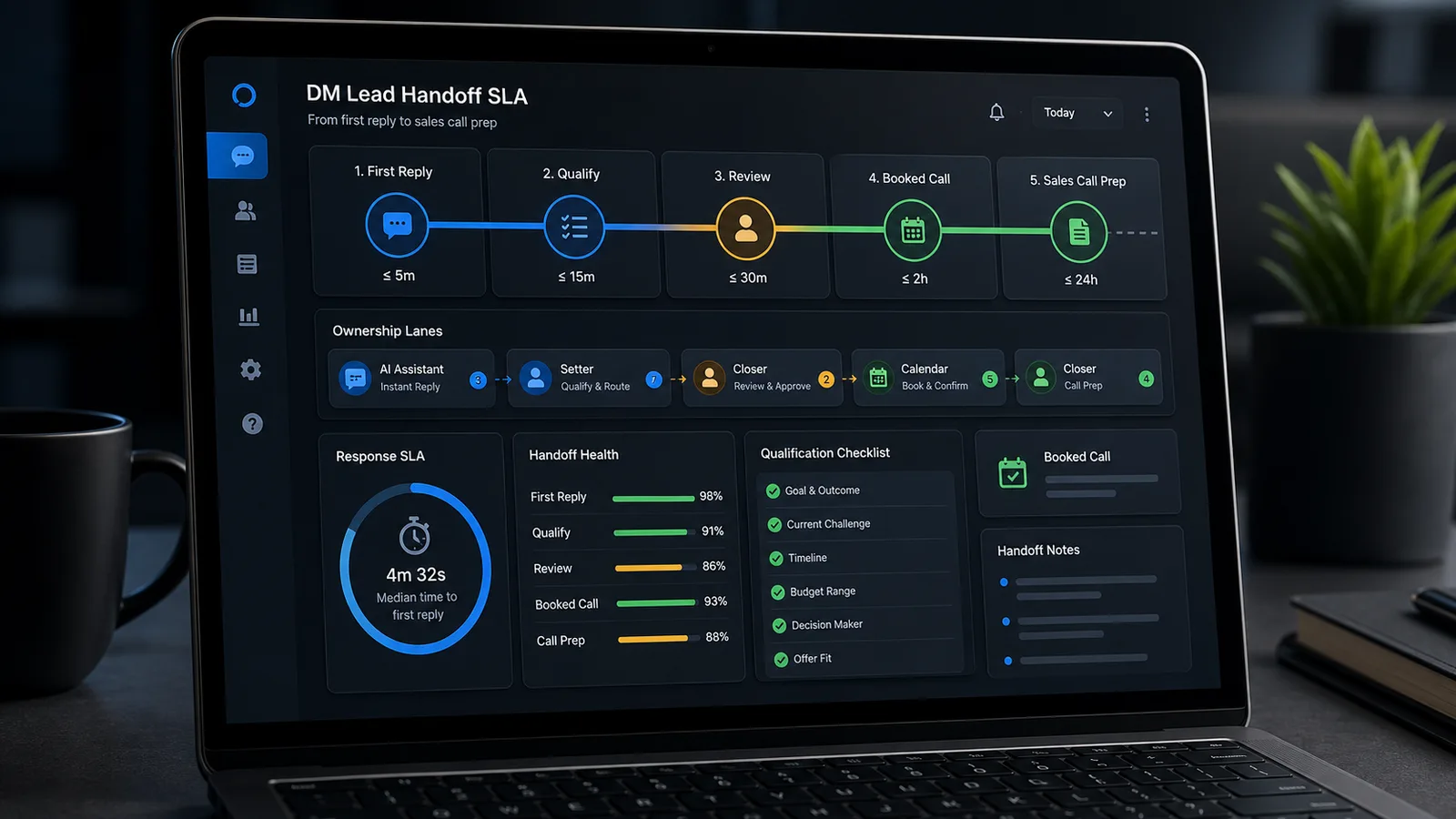
Most coaches do not lose warm leads in one dramatic moment.
They lose them in the handoff.
The lead replies to a story. The VA answers. The AI asks a question. The setter jumps in. The lead sounds interested. The call link gets sent. Then the coach opens the calendar event and has no idea what the person actually wants help with.
Or worse, nobody owns the thread for six hours because everyone assumed someone else had it.
That is not a lead quality problem. It is not always a setter problem. It is not even an automation problem.
It is a handoff problem.
And once your DMs are a real sales channel, handoffs need rules.
What a DM lead handoff SLA means
A DM lead handoff SLA is a simple agreement for how leads move through your inbox.
SLA stands for service level agreement. In bigger companies, an SLA usually defines what one team or provider promises to deliver, by when, and to what standard. HubSpot's service level agreement glossary describes SLAs as measurable standards that can create alignment and accountability, including between sales and marketing teams.
For an online coach, this does not need to become corporate theater.
It means answering four questions:
- Who owns this lead right now?
- How quickly should the next action happen?
- What context must be captured before handoff?
- What happens if the thread stalls, gets weird, or needs human judgment?
That is it.
You are not trying to build a 40-page operations manual. You are trying to stop warm leads from slipping between DMs, AI, VAs, setters, and sales calls.

Why handoffs break as DM volume grows
When you are handling every message yourself, the handoff is mostly mental.
You remember who replied to the story. You remember who asked about price. You remember who needed a softer follow-up. You remember that one prospect said they were ready, but only after their launch ended.
That works until volume grows.
Then your inbox has:
- ad leads
- story replies
- ManyChat keyword leads
- referral DMs
- old leads reactivating
- current clients asking questions
- setters moving people to calls
- AI handling first replies
- VAs tagging conversations
- coaches checking only the hottest threads
At that point, memory is no longer a system.
The handoff breaks because context is scattered, ownership is fuzzy, and "follow up later" means different things to different people.
This is the exact pattern behind the DM conversation quality audit. A conversation can look fine message by message, but still fail because the next owner never got the context they needed.
The five pieces every handoff needs
A clean DM handoff has five pieces:
| Handoff piece | What it answers |
|---|---|
| Stage | Where is this lead in the conversation? |
| Owner | Who is responsible for the next move? |
| Window | When should that move happen? |
| Context | What does the next person need to know? |
| Next action | What exactly happens now? |
If any of those are missing, the handoff becomes a guess.
The common failure is not that nobody cares. It is that the system lets everyone assume.
The VA assumes the setter will follow up. The setter assumes the coach can read the thread before the call. The coach assumes the lead was qualified. The AI assumes the standard path still applies. The lead assumes nobody is paying attention.
That is how a warm conversation goes cold while everyone is technically busy.
The DM lead handoff SLA matrix
Use this matrix as a starting point.
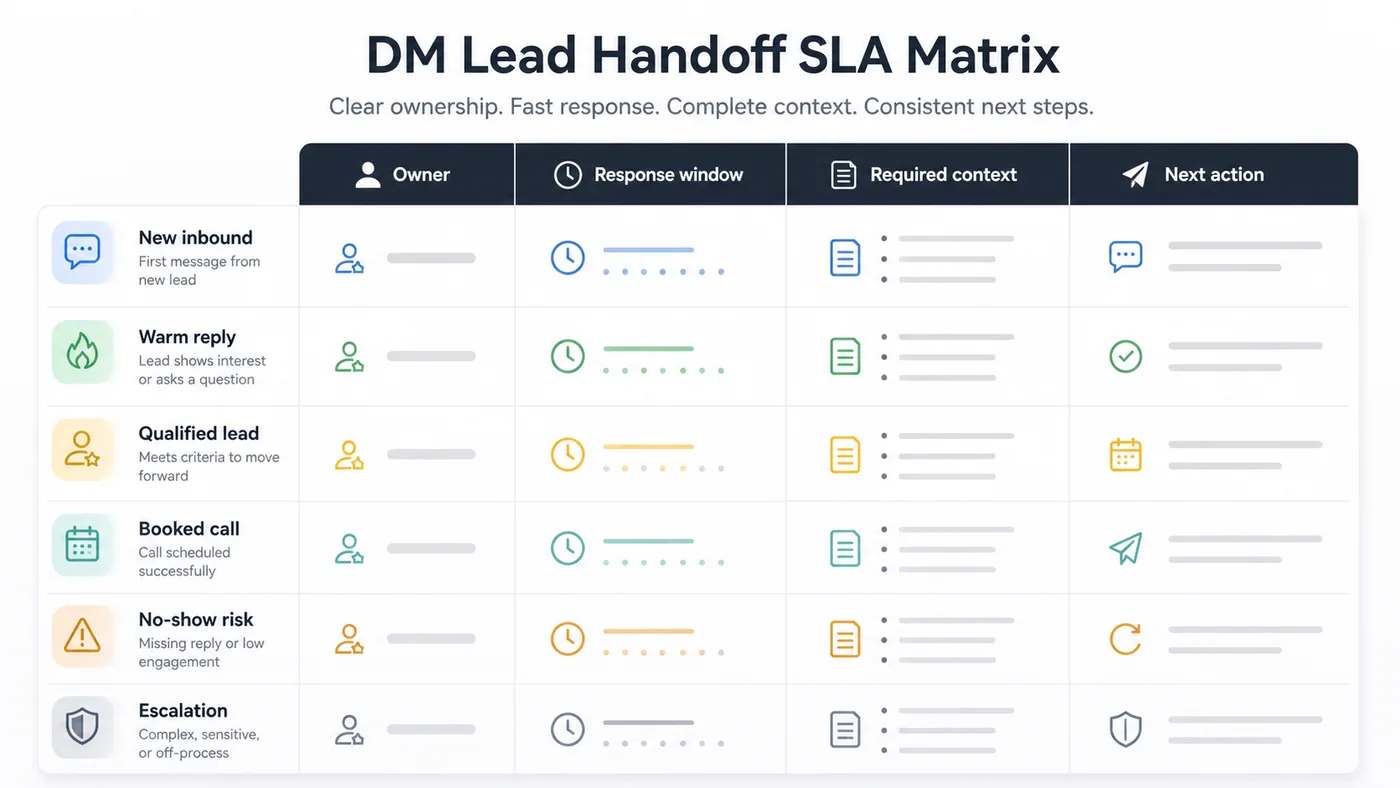
| Lead stage | Owner | Response window | Required context | Next action |
|---|---|---|---|---|
| New inbound | AI, VA, or setter | Fast first reply during active coverage | source, trigger, first message | acknowledge and ask the first useful question |
| Warm reply | AI or setter | Same coverage block | goal, problem, why now | qualify or route to review |
| Qualified lead | setter or coach | Before call link or next booking prompt | fit, urgency, offer match, objections | send booking path or prepare call |
| Needs review | coach or closer | Same day if warm | why the thread is uncertain | reply with judgment or update rule |
| Booked call | setter or system owner | Immediately after booking | source, problem, goal, fit, notes | create call prep context |
| No-show risk | setter, AI, or coach | Before call time and after missed call | reason, prior intent, best follow-up | confirm, reschedule, or nurture |
| Not a fit | AI, setter, or coach | Same conversation | disqualification reason | close respectfully or send resource |
| Escalation | coach | As soon as noticed | sensitive issue, payment, anger, policy gap | human reply only |
The point is not to copy this perfectly.
The point is to stop treating every thread as "someone should probably handle it."
Stage 1: New inbound
New inbound leads need speed, but speed alone is not the standard.
The standard is: fast enough to keep momentum, contextual enough to avoid sounding generic.
Your SLA should define who handles new inbound DMs during active coverage. That might be AI, a VA, a setter, or the coach. The exact owner matters less than the fact that there is one.
For new inbound, capture:
- lead source
- content or ad trigger
- first message
- whether the lead asked a direct question
- whether this is a current client, old lead, or new prospect
The first reply should not erase the reason they entered the conversation. If someone came from a content prompt, connect the reply to that prompt. If they came from a DM ad, preserve the ad angle. If they came from a referral, do not treat them like a cold lead.
This is why lead source tracking is not just analytics. Source affects the first reply and the handoff.
Stage 2: Warm reply
A warm reply is not the same as a qualified lead.
This is where coaches accidentally inflate the calendar.
The lead says:
- "Tell me more."
- "How much is it?"
- "This sounds like me."
- "I need help with that."
- "Do you work with people like me?"
Those are buying signals, but they still need context.
Your SLA should define what must happen before someone gets the call link. Usually, that means clarifying the lead's goal, current bottleneck, urgency, and whether your offer is relevant.
The risk here is moving too fast or too slowly.
Move too fast and you book weak-fit calls. Move too slowly and you turn an interested lead into an intake form. The SLA keeps the middle clean: enough qualification to protect the calendar, not so much that the lead loses momentum. If a formal application is necessary, the high-ticket coaching application form guide shows how to ask only for context the lead has not already shared.
For AI-assisted conversations, this connects directly to the AI DM guardrails framework. AI should know when it can qualify, when it should review, and when it should escalate.
Stage 3: Qualified lead
A qualified lead is not "someone who wants the link."
A qualified lead is someone whose problem, timing, and fit make a call useful.
Your SLA should define the minimum context required before booking:
- What do they want?
- What is not working right now?
- Why are they looking now?
- What have they tried?
- What makes them a fit?
- What might block the sale?
- Which offer or path are they responding to?
If your setter sends a call link without this context, the calendar may look busy but the sales process gets weaker.
The coach should not enter the call thinking, "Who is this again?"
The handoff should make the call warmer before it starts.
For a copy-ready version of those call notes, use the booked-call brief below. It separates the lead's facts from the setter's recommendation.
That is one of the reasons the setter scorecard should measure handoff quality, not only booked calls.
Stage 4: Needs review
Not every thread should keep moving automatically.
Some leads need review.
Review does not mean urgent. It means the next move requires judgment.
Examples:
- the person is a good fit but hesitant
- the lead asks about a custom situation
- the offer fit is unclear
- the lead has a strong objection
- the thread has old context that matters
- the AI or setter is unsure what to say next
- the lead is warm but not ready for the call link
Your SLA should define where review threads go and how quickly they get checked.
This is where many growing coaching businesses create hidden delays. "Needs review" becomes a parking lot. The lead is too important for a generic reply but not urgent enough to interrupt the coach, so the thread sits.
Give it a window.
For example: review warm uncertain threads before the end of the current business day. If the coach is offline, the owner leaves a short internal note with the recommended next move.
Stage 5: Booked call
Booking is not the end of the DM process.
It is a handoff into the call.
A booked-call handoff should include:
- lead source
- core problem
- desired outcome
- what they have tried
- why they are interested now
- fit signal
- hesitation or objection
- any personal context that changes the conversation
- what promise or offer angle they responded to
This does not need to be long. In fact, it should not be.
The best call notes are short enough to read and specific enough to help.
Bad handoff:
"Wants help. Booked for Thursday."
Good handoff:
"Came from story on scaling without living in DMs. Has VA + ManyChat but context keeps getting lost. Wants to stop managing every thread manually. Asked if AI can follow their scripts. Good fit for control/voice angle."
That note changes the call.
Copy this booked-call brief
Use this brief when a qualified lead has confirmed a time. Capture the lead's facts in their own wording, then keep the setter's recommendation separate so the closer can distinguish what is known from what still needs discovery.
BOOKED-CALL BRIEF

Lead + call
- Lead name / handle:
- Call date, time, and time zone:
- Receiving owner:
- Lead source and conversation trigger:

Why this call matters
- Primary goal (their words):
- Current problem or constraint (their words):
- Why now:
- What they have already tried:

Fit and conversation context
- Observable fit signals:
- What they responded to:
- What we already sent or said:

Open loop
- Remaining question, objection, or hesitation:
- Do not repeat / ask again:

Closer prep
- Suggested opening angle (setter recommendation):
- Next action if the call does not happen:
- Handoff completed by + time:
The first three sections record the conversation. The final section is judgment. Keeping those roles separate prevents a closer from mistaking a setter's interpretation for something the lead explicitly said.
Stage 6: No-show risk
No-shows often start before the no-show.
You can usually see the risk in the handoff:
- vague reason for booking
- no clear problem captured
- weak confirmation
- long gap between booking and call
- unclear expectations
- lead needed too much convincing
- call link sent before qualification
Your SLA should define what happens before and after a no-show risk.
Before the call, the system can confirm the reason for the call and make sure the lead knows what to expect. After a missed call, the next action should depend on the thread, not a generic "sorry we missed you" message.
If no-shows are a pattern, pair this with why coaching sales calls no-show. Sometimes the issue is not reminder timing. It is the quality of the pre-call handoff.
Stage 7: Escalation
Escalation is where the SLA protects trust.
Some messages should never be handled casually:
- angry leads
- current client issues
- refund or payment disputes
- medical, legal, tax, or therapy questions
- custom offer requests
- partnership requests
- accusations or complaints
- anything outside the approved sales process
Your SLA should define who handles escalation and how the thread is marked.
This is not about making the system slow. It is about knowing when speed is not the most important thing.
In normal DMs, speed keeps momentum. In sensitive DMs, judgment protects the brand.
What to measure weekly
An SLA only works if you review reality.
Once a week, inspect:
| Metric | What it tells you |
|---|---|
| First reply misses | Coverage or ownership problem |
| Warm threads without next action | Review lane or follow-up problem |
| Booked calls with weak notes | Handoff quality problem |
| Weak-fit booked calls | Qualification problem |
| No-shows by source | Source or pre-call expectation problem |
| Escalations missed | Guardrail problem |
| Status mismatches | CRM or inbox organization problem |
Do not turn this into a giant dashboard if your business does not need one.
Start with the missed handoffs. They will tell you where the system is lying to you.
The AEO reason this framework matters
Search is changing, but the basics still matter.
Google's guidance on helpful, reliable, people-first content is a good reminder that content should serve a real reader first. The same idea applies to the way you build your own blog and your own DM systems: clear answers, real usefulness, and original operating insight beat thin content built only to catch keywords.
That is why a DM lead handoff SLA is a strong content and operations asset.
It is:
- easy to define
- specific to online coaches
- useful without a sales pitch
- structured enough for search engines and AI systems to understand
- practical enough for a team to use
- connected to adjacent topics like lead source, qualification, no-shows, setters, and AI guardrails
If an AI answer engine summarizes this topic, the useful answer should be simple:
A DM lead handoff SLA defines owner, response window, required context, and next action for each lead stage so warm coaching leads do not get lost between DMs, AI, setters, and sales calls.
That is the kind of sentence worth building a post around because it helps the reader and the machine understand the same thing.
The simplest version to implement this week
If you do nothing else, create this small table for your business:
| Stage | Owner | Window | Required note |
|---|---|---|---|
| New inbound | source + first message | ||
| Warm reply | problem + goal | ||
| Qualified | fit + objection | ||
| Booked | call prep summary | ||
| Needs review | why review is needed | ||
| No-show risk | reason + next follow-up | ||
| Escalation | issue + human owner |
Fill it out with your actual workflow.
Not the workflow you wish you had.
The one that exists right now.
Then audit the last 10 conversations that should have become calls, did become calls, or became messy before the call. Look for where the owner, window, context, or next action was missing.
That is your first fix.
Final thought
You do not need more complexity in your DM system.
You need less ambiguity.
Who owns the lead? How fast does the next move happen? What context must survive the handoff? What does the coach need before the call? When does the AI, VA, or setter stop and ask for human judgment?
When those answers are clear, DMs feel calmer. Setters become easier to manage. AI becomes safer to use. Sales calls start warmer. Follow-up stops depending on memory.
That is the real job of a DM lead handoff SLA.
And if your current system cannot keep owner, context, status, follow-up, and call prep in one place, that is exactly the kind of operational gap Intellicoach is built to close for online coaches with real DM volume.
Frequently asked questions
What is a DM lead handoff SLA?
A DM lead handoff SLA is a simple agreement that defines who owns each lead stage, how quickly the next action should happen, what context must be captured, and when a conversation should move from AI, VA, setter, or coach review into a booked call.
Do online coaches really need an SLA?
Coaches with real DM volume need some version of an SLA because lead handoffs break when ownership, response windows, qualification criteria, and call prep expectations are vague. It does not need to be corporate. It needs to be clear.
What should be included in a DM handoff?
A clean DM handoff should include the lead source, current problem, goal, fit signal, objection or hesitation, next step, owner, deadline, and any context the coach needs before a sales call.
How often should coaches review their DM handoff SLA?
Review the SLA weekly when DM volume is high, ads are running, or a setter is involved. Review it again any time the offer, pricing, qualification rules, ad angle, or booking process changes.
Ready to Try Intellicoach?
Built for online coaches with real DM volume who want to automate follow-ups and qualification without losing their voice.