
Lead Routing for Online Coaches: How to Decide Who Handles Each DM Before Context Gets Lost
A practical lead routing framework for online coaches who need to decide which DMs go to AI, a VA, a setter, the coach, or nurture without losing speed, context, or booked-call quality.
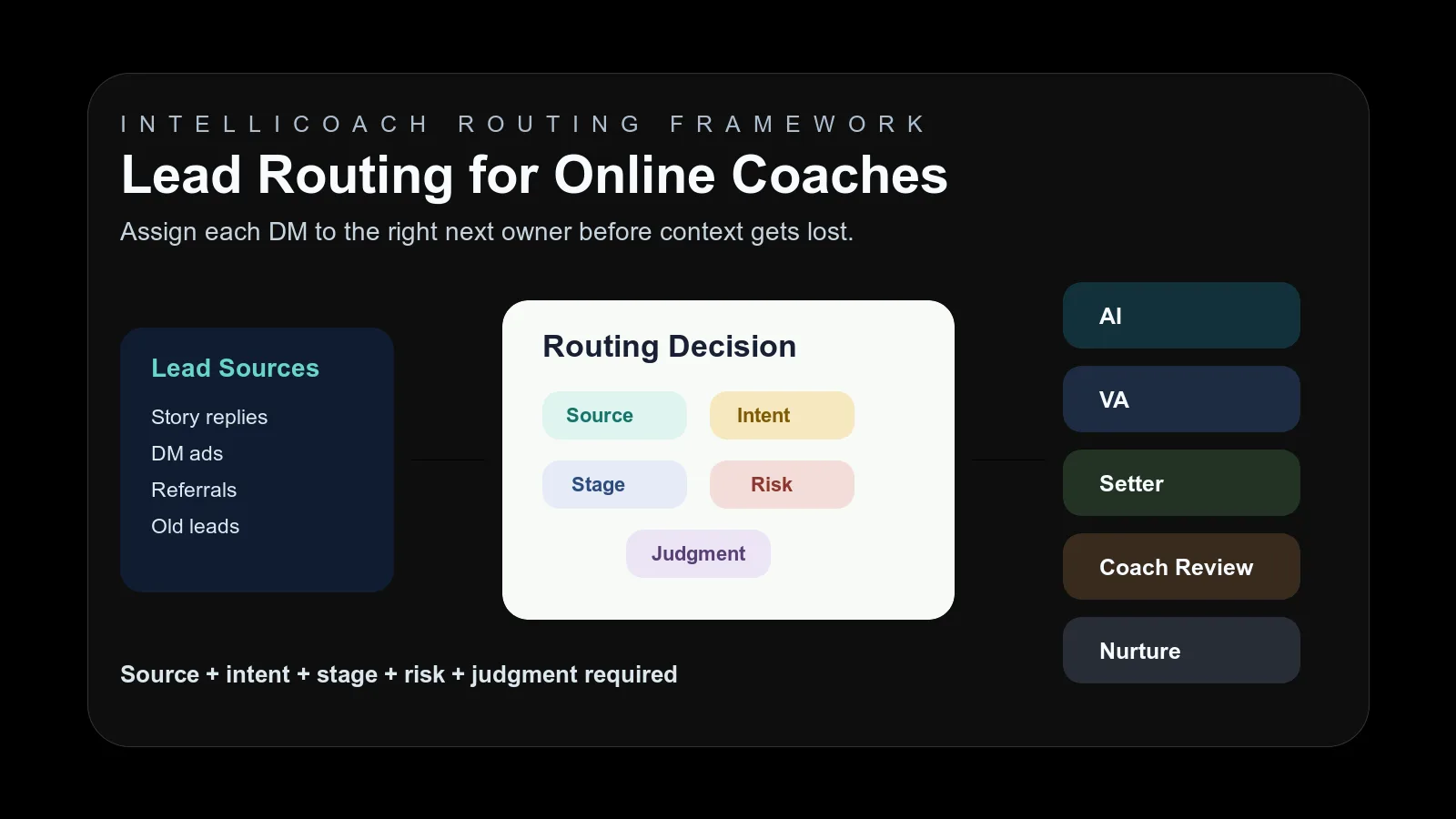
The question is not just "who should reply to this DM?"
The better question is:
Where should this lead go next?
That is the question most online coaching businesses do not answer until the inbox is already messy.
A story reply comes in. A DM ad lead asks a question. A referral messages you directly. A warm old lead reappears. A current client sends a support question in the middle of a sales thread. A setter is answering some messages, AI is handling others, and you are still jumping in when something feels important.
Everybody is active.
Nobody is fully sure where each lead should go.
That is a lead routing problem.

The short definition
Lead routing is the set of rules that decides who or what should handle each interested lead next.
For an online coach, lead routing usually means assigning Instagram DMs, ad replies, referrals, old leads, ManyChat conversations, application replies, and warm follow-ups to the right lane:
- AI first response
- VA support
- setter qualification
- coach review
- booked-call prep
- nurture
- not-fit closeout
The goal is not to make the business feel corporate. The goal is to stop serious leads from sitting in the wrong place, getting duplicate replies, receiving generic messages, or losing context before the sales call.
HubSpot's overview of lead response time frames the broader sales problem well: delayed response is often a workflow issue, not just an effort issue. In coaching DMs, the workflow issue is usually routing. The lead does not only need a fast reply. The lead needs the right next owner.
Why this matters more once DMs are working
When you have low volume, routing feels unnecessary.
You see the message. You reply. You remember the context. You decide what happens next.
That changes once DMs become a real sales channel.
Now you have:
- organic content replies
- story poll responses
- DM ad conversations
- referral intros
- old leads coming back
- ManyChat keyword starts
- outbound replies
- application questions
- pricing questions
- objection-heavy threads
- booked-call logistics
- no-show reschedules
- current client messages mixed into the same inbox
At that point, "I will just check the inbox" stops being a system.
Lead routing matters because every lead does not need the same next step. Some need a quick contextual first response. Some need qualification. Some need a human review. Some should not get a booking link yet. Some should be moved out of the active sales lane entirely.
If every lead goes through the same path, the path gets worse for everyone.
Lead routing vs lead handoff
These two ideas are close, but they are not the same.
| Concept | What it answers | Example |
|---|---|---|
| Lead routing | Where should this lead go next? | This referral should go to coach review, not the normal AI first response |
| Lead handoff | What must move with the lead? | Source, problem, goal, objection, next action, owner, and response window |
Routing decides the lane.
Handoff protects the context.
If routing is wrong, the lead starts in the wrong place. If handoff is wrong, the lead may start in the right place but lose context as soon as it moves.
That is why routing pairs naturally with a DM lead handoff SLA. The SLA defines owner, window, required context, and next action. Routing decides which owner should have the thread in the first place.
The five routing signals
Use five signals to decide where a lead should go next.
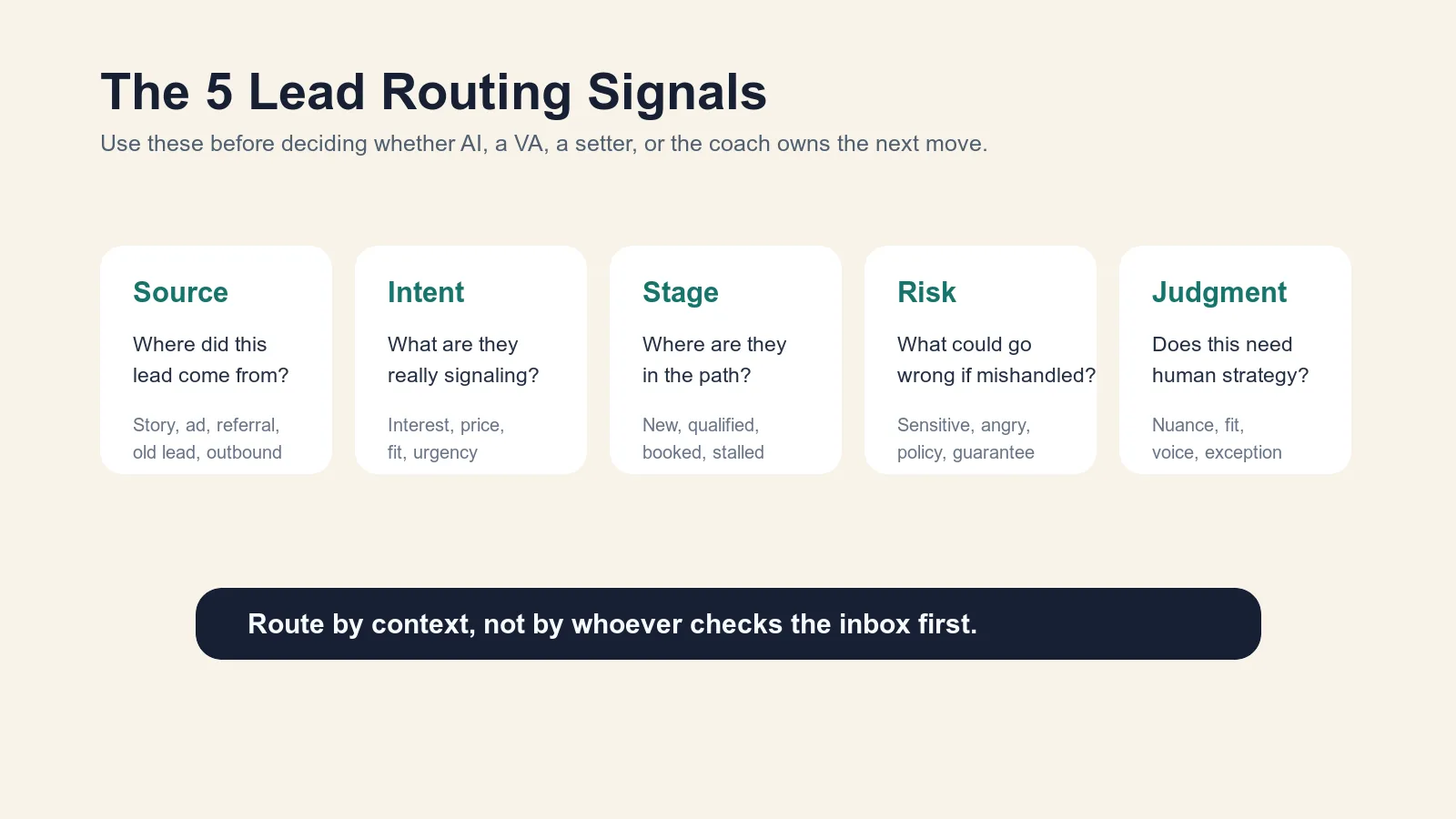
1. Source
Where did the lead come from?
This matters because source changes context.
A referral lead is not the same as a cold DM ad lead. A story reply is not the same as a ManyChat keyword. An old lead coming back is not the same as a brand-new inquiry.
Source affects:
- how warm the conversation is
- what the lead already knows
- how direct the first response should be
- whether a human should review early
- which objections are likely
- what should be recorded before booking
If you do not know the source, you are routing blind.
This is why lead source tracking for online coaches is not just a reporting habit. Source should change the conversation path.
2. Intent
What is the lead actually signaling?
Not all replies mean the same thing.
Compare these:
- "Love this."
- "Can you send the guide?"
- "How much is coaching?"
- "I need help with this."
- "Do you work with people who have tried other programs?"
- "My friend said I should message you."
Those should not all route to the same lane.
Low-intent engagement may stay in light nurture. A direct coaching question may go into qualification. A price question may need context before booking. A referral may deserve a faster human look because the relationship context is different.
Intent tells you whether the next step is response, qualification, review, booking, or nurture.
3. Stage
Where is the lead in the current conversation?
A new lead needs a different route than someone who already answered three qualification questions.
Common stages:
- new inbound
- engaged but not qualified
- qualified but not booked
- link sent, not booked
- booked
- no-show
- old lead reactivated
- unclear fit
- not fit
The mistake is treating every new message like a new lead.
If someone comes back after three days and says, "I talked to my partner and I think I want to do it," that should not go to the generic first-response lane. That should route based on prior context and buying stage.
Your online coach CRM fields do not need to be fancy, but stage and owner have to be visible. Without those two fields, routing becomes guesswork.
4. Risk
What could go wrong if the wrong person or tool replies?
Some DMs are safe to route to AI or a trained setter. Others should be escalated.
High-risk signals include:
- medical, legal, or sensitive personal issues
- anger or frustration
- payment dispute
- refund or policy question
- unclear fit with a vulnerable prospect
- a lead asking for a guarantee
- a VIP referral
- a conversation where tone could easily be misread
- a pricing objection that requires nuance
Routing is not only about speed. It is about protecting trust.
The point of AI is not to handle everything. The point is to handle the right things quickly and escalate the conversations where human judgment matters.
5. Judgment required
Does this next reply require strategic judgment?
Some replies are operational:
- acknowledge the message
- ask the first useful question
- confirm a call time
- remind someone to book
- tag the source
- update the stage
- send a saved resource
Some replies are judgment-heavy:
- decide whether the person is a fit
- handle a nuanced objection
- decide whether to send the booking link
- adjust tone for a referral
- protect brand voice in a sensitive moment
- choose whether to nurture or close out
If the reply needs judgment, route it to coach review or a trained setter with clear authority.
If it needs consistency and speed, AI or a VA-supported lane may be enough.
The lead routing matrix
Use this as a starting point.
| Lead type | Best first lane | Why | Watch for |
|---|---|---|---|
| Story reply with clear interest | AI or setter | Needs fast context-aware first question | Do not lose the story context |
| DM ad lead | AI first response, then setter qualification | Needs speed plus ad-angle continuity | Cheap message volume can hide weak fit |
| Referral DM | Coach review or senior setter | Trust is already borrowed from someone else | Do not treat it like a cold lead |
| ManyChat keyword start | AI or setter | Trigger is known and next question can be structured | Do not over-automate if they go off-script |
| Old lead reactivation | AI with context or setter review | Prior objection or timing matters | Do not restart the whole conversation |
| Direct price question | Setter or coach review depending on context | Usually needs qualification before price or booking | Do not dodge, but do not flatten the answer |
| Objection-heavy thread | Setter or coach review | Needs judgment and nuance | Do not send generic reassurance |
| Link sent, not booked | AI or setter follow-up | Needs timely nudge and status update | Do not let it sit with no owner |
| Booked call | System owner or setter | Needs call-prep context captured immediately | Do not make the coach reread the thread |
| Not-fit lead | AI, setter, or coach depending on sensitivity | Needs respectful closeout | Do not keep weak-fit leads active forever |
This matrix should not become a rigid script.
It should become a shared mental model.
When a lead enters the inbox, the system should know the likely lane. When the lead changes behavior, the system should change the lane.
The ownership lanes
A practical online coaching routing system usually has six lanes.
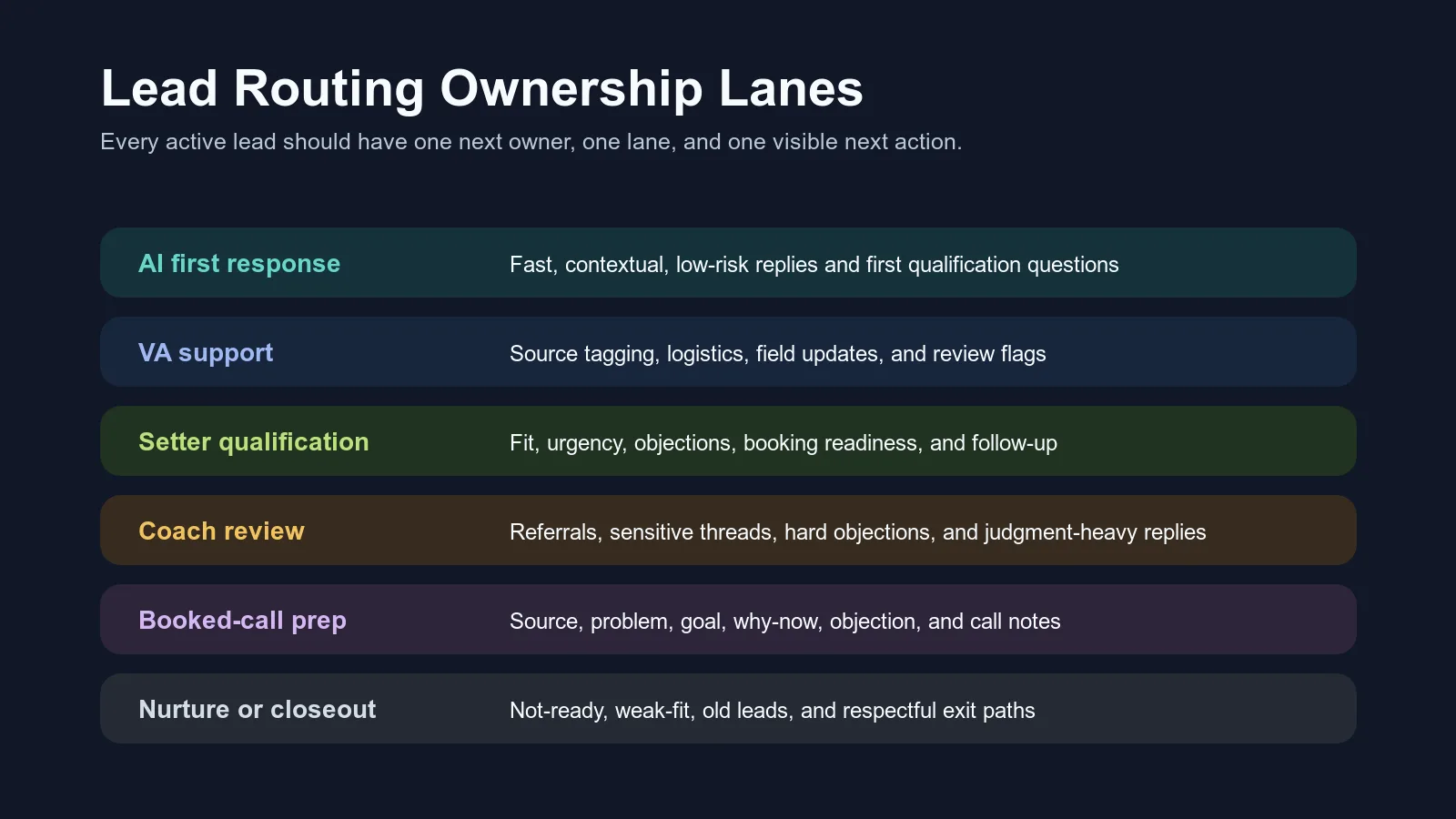
Lane 1: AI first response
Use this lane when the lead needs a fast, contextual reply and the next step is relatively clear.
Good fit:
- new inbound from content
- DM ad first response
- ManyChat keyword continuation
- simple qualification opener
- link-sent reminder
- low-risk follow-up
Bad fit:
- sensitive topics
- policy issues
- complex objections
- angry messages
- unclear fit that could cause harm if mishandled
AI should keep the conversation warm without pretending every thread is simple.
Lane 2: VA support
Use this lane for operational movement, not sales judgment.
Good fit:
- tagging source
- checking whether call notes exist
- confirming booking logistics
- updating a CRM field
- moving obvious not-fit or client-support messages out of the sales lane
- flagging threads for review
Bad fit:
- high-ticket objection handling
- qualification strategy
- deciding who gets the booking link
- replying in a nuanced sales moment unless trained for it
A VA can be valuable in the system, but a VA should not be treated like a setter by accident. If the role is unclear, revisit VA vs setter vs closer.
Lane 3: Setter qualification
Use this lane when the lead has enough intent to justify a real sales conversation but not enough context to book yet.
Good fit:
- "Tell me more"
- "How does coaching work?"
- "Can you help with this?"
- "What is the price?"
- leads who engaged with an offer post
- ad leads who answered the first question
The setter's job is not to chat forever. It is to decide whether the lead should book, be nurtured, be disqualified, or move to coach review.
This lane needs clear qualification criteria. Otherwise the setter becomes a friendly bottleneck.
Lane 4: Coach review
Use this lane when the thread needs strategic judgment.
Good fit:
- high-value referral
- sensitive objection
- unclear fit
- a lead who knows the coach personally
- an offer exception
- a message that could change the sales angle
- any conversation where voice matters more than speed
Coach review does not mean the coach has to carry every thread manually.
It means the system knows when to slow down for judgment.
Lane 5: Booked-call prep
Use this lane the moment someone books.
This is where a lot of revenue leaks quietly.
The lead technically booked, so everyone relaxes. But the coach gets a calendar event with no useful context. Then the call starts cold.
Booked-call prep should capture:
- source
- content or ad trigger
- current problem
- desired outcome
- why now
- offer fit
- objection or hesitation
- promised next step
The booking link rule helps earlier in the chain. This lane protects what happens after the link is accepted.
Lane 6: Nurture or closeout
Not every lead should stay active.
Some people need time. Some are bad fit. Some are interested but not ready. Some are only engaging with content. Some should be closed respectfully so the team stops treating them like a live opportunity.
Good nurture or closeout routing prevents your active pipeline from becoming a junk drawer.
This matters because the more weak-fit leads sit in active lanes, the easier it is to miss serious ones.
What bad routing looks like
Bad routing rarely looks dramatic.
It looks like normal mess.
The coach becomes the invisible default owner
The team technically exists, but everything still ends up with the coach.
AI starts the thread. The VA tags it. The setter asks a question. Then anything unclear gets mentally routed to "Aaron will figure it out later" or "the coach will probably see it."
That is not routing.
That is a bottleneck wearing a team costume.
Every lead gets the same path
The cold ad lead, warm referral, old buyer, price shopper, and serious application all get the same first question.
The system feels consistent, but the experience feels off.
Consistency is only useful when the route matches the context.
The booking link becomes the escape hatch
When nobody knows what to do next, the calendar link gets sent.
That can make the pipeline look active while quietly lowering call quality.
If booking links are being used to avoid qualification, route the thread back to setter qualification or coach review before booking.
Follow-up has no owner
The lead said they would check their calendar.
The setter assumes AI will nudge.
AI waits because the stage is unclear.
The coach assumes the setter handled it.
Three days later, nobody knows what happened.
This is why weekly sales dashboard owner gaps matter. Owner gaps are routing problems showing up as stale leads.
The routing rules to write first
If your system is messy, do not try to route every possible edge case on day one.
Start with these seven rules.
| Rule | Routing decision |
|---|---|
| New organic DM with clear offer interest | AI or setter first response, then qualification |
| New DM ad lead | AI first response tied to ad angle, then setter if engaged |
| Referral lead | Coach review or senior setter within the current coverage block |
| Price question before context | Setter qualification or coach review, not instant link send |
| Qualified but not booked | Setter or AI follow-up with clear booking path |
| Sensitive, angry, medical, payment, or guarantee language | Human review |
| Booked call | System owner captures call-prep context immediately |
Once those are working, add more nuance.
Do not build a routing encyclopedia before the basic lanes work.
How this fits inside the bigger acquisition system
Lead routing is one layer inside a broader client acquisition system.
The acquisition system asks:
- Where do leads come from?
- How do they become conversations?
- How are they qualified?
- How do they book?
- How do outcomes get reviewed?
Lead routing asks:
Who or what should handle this specific lead next?
That is the missing middle for a lot of coaches.
They have lead sources. They have a calendar. They may even have a setter and AI. But they do not have clear rules for which path each lead should take.
So the business feels busy but not controlled.
How to audit your routing this week
Pick 20 recent conversations.
Choose a mix of:
- new inbound DMs
- ad leads
- referrals
- old leads
- booked calls
- no-shows
- conversations that went quiet
- leads you personally jumped into
For each one, answer:
- What was the source?
- What was the first signal of intent?
- Who handled it first?
- Was that the right lane?
- Did the owner change?
- Did context move with it?
- Did the next action happen on time?
- Did the lead book, stall, get nurtured, or close out?
Then look for the pattern.
You are not looking for one bad message.
You are looking for the route that keeps breaking.
Maybe referrals need coach review faster. Maybe ad leads need better first qualification. Maybe old leads need prior context surfaced before anyone replies. Maybe booked calls need an automatic call-prep note. Maybe too many threads are routed to the coach because the setter does not have decision rules.
That is the fix.
Where AI helps and where it should not
AI is useful in lead routing when it helps the system move faster without losing context.
Strong uses:
- identifying source
- tagging stage
- drafting first replies
- asking first qualification questions
- flagging human-review triggers
- reminding on link-sent-not-booked leads
- surfacing stale warm conversations
- keeping booked-call notes close to the thread
Weak uses:
- pretending every objection is simple
- sending booking links based on one keyword
- handling sensitive edge cases without escalation
- ignoring source context
- flattening the coach's voice
- routing everything to automation because it is faster
The right question is not "Can AI answer this?"
The better question is:
Should AI own the next move, or should it route the thread to a human with the right context?
That is the difference between automation that creates control and automation that creates cleanup.
The takeaway
Lead routing is what keeps your DM sales system from becoming a pile of active conversations with no clear owner.
It decides where each lead goes next based on source, intent, stage, risk, and judgment required.
For online coaches with real volume, this is not optional forever. The moment you have AI, a VA, a setter, referrals, ads, and old leads all moving through the same inbox, you need routing rules.
Not because you want a corporate sales department.
Because you want the right lead in the right lane before context gets lost.
And if your current setup cannot keep source, stage, owner, follow-up, and handoff context visible in one place, that is exactly the kind of front-end sales system Intellicoach is built to support.
Frequently asked questions
What is lead routing for online coaches?
Lead routing is the set of rules that decides who or what should handle each interested lead next. For online coaches, it usually means routing Instagram DMs, ad replies, referrals, old leads, and application conversations to AI, a VA, a setter, the coach, or nurture based on source, intent, stage, risk, and required judgment.
How is lead routing different from a lead handoff?
Lead routing decides where a lead should go right now. A handoff defines what context, owner, response window, and next action must travel with the lead when it moves from one lane to another.
Who should own new Instagram DM leads?
The right owner depends on the type of lead. Simple new inbound can often start with AI or a trained setter. Referral leads, sensitive objections, payment questions, unclear fit, or high-intent buying signals may need coach review sooner.
When should a coach use AI for lead routing?
AI helps when the business already has consistent DM volume and needs faster first response, cleaner tagging, follow-up reminders, qualification support, or escalation rules. It should not replace human judgment for sensitive, ambiguous, or high-risk conversations.
Ready to Try Intellicoach?
Built for online coaches with real DM volume who want to automate follow-ups and qualification without losing their voice.