
The DM Sales Pipeline: How Online Coaches Track Leads From First Reply to Won Client
A practical DM sales pipeline framework for online coaches who need clear lead stages, ownership, follow-up rules, booked-call context, and weekly pipeline review.
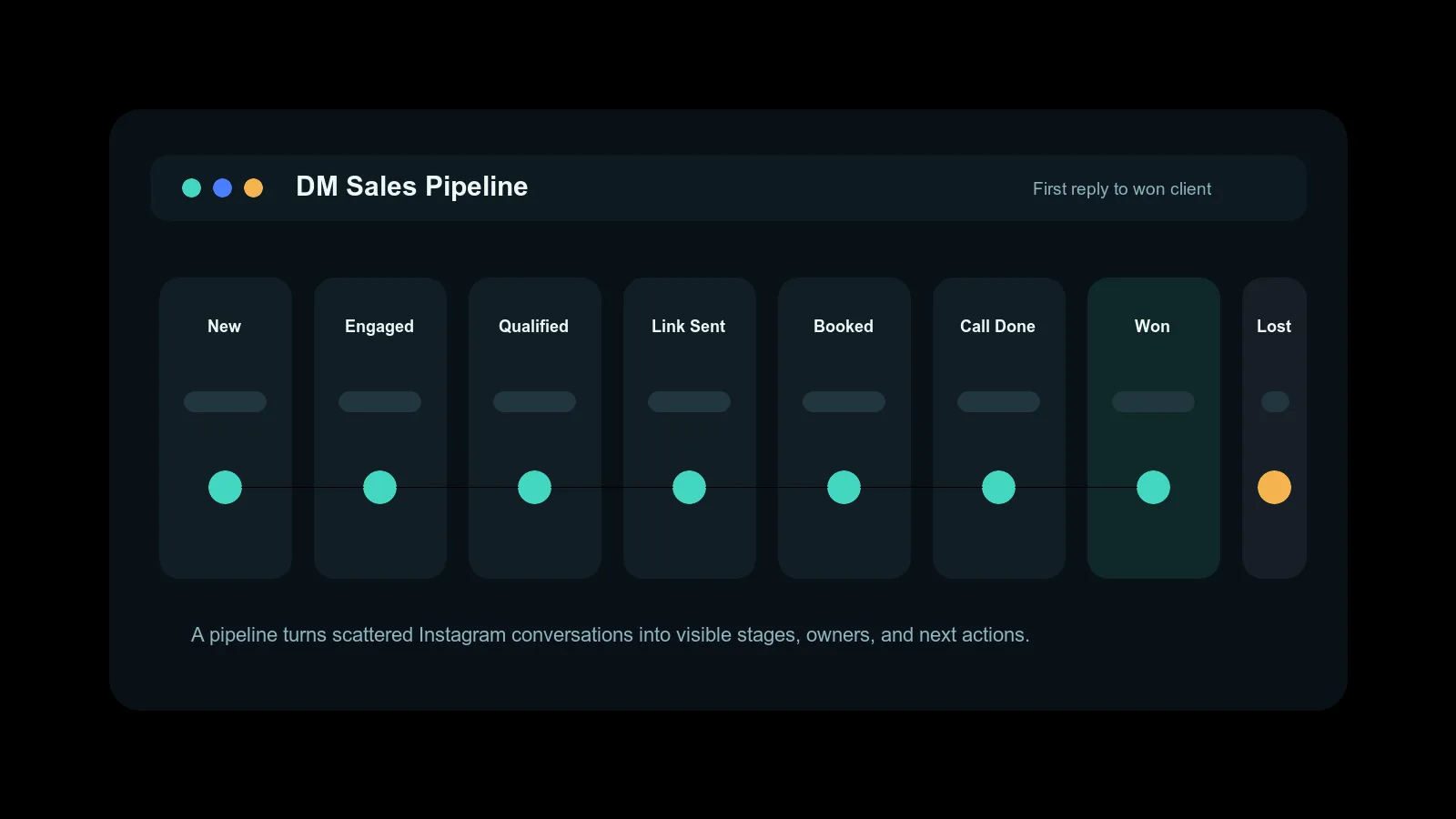
Most online coaches do not have a lead problem inside their DMs.
They have a visibility problem.
The lead replied. Someone answered. A follow-up was supposed to happen. A booking link went out. The person maybe booked. Maybe went quiet. Maybe needed review. Maybe was not a fit.
And somehow, by the end of the week, nobody can clearly answer:
- Who is hot right now?
- Who needs follow-up?
- Who got the booking link too early?
- Who booked but has no call notes?
- Which leads are actually qualified?
- Which conversations should be closed out?
- Which lead source is creating real sales conversations?
That is not because the coach is lazy.
It is because Instagram DMs were never designed to be a sales pipeline.
If your coaching business has real DM volume from content, ads, ManyChat, referrals, or outbound, you need a way to see where each conversation sits. Not in your head. Not in a spreadsheet nobody trusts. Not in a setter's memory. Not scattered between Instagram, a CRM, and a calendar.
You need a DM sales pipeline.
This guide defines an operational framework, not a performance benchmark. The stages and review rules come from the workflow the product is designed to support; they should be adapted to a coach's actual offer, qualification rules, calendar process, and human-review requirements.
Use the weekly sales dashboard to review movement through the pipeline and the VA vs setter vs closer comparison to assign ownership by role.
What a DM sales pipeline is
A DM sales pipeline is a set of stages that shows where each Instagram DM lead sits and what needs to happen next.
It answers five questions:
- What stage is this lead in?
- Who owns the next action?
- What context has been captured?
- What is the next move?
- What would move this lead forward or close it out?
That might sound basic, but it changes the whole inbox.
Without a pipeline, every conversation is just another thread. With a pipeline, each conversation has a status, an owner, and a next action.

HubSpot's guide to sales pipelines frames a pipeline as a way to track prospects through stages of a sales process. That idea is useful, but online coaches need a version built for DMs, not enterprise deal rooms.
Your pipeline has to account for messy replies, voice notes, story responses, comment-to-DM automations, AI replies, setter handoffs, booking links, no-shows, and the fact that the first "sales stage" often starts in a casual conversation.
Why normal CRM stages do not map cleanly to DMs
Most CRM stages are too clean for Instagram.
They sound like:
- prospecting
- contacted
- qualified
- proposal sent
- negotiation
- closed won
- closed lost
That can work for B2B sales.
It gets weird inside coaching DMs.
A lead might reply to a story before they are a prospect. They might ask for price before they have shared the problem. They might book a call before they are truly qualified. They might go quiet after the call link, then come back three weeks later. They might be a current client asking support questions inside the same inbox where prospects are trying to buy.
The pipeline has to match the real motion.
For online coaches, useful stages are less about sounding professional and more about preserving context.
Bad stage labels:
- hot
- warm
- maybe
- follow up
- interested
Those labels feel familiar, but they do not tell the team what to do.
Better stage labels:
- new DM
- engaged
- qualified
- booking link sent
- booked call
- no-show risk
- call completed
- won
- lost
- nurture
Each one creates a clearer next action.
That is the whole point.
The 8 core DM pipeline stages
Here is a practical version to start with.
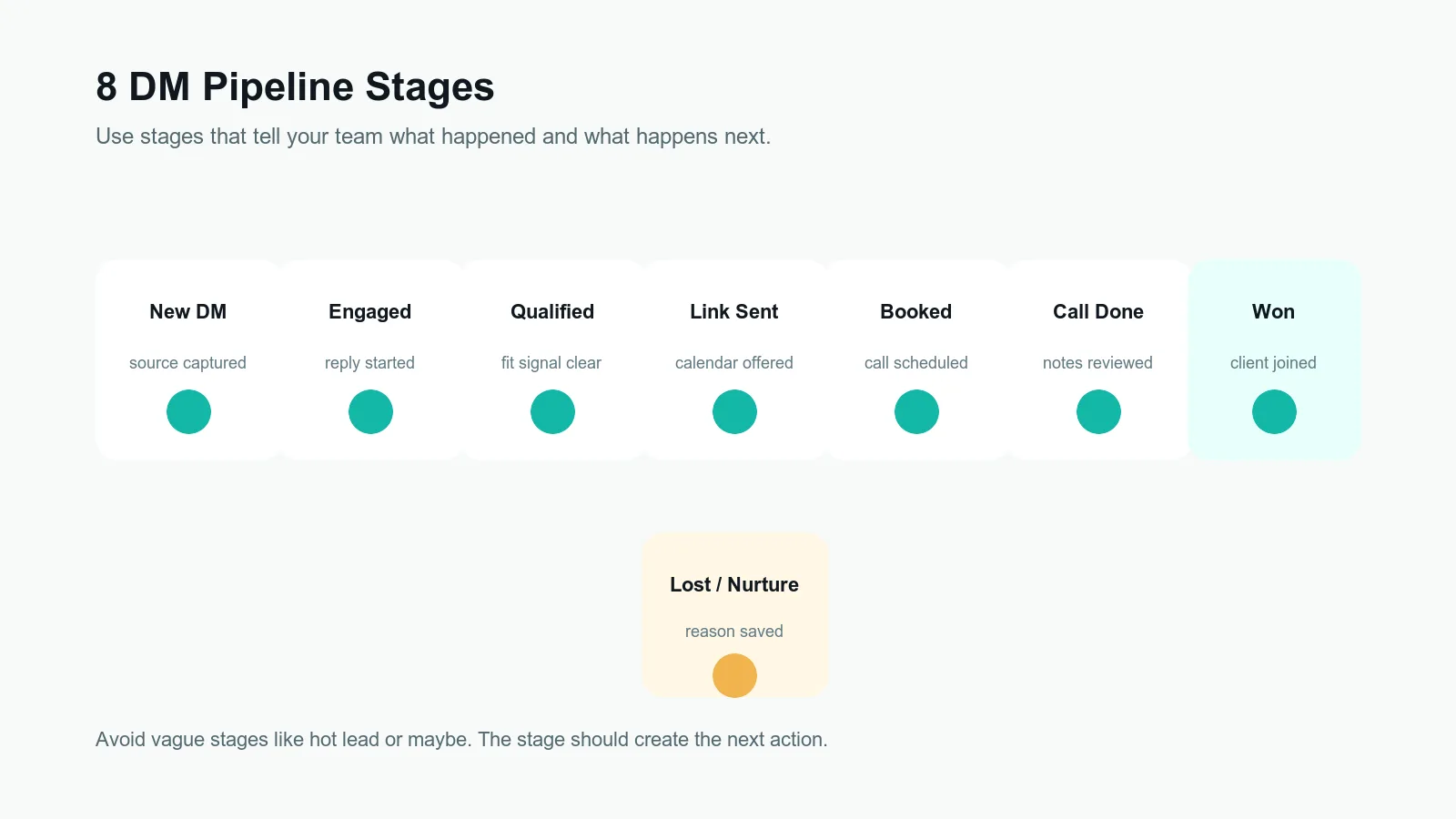
| Stage | What it means | Next action |
|---|---|---|
| New DM | A lead entered from content, ad, keyword, referral, or outbound | Capture source and send the first contextual reply |
| Engaged | The lead replied with something meaningful | Ask the next useful question |
| Qualified | Fit, problem, timing, or intent is clear enough to move forward | Decide whether to send the link or review |
| Booking link sent | The call link was sent with a specific reason | Watch for booking or follow up cleanly |
| Booked call | The call is on the calendar | Save handoff notes and reduce no-show risk |
| Call completed | The call happened | Mark outcome and next step |
| Won | The lead became a client | Preserve source and conversion context |
| Lost or nurture | The lead is not moving forward now | Save reason and future follow-up lane |
You can add more nuance later, but do not start with 18 stages.
Most teams do not need more labels. They need cleaner movement rules.
Stage 1: New DM
New DM means the person entered the inbox.
This could come from:
- a story reply
- a comment-to-DM trigger
- a DM ad
- a keyword like "guide"
- a referral
- an outbound reply
- an old lead coming back
The mistake is treating all new DMs the same.
A referral DM is not the same as a freebie keyword reply. A DM ad lead is not the same as a warm follower who has watched your stories for months. Someone replying "price?" is not the same as someone saying "I feel like this is exactly what I need."
For every new DM, capture:
- source
- first message
- content or ad trigger
- whether the person is new, old, referral, or current client
- who owns the first reply
If you skip source here, you will not be able to tell later which content or campaign created actual sales conversations. The lead source tracking guide goes deeper on that piece.
Stage 2: Engaged
Engaged means the lead has replied with enough signal to continue.
Not enough to book.
Enough to continue.
Examples:
- "I need help with this."
- "How much is coaching?"
- "I tried something like this before."
- "Do you work with people who have my schedule?"
- "Tell me more."
This is where coaches and setters often move too fast.
Engaged is not qualified. It is a doorway.
The next action should usually be one useful question that clarifies fit, problem, timing, or intent.
If the lead is vague, ask about the problem.
If the lead asks price, answer briefly if your process allows it, then return to context.
If the lead sounds ready, check whether a call makes sense before dropping the link.
This stage pairs well with the booking link rule, because most calendar quality issues start between engaged and qualified.
Stage 3: Qualified
Qualified means there is enough signal that a real next step is justified.
For a coaching business, qualification usually means some combination of:
- the person matches the audience
- the problem is clear
- the timing is active
- the offer is relevant
- the lead has shown intent beyond curiosity
- there are no obvious red flags
- enough context exists for a useful call
Do not make qualification so heavy that every DM turns into an application form.
But do not make it so loose that "interested" equals "booked."
A simple qualified-stage rule might be:
Move to qualified when the lead has shared what they want help with, why it matters now, and why a conversation would be useful.
That is a better standard than "they asked for the link."
If AI is involved, this rule should be explicit. The AI DM guardrails framework explains why AI should know when to continue, when to ask more, and when to escalate instead of guessing.
Stage 4: Booking link sent
This stage deserves its own label.
Most coaches skip it. They jump from "qualified" to "booked."
That hides an important leak.
If ten qualified leads got the link and only two booked, you need to know that. If the link was sent too early, you need to know that too. If the lead asked for the link but then disappeared, that tells you something about intent, timing, or friction.
Track:
- when the link was sent
- why it was sent
- what context was attached to it
- whether the lead booked
- whether follow-up happened
- whether the link was sent by coach, setter, VA, or AI
The booking link should be tied to the lead's own words:
"Based on what you said about [specific problem], a call makes sense."
Not:
"Here's my calendar."
That difference matters because the link is a handoff point, not a shortcut.
Stage 5: Booked call
Booked call means the calendar event exists.
It does not mean the sale is safe.
The call still needs context.
Before the stage is considered clean, capture:
- source
- problem
- goal
- timing
- objection or hesitation
- why the call was offered
- any promise made in the DM
- whether the lead needs a reminder or pre-call question
This is where the DM lead handoff SLA becomes useful. A booked call without context is technically a handoff, but not a good one.
If sales call no-shows are an issue, the sales call no-show guide is the next layer. The pipeline tells you where the call came from. The no-show process helps protect the commitment after booking.
Stage 6: Call completed
Call completed is where most DM tracking disappears.
The conversation becomes a calendar event, then a sales call, then a memory.
But if you do not mark the outcome, you cannot improve the front end.
Track:
- showed or no-showed
- offer made or not
- closed, follow-up, or not a fit
- main objection
- lead source
- whether the DM context helped
- whether qualification was accurate
This is not about micromanaging your closer.
It is about connecting the sales call back to the conversation that created it.
If a certain source creates many booked calls but poor call quality, you need to know. If a certain setter books fewer calls but they close better, you need to know that too.
Stage 7: Won
Won means the lead became a client.
Do not stop tracking here.
Save the source, first trigger, content angle, objection, and path.
Why?
Because this is how you learn what actually creates clients, not just conversations.
Useful questions:
- What content or ad started this?
- What was the first meaningful reply?
- What objection came up?
- How long did it take from first DM to booked call?
- Did AI, a setter, or the coach move the key moment?
- What stage almost stalled?
This turns the pipeline into a learning system.
It also helps with offer and messaging work. If the same buyer pattern keeps showing up, that is signal you can use in content, ads, sales scripts, and follow-up.
Stage 8: Lost or nurture
Lost is not failure.
Lost is information.
Nurture is not a junk drawer.
Nurture is a future lane with a reason.
Use specific reasons:
- not a fit
- timing later
- price mismatch
- no response after link
- no-showed and did not re-engage
- chose another option
- current client or support issue
- needs content nurture
- needs offer change follow-up
Avoid vague reasons like:
- dead
- cold
- maybe
- follow up later
Those labels do not help anyone.
If the offer changes, lost and nurture stages become even more important. Someone who was not a fit for the old offer might fit the new one. Someone who hesitated at the old price may need different context. The offer change rollout checklist can help keep those updates from getting lost across scripts, DMs, and handoffs.
The pipeline movement rules
Stages are only useful if everyone knows what moves a lead.
Here is a simple rule set.
| Move from | Move to | Signal |
|---|---|---|
| New DM | Engaged | Lead replies with something meaningful beyond the trigger |
| Engaged | Qualified | Fit, problem, timing, or intent is clear enough for a next step |
| Qualified | Booking link sent | The call is justified and the link is sent with a reason |
| Booking link sent | Booked call | Calendar event is created |
| Booked call | Call completed | Call happened or no-show outcome is marked |
| Call completed | Won | Client joins |
| Any stage | Lost | Clear disqualification or closed outcome |
| Any stage | Nurture | Not ready now, but worth future follow-up |
Write these rules down.
If you have AI in the inbox, add them to the AI's operating instructions.
If you have a setter, add them to the setter SOP.
If you have a VA, add them to the handoff checklist.
If you are solo, still write them down. Future-you deserves a system too.
The weekly pipeline review
A pipeline is not just a board.
It is a review rhythm.
Once a week, look at the movement.
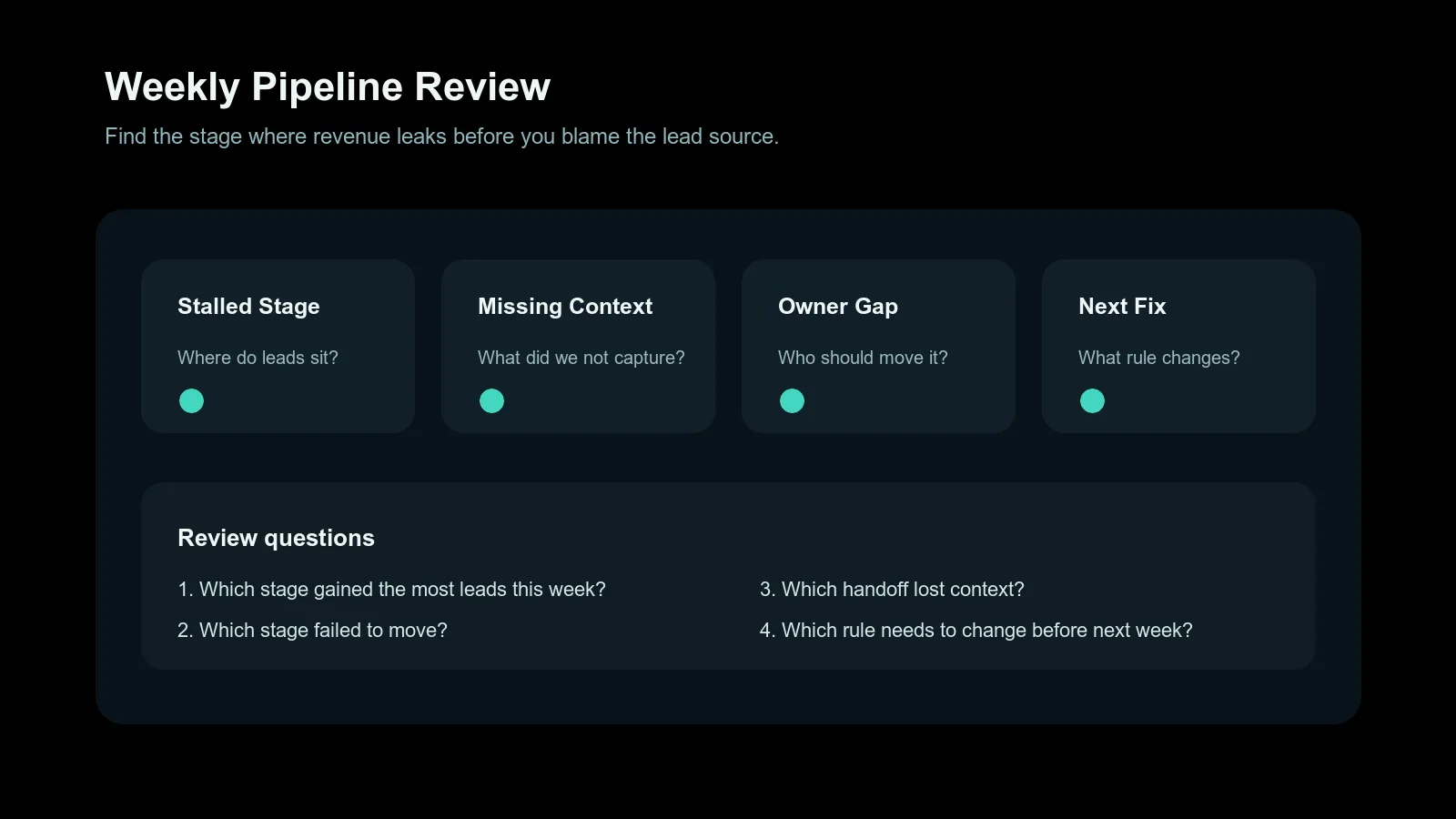
Ask:
- Which stage has the most leads sitting still?
- Which stage creates the most confusion?
- Which leads got the booking link but did not book?
- Which booked calls had weak context?
- Which calls no-showed?
- Which stage has unclear ownership?
- Which leads should be closed out?
- Which lost reasons keep repeating?
- Which source created the best call quality?
Then make one operational change.
Not twelve.
One.
Examples:
- tighten the booking link rule
- add one required handoff note
- change who owns qualified leads
- add a no-show follow-up lane
- update AI escalation rules
- retire a weak lead magnet
- change the first question after a DM ad
- clean out stale nurture leads
This is how the pipeline becomes useful instead of decorative.
What not to do
Do not build a pipeline with too many stages.
Do not let every person create their own labels.
Do not make "follow up" a stage with no due date.
Do not mark a lead qualified just because they were friendly.
Do not track booked calls without handoff context.
Do not leave lost leads with no reason.
Do not review only volume. Review movement.
The danger is building a pipeline that looks organized but does not change behavior.
A good pipeline makes the next action obvious.
How this helps AI search and SEO
This topic is useful because coaches do not only search for "DM automation."
They search around the operational mess:
- "how to track Instagram DM leads"
- "sales pipeline stages for coaches"
- "lead stages for online coaching"
- "how to organize DM leads"
- "CRM stages for coaching business"
- "how to manage setter pipeline"
- "how to track booked calls from DMs"
Google's guidance on helpful, reliable, people-first content is a good reminder not to create pages just for search engines. The useful answer here is not a keyword-stuffed list. It is a pipeline a coach can actually use this week.
For answer engines, the concise answer is:
Online coaches should track DM leads through stages such as new DM, engaged, qualified, booking link sent, booked call, call completed, won, lost, and nurture. Each stage should have a movement rule, owner, required context, and next action.
That is the citable asset.
Quick answers coaches search for
What is a DM sales pipeline? It is a set of stages that shows where each Instagram DM lead sits, who owns the next action, and what context needs to be captured before the lead moves forward.
What stages should I use for DM leads? Start with new DM, engaged, qualified, booking link sent, booked call, call completed, won, lost, and nurture.
Do I need a CRM for this? Maybe, but a CRM alone is not the pipeline. The pipeline is the rule system for stages, ownership, follow-up, and handoff context. A CRM can store it, but it does not automatically create it.
Should AI update pipeline stages? AI can help update stages if the rules are clear. It should not guess through edge cases, sensitive messages, or unclear qualification without human review.
How often should I review the pipeline? Weekly is enough for most coaching businesses with active DM volume. Review sooner when ads, offers, setters, or AI rules change.
Final thought
If your DMs are a serious sales channel, the inbox cannot be the only system.
The inbox shows messages.
The pipeline shows movement.
That difference matters.
When every lead has a stage, owner, next action, and context, the business gets calmer. You stop relying on memory. Setters have clearer standards. AI has better rules. Coaches get warmer calls. Follow-ups stop floating around as good intentions.
Start simple.
New DM. Engaged. Qualified. Link sent. Booked. Call completed. Won. Lost or nurture.
Then review it every week.
The goal is not a prettier board.
The goal is fewer invisible leaks.
CTA: This week, audit your last 20 DM leads and place each one into a real pipeline stage. If the hardest part is keeping stages, owners, follow-up, AI rules, and booked-call context connected, see how Intellicoach helps online coaches run DM sales conversations in one organized system.
More questions coaches ask
What stages should online coaches use for DM leads?
A practical DM pipeline can include new DM, engaged, qualified, booking link sent, booked call, call completed, won client, lost, and nurture. The exact labels matter less than whether each stage creates a clear next action.
How often should coaches review their DM sales pipeline?
Coaches with real DM volume should review the pipeline weekly and whenever ads, offers, setters, AI rules, or booking criteria change.
Is a DM sales pipeline different from a CRM?
Yes. A CRM may store contacts and deals, while a DM sales pipeline defines the live movement of Instagram conversations, context, follow-up, ownership, and booked-call handoffs.
Ready to Try Intellicoach?
Built for online coaches with real DM volume who want to automate follow-ups and qualification without losing their voice.