
The Lead Reactivation Sprint: How Online Coaches Reopen Old DMs Without Starting From Scratch
A practical lead reactivation framework for online coaches who want to reopen qualified old DMs with context, clear ownership, and a respectful next step.
You have old DMs that are not really cold.
They are just buried under everything that arrived after them: new ad replies, story responses, active clients, setter questions, booking links, and the normal mess of a coaching business that is actually getting attention.
Some of those conversations were never a fit. Some clearly asked not to be contacted. Some need a better offer, a different season, or a human conversation rather than another nudge.
But there is usually a smaller group worth revisiting: people who had a real conversation, named a problem, and then paused because life, timing, logistics, or decision friction got in the way.
The mistake is treating all old leads the same. Either the business ignores them forever, or someone sends a broad "just checking in" blast that makes every past conversation feel disposable.
There is a better middle ground: a lead reactivation sprint.
The short definition
A lead reactivation sprint is a short, deliberate campaign to review one qualified group of old conversations, reopen the right ones with context, and give every response a clear next owner and next step.
It is not a full-database blast. It is not an excuse to keep messaging people who said no. And it is not a way to make up for a weak first-response system.
It is an operating habit for the coaching business that already has DM volume and wants to stop treating every paused conversation as permanently dead.
That distinction matters. The DM sales pipeline should include a nurture or paused lane, but a label alone does nothing. A reactivation sprint is the moment you decide whether that lane contains real opportunities, people who need a different path, or records you can close with confidence.
Why old DMs deserve a system, not a random follow-up day
When a coach says, "I should follow up with old leads," that task usually stays vague for a reason. The list feels too big, the context is scattered, and nobody is sure what to say without sounding needy.
So it gets postponed until the next quiet week. Then the quiet week never shows up.
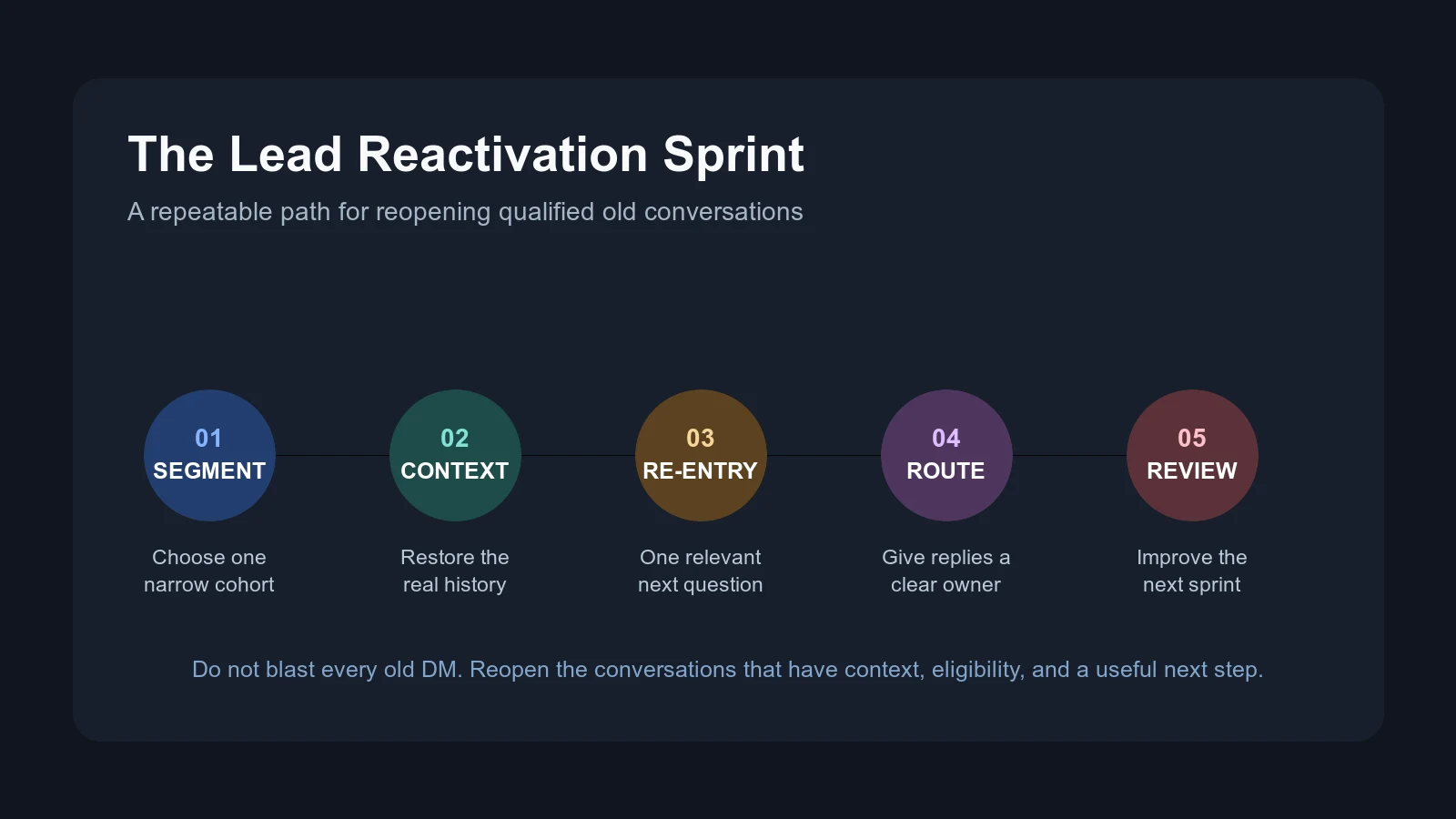
That is why the right unit is a sprint, not a permanent intention. You choose one narrow cohort, one review window, one standard for what counts as eligible, and one set of routing rules for replies.
The goal is not to squeeze a booking out of every old DM. The goal is to make a good decision about every conversation you touch.
The sequence below keeps that work contained.
What this fixes
A sprint makes four hidden problems visible:
- Good conversations without a next date. The lead said "not now," but nobody recorded when or why to revisit.
- Booking-link limbo. The person was qualified enough to receive a link, but there was no owner for the next move after they did not book.
- Lost context. A setter, VA, or coach can see a thread, but cannot quickly tell what mattered to the person.
- False pipeline health. The dashboard says there are 200 old leads, but no one knows which ones are eligible, which ones are not a fit, or which ones simply need nurture.
This is where the Online Coach CRM Fields Checklist becomes practical. You do not need a giant CRM. You need enough saved context to know whether an old conversation deserves a respectful re-entry.
Start with eligibility, not copy
Before you think about wording, decide who should not be in the sprint.
Exclude a lead when any of the following is true:
- They asked not to be contacted or clearly opted out.
- They were explicitly not a fit for your offer.
- The thread is mainly a current-client support issue.
- There is an unresolved complaint, payment issue, or sensitive conversation that needs owner review first.
- You cannot see enough history to know why you would contact them now.
- The only signal was a low-intent engagement with no real coaching conversation.
This is not just good manners. It protects your brand and keeps the campaign useful. A reactivation list should be made of people you can contact because you remember the relationship context, not everyone whose username happens to be in a spreadsheet.
For Instagram conversations in particular, stay within the platform's rules and respect a clear request to stop. The operational standard is simple: prior relationship, relevant context, and a useful reason to re-open the conversation.
The four old-lead segments worth separating
The fastest way to make reactivation feel robotic is to send the same message to people who stopped at completely different points.
Use four segments instead.
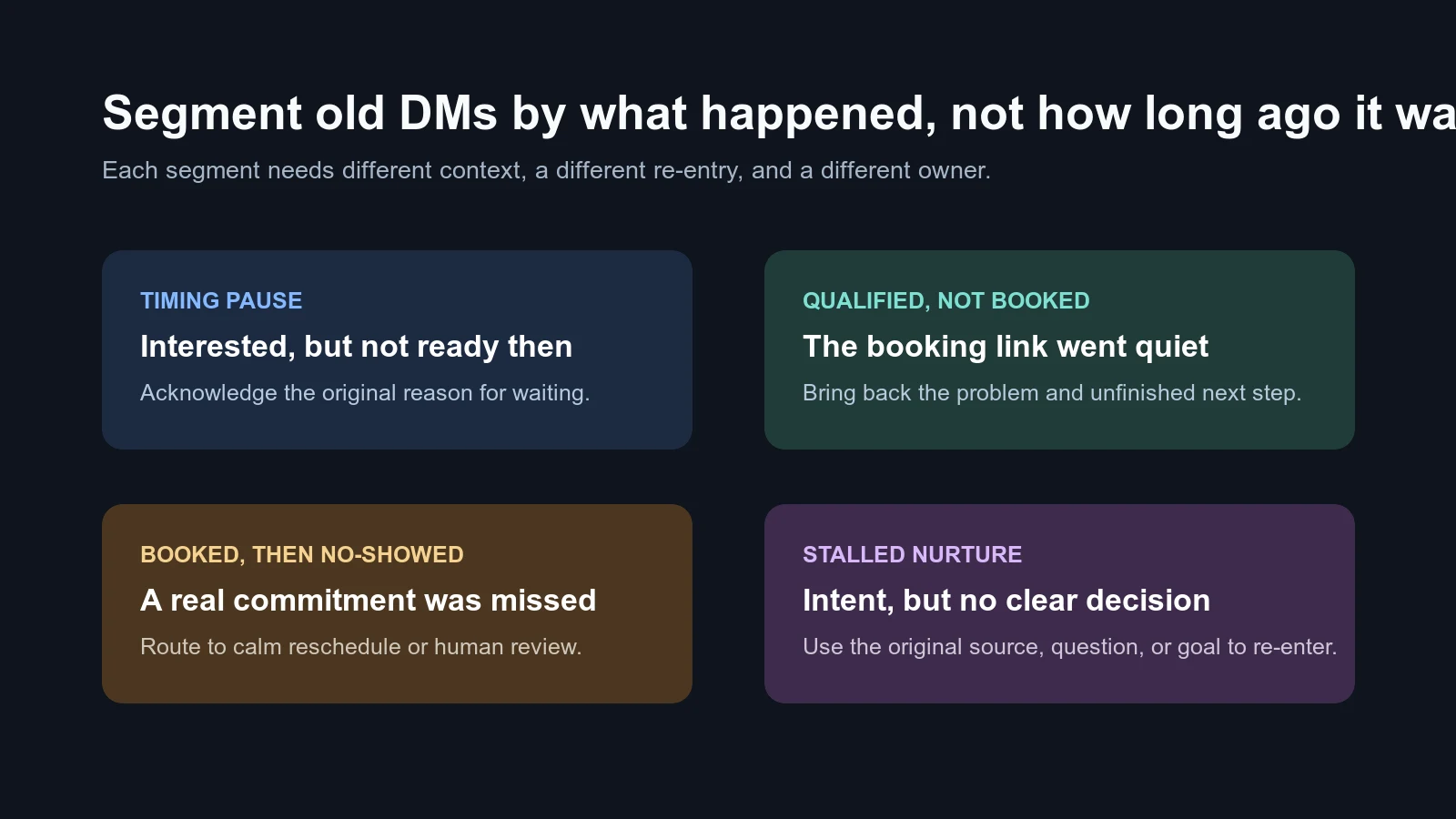
| Segment | What happened before | What the re-entry needs to acknowledge | Best next lane |
|---|---|---|---|
| Timing pause | They were interested but said the timing, cash flow, schedule, or priority was not right | Their original reason for waiting, without cornering them | Setter qualification or nurture |
| Qualified, not booked | The conversation was real and the booking link went out, but no call was booked | The problem they came in with and the unfinished next step | AI or setter follow-up, then booking if interest is still live |
| Booked, then no-showed | They chose a call but did not attend or did not reschedule | The missed commitment without guilt or a generic reset | Setter or coach review |
| Stalled nurture | They had intent but the conversation lost momentum before a clear decision | The content, source, question, or goal that started the thread | AI or setter for a contextual re-entry |
This is deliberately more useful than a bucket called "cold lead."
"Cold" tells you how long it has been. It does not tell you what happened, what they already know, or what the next message should do.
If you do not know the segment, go back to the conversation before you write a word. The DM conversation quality audit is a good companion here: it helps you review whether the original exchange had enough clarity, warmth, and forward movement to justify reopening.
Restore the context before you reopen the conversation
The person should not have to remember the entire DM thread for you.
Before any outreach, capture a short reactivation brief for each eligible lead:
- source: the Reel, story, DM ad, referral, keyword, or other entry point
- stated goal or problem
- prior obstacle or objection
- last meaningful message, not just the last timestamp
- pipeline stage when the thread paused
- reason this person is being contacted now
- current owner and allowed next action
This can be a few clean fields, not a novel. The point is to make the re-entry feel like a continuation, not a strange fresh pitch months later.
For example, "Lead from April" is not useful context. "Came from the strength-training story, wanted help with a 12-week event goal, said travel made coaching hard to start, asked to revisit after a work deadline" is useful context.
The first version produces generic outreach. The second gives a team member or AI a reason to be specific without pretending to be a close friend.
That is also why lead routing matters before you press send. Some prior conversations can safely start with an AI-assisted re-entry. Others, such as referrals, high-ticket objections, sensitive health contexts, or a thread where the coach made a specific promise, should move straight to human review.
The re-entry rule: make it easy to continue, not hard to remember
The worst old-lead message is not necessarily aggressive. It is usually blank.
"Just checking in."
"Still interested?"
"Did you see my last message?"
Those messages make the lead do the work. They have to remember the conversation, decide whether you care, and figure out what they are meant to say back.
A useful re-entry has three parts:
- A real reference point. Mention the original problem, timing note, source, or conversation stage.
- A credible reason to reconnect now. This can be a meaningful offer update, a relevant resource, a season-specific change, or simply the follow-up date you agreed on.
- One low-friction question. Ask something that lets them answer honestly, including "not right now."
The aim is not a clever script. It is a natural door back into a conversation.
HBR's analysis of the short life of online sales leads is useful context here: rapid, relevant first response still matters. Reactivation should not become an excuse to let fresh leads sit. It is a separate system for people whose timing changed after a real conversation.
Keep the message proportional to the history
A lead who asked one question six months ago does not need a paragraph about their transformation. A lead who had a detailed qualification conversation does not need to be treated like they have never heard of your offer.
Match the message to what actually happened:
- Light history: acknowledge the entry point, offer a useful next step, and leave room for a no.
- Strong prior intent: reference the goal or pause point, then ask whether the situation has changed.
- Prior booking or no-show: acknowledge the missed step calmly and route to a clear reschedule or review path.
- Complex or sensitive history: do not automate the nuance. Give it to the person who can make the right call.
That is how you avoid the two bad extremes: pretending the past conversation never happened, or acting more familiar than the relationship supports.
What happens after someone replies matters more than the first message
Reactivation fails when a reply arrives and the team treats it as a small win rather than a live sales moment.
Every reply needs a destination.
| If the lead replies with... | The system should do... |
|---|---|
| Clear new interest | Restore the old context, qualify only what has changed, and move toward the appropriate booking rule |
| "Not now" with a real timing reason | Capture the reason and a future revisit date, rather than restarting the same sequence next week |
| A new objection | Route to a trained setter or coach review with the previous objection visible |
| A request to stop | Respect it, close the reactivation path, and remove them from future outreach |
| No response | Record the attempt and stop according to your own contact rules; do not keep the thread in active limbo |
This is where a sprint becomes more than a batch of messages. You are cleaning the pipeline while you reopen it.
The DM lead handoff SLA gives this work some teeth. It defines who owns the reply, what context must travel with it, and how long the lead should wait before the next action happens. Without that, a reactivated lead can become a new version of the exact leak you were trying to fix.
Use AI for the repetitive preparation, not the judgment you have not defined
AI can be genuinely useful in a reactivation sprint when the business already has an operating system behind it.
It can help:
- find leads that match a clear segment
- summarize the previous conversation into a short brief
- surface the source, problem, stage, and last meaningful message
- draft a first message in the coach's actual voice for review
- tag replies and move obvious next actions into the right lane
- flag missing context before outreach happens
It should not guess its way through a sensitive conversation or decide that someone is ready to book because they sent a polite reply.
The rule is simple: automate the retrieval and repeatable movement. Keep judgment-heavy decisions with the coach or a trained setter. The broader Instagram DM automation examples show where that split tends to work well across the full DM system.
Run the sprint in a way your team can repeat
For the first pass, pick a cohort small enough that you can review the outcomes. For many coaches, that may mean one source or one pipeline segment, not every lead since last year.
Then track five things:
- total eligible leads reviewed
- contacts excluded and why
- re-entry messages sent
- replies by segment
- outcomes: qualified, booked, nurture, not fit, no further outreach
Do not judge the sprint only by booked calls. A strong sprint also improves your records. You may discover that a whole segment should have been closed months ago, that a common timing objection needs a different nurture path, or that leads from a certain source need a different first conversation.
Bring those observations into the weekly sales dashboard. Over time, the sprint tells you where your active pipeline is creating future "old lead" problems.
The takeaway
Old DMs are not a free-for-all list of people to chase. They are a record of prior conversations that deserve better sorting.
The best reactivation systems do three things well: they contact only people who are eligible, they preserve the context that makes the conversation worth reopening, and they give every reply a clear path forward.
Start with one narrow cohort this week. Review the history. Segment it. Remove the people you should not contact. Reopen the conversations that have a genuine reason to continue. Then use what you learn to improve the way fresh leads move through your system today.
CTA: Audit one paused DM segment this week. If the hard part is keeping conversation context, follow-up dates, routing, and human review connected as volume grows, see how Intellicoach helps online coaches run DM sales conversations with more control.
Frequently asked questions
What is lead reactivation for an online coaching business?
Lead reactivation is a structured process for reviewing qualified past conversations, deciding which people still deserve a respectful follow-up, reopening the DM with the original context, and routing every reply to a clear next step. It is not a mass message to every person who has ever engaged.
How should online coaches follow up with old Instagram DM leads?
Start by separating old DMs by prior stage and reason for stalling. Use the original conversation to make the message easy to re-enter, give the person a real reason to reply, ask one useful question, and respect a clear no or opt-out. Do not restart qualified conversations as if they are brand new leads.
Which old coaching leads are worth reactivating?
Prioritize people who had a real coaching conversation, named a goal or problem, showed fit, or paused because of timing. Exclude people who opted out, were clearly not a fit, were existing-client support issues, or lack enough context to contact respectfully.
Can AI help reactivate old DM leads?
AI can help find relevant context, draft a voice-aligned first message, tag replies, and route the next action. A coach or trained setter should review sensitive history, unclear fit, pricing exceptions, health-related conversations, and any situation where an old thread could be misread.
Ready to Try Intellicoach?
Built for online coaches with real DM volume who want to automate follow-ups and qualification without losing their voice.