
The Booking Link Rule: When Online Coaches Should Send the Calendar Link in DMs
A practical booking link rule for online coaches deciding when to send a calendar link in Instagram DMs, what to qualify first, and how to avoid weak-fit calls and no-show risk.
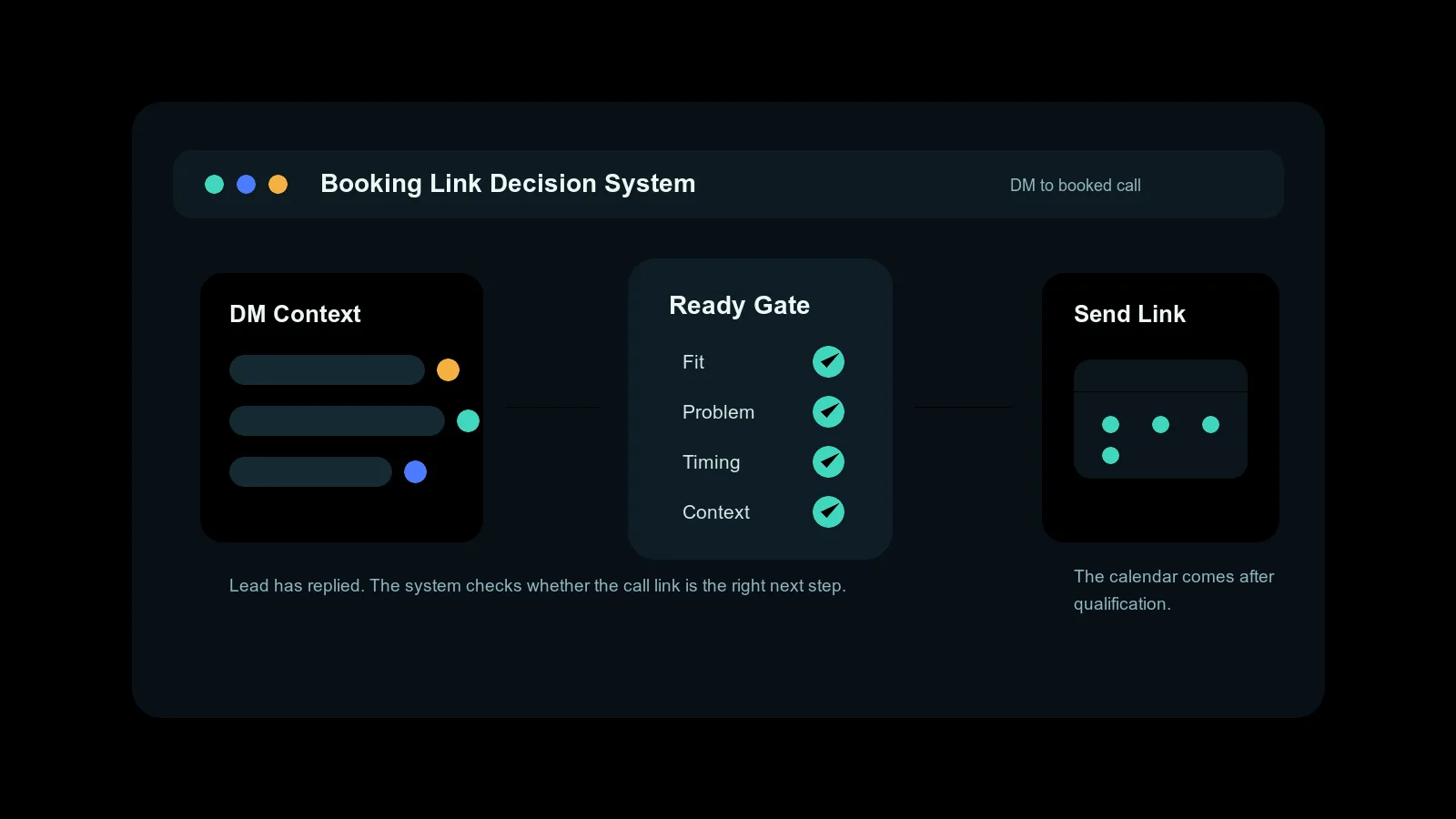
The booking link feels like progress.
Someone replies. They sound interested. They ask a good question. Maybe they even say, "Can I book a call?"
So you send the link.
Sometimes that is the right move.
Sometimes it is the moment the conversation gets weaker.
If you run an online coaching business with real DM volume, the calendar link is not just a scheduling convenience. It is a handoff point. It moves the lead from a private, contextual conversation into a scheduled sales process. If you send it too late, you create friction. If you send it too early, you create weak-fit calls, vague calls, no-shows, and calls where the coach has to restart the whole conversation from scratch.
The fix is not to hide your calendar link forever.
The fix is to use a booking link rule.
The simple rule
Send the booking link when the lead has shown enough fit, problem clarity, timing, intent, and context for the call to be useful.
If one of those is missing, ask one more useful question before sending the link.
That is the whole rule.
Not complicated. Not corporate. Not a 14-step intake process.
Just enough structure to stop treating every interested reply like a booked-call opportunity.

This is especially important if you have a VA, setter, or AI assistant helping in DMs. The more people or tools can send the link, the clearer the rule needs to be.
If you just created an AI setter workflow, pair this with the AI setter onboarding checklist. The AI should not only know your booking link. It should know when the link is appropriate.
Why sending the link too early creates messy calls
A booking link is easy to send, which is why it gets overused.
The lead says:
- "How much is it?"
- "Tell me more."
- "I think I need help."
- "Do you have calls available?"
- "Can you send the link?"
Those can be buying signals, but they are not always booking signals.
Interest means the lead is paying attention. Qualification means a call is worth both people's time.
When the link goes out too early, a few things happen.
First, the call feels optional. The lead did not say much out loud before booking, so there is not much commitment attached to the call.
Second, the coach gets less context. The calendar event has a name and a time, but not the story behind it.
Third, weak-fit leads sneak through. They might be curious, but not actually ready, not a fit, or not aligned with the offer.
Fourth, the setter or AI learns the wrong behavior. If every interested reply gets a link, your system slowly optimizes for calendar volume instead of call quality.
This connects directly to why coaching sales calls no-show. Some no-shows happen after booking, but the risk often starts before the link is sent.
The five checks before the link
Use this as the simplest version of the booking link rule.
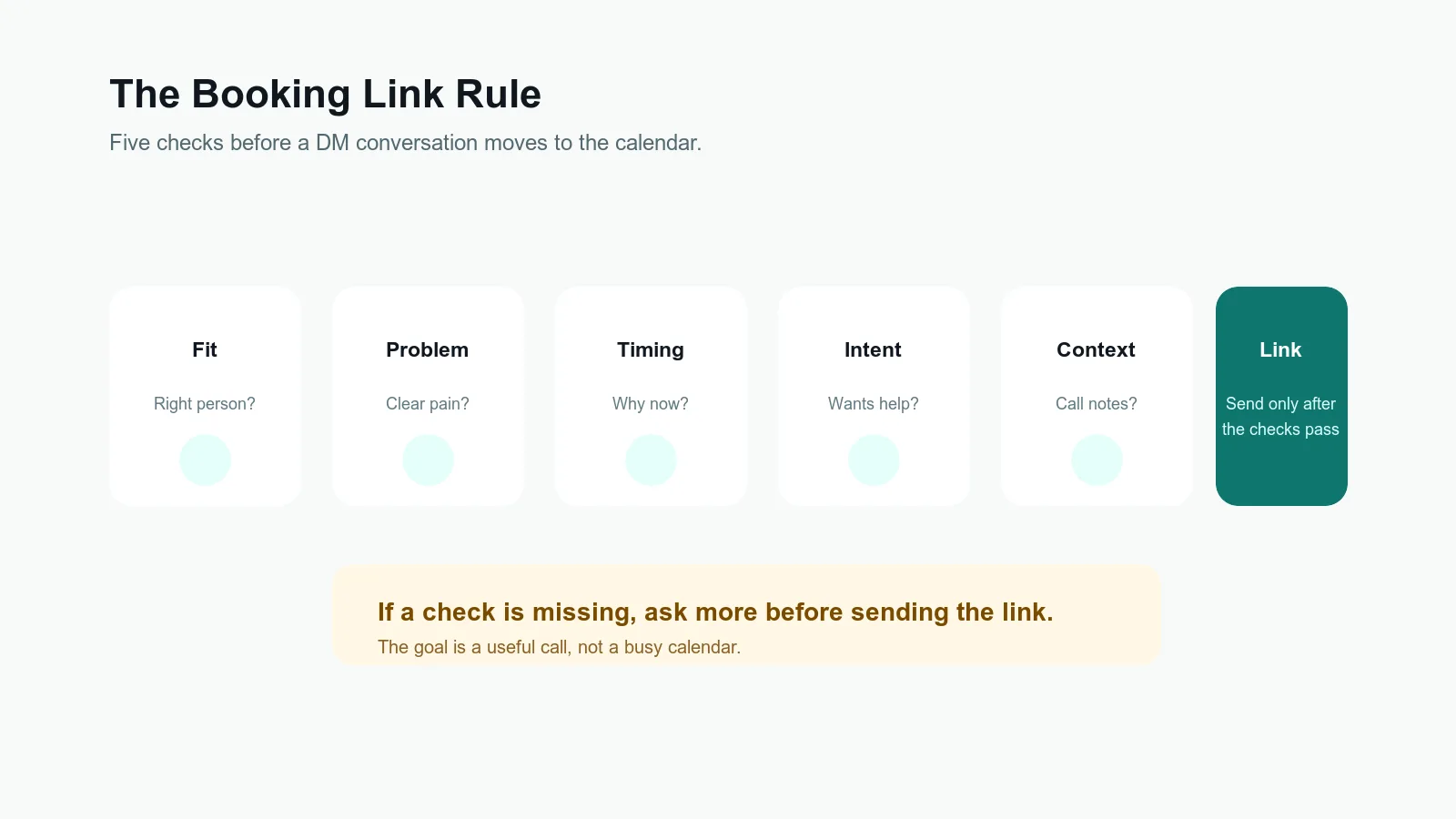
| Check | What you need to know | If missing, ask |
|---|---|---|
| Fit | Does this person broadly match who the offer is for? | "What are you looking for help with right now?" |
| Problem | Have they described a real problem, goal, or bottleneck? | "What feels like the main thing getting in the way?" |
| Timing | Is there a reason this matters now? | "Is this something you are trying to solve soon, or are you mostly exploring?" |
| Intent | Do they want help, or only information? | "Are you looking for support with this, or just trying to understand options?" |
| Context | Would the call start warm if booked now? | "Before I send the link, what should I know so the call is actually useful?" |
You do not need all five in essay form.
You just need enough signal to know the call has a reason.
Check 1: Fit
Fit comes first because not every interested person belongs on the calendar.
For a coaching business, fit might include:
- the type of person you help
- the problem you solve
- the stage they are in
- whether they can realistically use the offer
- whether they are looking for the kind of support you sell
- whether there are obvious red flags
A lead can be warm and still not be a fit.
Example:
Lead: "This looks awesome. Can I book a call?"
If you know nothing else, do not rush.
Better:
Coach or setter: "Potentially, yes. Quick context first so I do not send you to the wrong next step: what are you mainly trying to get help with right now?"
That reply keeps momentum without handing over the calendar blindly.
This is where a lot of teams need cleaner rules. If your setter is booking anyone who sounds interested, use the setter scorecard and make call quality part of the evaluation, not just booked-call count.
Check 2: Problem clarity
Problem clarity means the lead has said what is not working or what they want to change.
Not perfectly.
Not in a polished application answer.
Just enough that the call has a center of gravity.
Weak context:
Lead: "I want to learn more."
Better context:
Lead: "I keep losing weight and gaining it back, and I need something that works with my travel schedule."
Or for a business coach:
Lead: "I am getting calls from content, but I keep freezing when it is time to make the offer."
Those are different conversations. The call should not start the same way.
If the problem is vague, ask:
"What made this feel relevant right now?"
or:
"What is the main thing you would want help solving if we did talk?"
That one question usually gives you enough to decide whether to send the link or keep qualifying.
Check 3: Timing
Timing does not mean pressure.
It means whether the person is actively trying to solve the problem or just casually browsing.
You can ask this without sounding pushy:
"Is this something you are actively trying to solve soon, or more something you are researching for later?"
That question protects everyone.
If they say "later," you can nurture them without forcing a call.
If they say "now," the call has a reason.
This matters more as your calendar gets crowded. When you have real DM volume, every weak-fit call pushes another conversation down the queue. The goal is not to act scarce. The goal is to protect the parts of your schedule that actually move the business.
Check 4: Intent
Intent answers a slightly different question than timing.
Timing is "when."
Intent is "what do they want from you?"
Some leads want:
- a free answer
- a quick price check
- proof that you work with people like them
- a resource
- reassurance
- a real conversation about getting help
Only the last one clearly belongs on the calendar.
This does not mean you punish people for asking questions. Good buyers ask questions.
It means you do not use the booking link as a way to avoid answering.
If someone asks about price, you may need to answer briefly and return to fit:
"The coaching starts at [approved range or positioning], but I would only send you to a call if it actually fits what you need. What are you trying to change right now?"
If someone asks whether you work with their situation:
"Possibly. I would want to understand the context first. What have you tried so far?"
Intent becomes clearer when the lead gives you something real back.
Check 5: Handoff context
This is the check most coaches skip.
Before the booking link goes out, ask:
If this person books right now, will the call start warm?
Warm does not mean "easy close." It means the coach, closer, or setter can open the call with context instead of starting from zero.
The handoff should include:
- lead source
- why they reached out
- problem or goal
- timing signal
- objection or hesitation
- why the call was offered
- anything promised in the DM
If your call notes do not include that, the link is doing too much work.
This is exactly what the DM lead handoff SLA is designed to fix. The booking link should move the lead into a better next step, not drop context on the floor.
Ask more vs send the link
Here is the cleanest split.
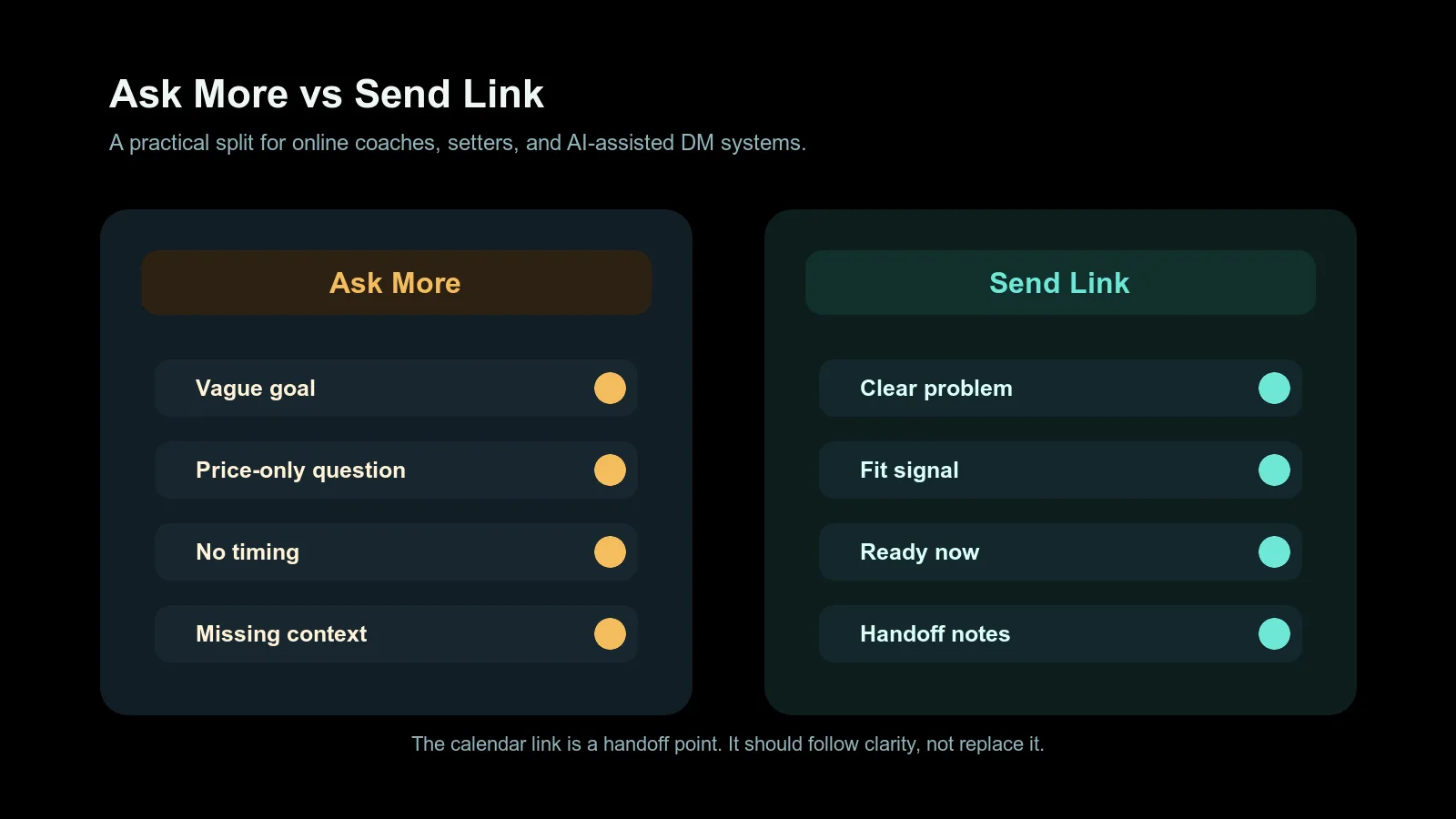
| Ask more when | Send the link when |
|---|---|
| The goal is vague | The problem is clear enough for a useful call |
| They only asked for price | Price has been framed and they still want the next step |
| You do not know why now matters | There is some urgency or active intent |
| They might not fit the offer | Fit is likely enough to justify a call |
| The thread has no call context | The handoff notes would make sense |
| The request feels like avoidance | The call feels like a natural next step |
The phrase "ask more" does not mean interrogate.
It means ask the one question that reveals whether the link is the next move.
What to say when sending the link
Do not just paste the calendar URL.
Anchor the link to the reason for the call.
Weak:
"Here's my calendar."
Better:
"Based on what you said about [specific problem], I think a call makes sense. Pick a time here and we can look at whether this is actually a fit."
Better:
"Yeah, this is probably worth a proper conversation. Use this link to grab a time, and I will make sure we focus on [specific goal] and what has been getting in the way."
Better:
"I can send it. Before you book, the call is mainly to see if this is a fit, not to pressure you into anything. If that feels good, here is the link."
That language does three things.
It makes the call specific. It lowers weird sales pressure. It reminds the lead why they are booking.
What to say when not sending the link yet
You do not need to make it awkward.
If the lead is not ready for the link, say so lightly.
Examples:
"I can send it if it makes sense. Quick question first so I do not point you to the wrong next step."
"Potentially, yes. I just want to understand what you are trying to solve before I send you to a call."
"Happy to. Before I do, what made this feel like something you want help with now?"
"I do not want to waste your time with a call if it is not the right fit. What have you tried so far?"
This is not friction for the sake of friction.
It is quality control.
How AI setters should use the booking link rule
If AI is helping in your DMs, the booking link rule needs to be explicit.
Do not give the AI only the URL.
Give it criteria.
For example:
| AI rule | What it prevents |
|---|---|
| Do not send the link after the first vague interest message | Booking curiosity instead of qualified intent |
| Ask one qualifying question if fit, problem, timing, or context is missing | Turning the conversation into a blind calendar handoff |
| Send the link only with a specific reason tied to the lead's own words | Generic booking prompts |
| Escalate if the lead asks for custom pricing, sensitive advice, or policy exceptions | AI guessing through judgment calls |
| Capture handoff notes after the link is sent | Calls starting cold |
This is where the AI DM guardrails framework matters. The AI should know the difference between "qualified enough to book," "needs one more question," and "needs human review."
For coaches still comparing categories, what an AI setter is explains the broader role. This post is the operational rule inside that role.
The calendar still matters
The booking link rule happens before the calendar.
But the calendar setup still matters after the link is sent.
Google Calendar's appointment schedule guide shows that booking pages can include availability, booking forms, email verification, buffer time, booking limits, confirmations, and reminders. Calendly's Workflows overview describes reminders, reconfirmations, follow-ups, and no-show rescheduling messages around scheduled meetings.
Those tools help protect the call after booking.
They do not replace qualification before booking.
Use the calendar layer for:
- availability
- buffer time
- booking questions
- confirmations
- reminders
- reschedule paths
- no-show follow-up
Use the DM layer for:
- fit
- problem clarity
- timing
- intent
- objection context
- warm handoff notes
When those two layers work together, the call feels like the natural next step instead of a random link drop.
The review loop
Once a week, review the calls that came from DMs.
Look at:
- no-shows
- reschedules
- weak-fit calls
- calls where the coach lacked context
- calls where the lead seemed confused about the offer
- calls that should have been nurture instead of booking
- strong calls where the handoff worked well
Then trace each one backward.
Was the link sent too early?
Was the lead qualified but the handoff weak?
Did the calendar reminder fail to reconnect the lead to the reason they booked?
Did the AI or setter skip a question?
Did the offer change but the booking criteria stay old?
This is the kind of review that keeps the system honest. The DM conversation quality audit is a good companion if you want a broader way to score the whole thread, not just the booking moment.
Quick answers coaches search for
When should I send the booking link in DMs? Send it when the lead has enough fit, problem clarity, timing, intent, and context for the call to be useful.
What if the lead directly asks for the link? You can send it if the checks are already clear. If not, ask one short qualifying question first so the call is not blind.
Should my setter send links as fast as possible? No. A setter should protect call quality, not only calendar volume. Fast is good when the lead is ready. Fast is sloppy when the lead is vague.
Can AI send my booking link? Yes, if the AI has clear booking criteria, stop rules, escalation rules, and handoff-note requirements.
How do I reduce no-shows from DM-booked calls? Qualify before sending the link, anchor the link to a specific reason, use booking reminders, and make sure the call has context before it starts.
Final thought
The booking link is not the sales process.
It is one transition inside the sales process.
Use it too late and you create friction. Use it too early and you create calendar noise. Use it without context and the call starts cold. Use it with the right rule and the lead feels guided instead of pushed.
Before your team, setter, VA, or AI assistant sends the link, check five things:
- fit
- problem
- timing
- intent
- context
If the checks are clear, send the link with a specific reason.
If they are not clear, ask one better question.
That tiny pause is often the difference between a busy calendar and a useful one.
CTA: Review your last 20 DM-booked calls and mark where the booking link was sent too early, too late, or with missing context. If your team or AI needs one place to keep qualification, follow-up, booking rules, and handoff notes connected, see how Intellicoach helps online coaches run DM sales conversations with more control.
Frequently asked questions
When should an online coach send the booking link in DMs?
Send the booking link after the lead has shown fit, described a clear problem, given some timing or intent signal, and shared enough context for the call to start warm. If those pieces are missing, ask one more useful question first.
What should I ask before sending a calendar link?
Before sending a calendar link, clarify what the lead wants help with, what is not working now, why they are looking now, whether the offer is relevant, and whether a call is the right next step.
Should an AI setter send booking links automatically?
An AI setter can send booking links automatically only when the coach has defined clear booking criteria, stop rules, escalation rules, and required handoff context. Otherwise, the AI should qualify or route the thread for review.
How do I stop booking weak-fit calls from DMs?
Stop booking weak-fit calls by separating interest from qualification, using a simple booking-readiness checklist, capturing handoff notes, and reviewing calls that no-show, reschedule, or close poorly.
Ready to Try Intellicoach?
Built for online coaches with real DM volume who want to automate follow-ups and qualification without losing their voice.