
Weekly Client Check-Ins for Online Coaches: What to Ask, Review, and Change
Build a weekly client check-in system that gives online coaches the right signals, clearer responses, and a repeatable way to adjust support at scale.

Weekly check-ins are where online coaching either feels like coaching or starts to feel like a subscription somebody forgot to cancel.
Your client sends an update. You scan it between calls. You answer "looks good, keep going" because the rest of the roster is waiting. They have questions in a different app, progress photos in their camera roll, an obstacle from last week in a voice note, and a new work trip coming up that nobody flags until the plan has already stopped fitting their life.
Nothing is dramatically broken.
But the client does not feel fully seen, and you are doing more mental reconstruction than actual coaching.
That is not a check-in problem. It is a weekly client check-in system problem.
For an established online coach, the goal is not to collect more information from every client. The goal is to collect the right information, make a useful decision, and show the client what changes next.
The short definition
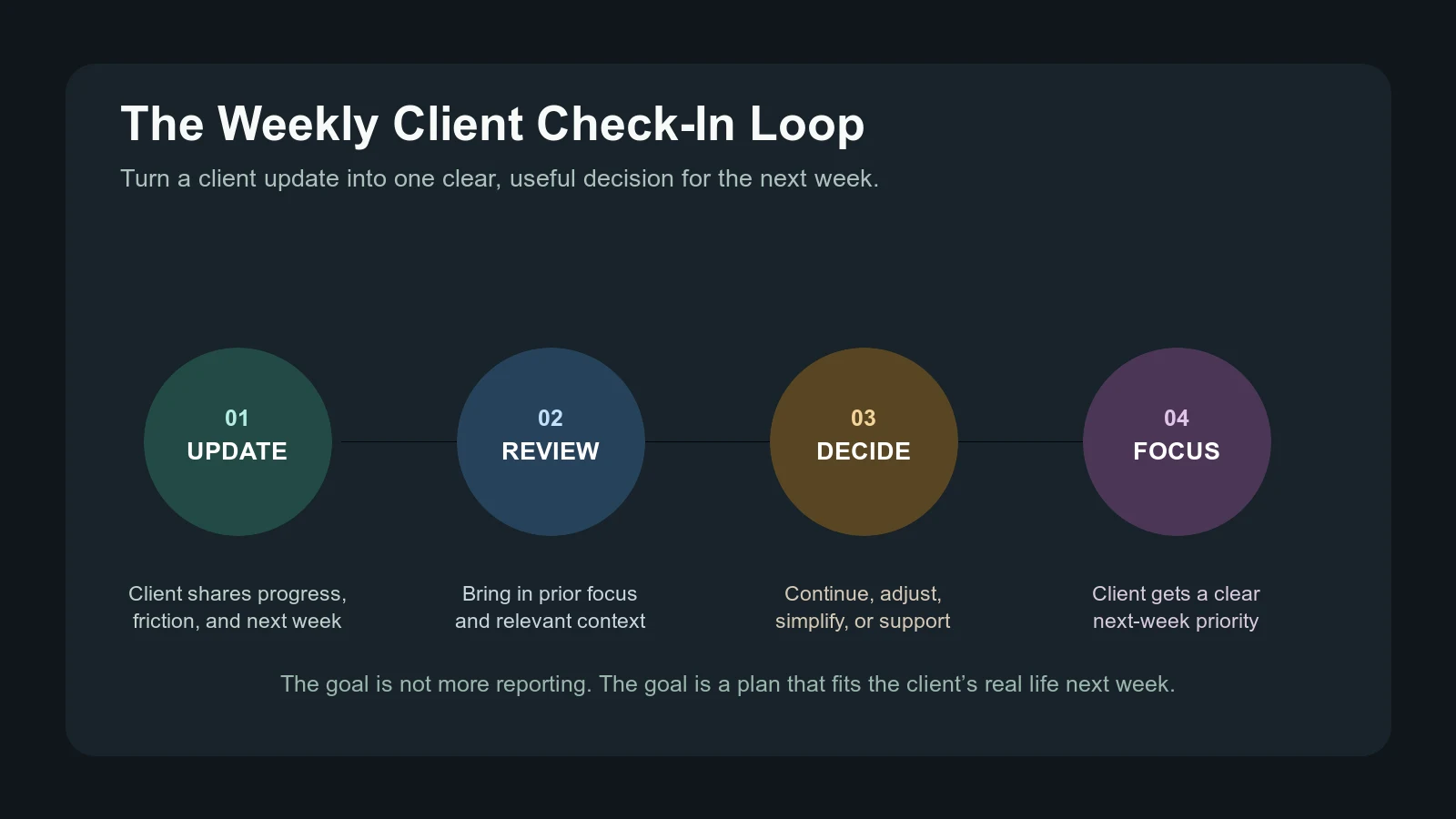
A weekly client check-in system is the repeatable loop an online coach uses to gather a client update, review the relevant context, decide what needs to change, and give the client a clear focus for the next week.
It is bigger than a form and smaller than a giant client-management platform.
At its best, the loop has four parts:
- The client submits a structured update.
- The coach reviews the update alongside the context that matters.
- The coach decides whether to continue, adjust, simplify, or intervene.
- The client receives a clear response and knows what matters next.
The loop below is the simplest version that still holds up as your roster grows.
The point is not to make every week complicated. A healthy check-in may only confirm that the current plan is working.
But when a client is struggling, traveling, overthinking, avoiding the plan, or quietly disengaging, the system should make that visible before you are guessing from an empty message thread.
A form is not the system
Many online coaches have a check-in form. That is a useful start, but it is only one part of the job.
The form tells you what the client submitted. It does not automatically tell you:
- what they committed to last week
- whether the obstacle is new or repeating
- whether the current plan still matches their real life
- whether their engagement is changing over time
- whether they need a program adjustment, a clearer expectation, or a deeper conversation
- whether another person on your team already promised a next step
That is why a weekly check-in can become a pile of answers instead of a coaching system.
The same principle appears in customer-success work outside coaching: a useful health view combines several signals instead of relying on one isolated metric. HubSpot's overview of customer health scores describes the broader pattern of combining engagement, feedback, and outcome signals to spot risk earlier. You do not need to build an enterprise health score for every coaching client. You do need enough context to avoid treating a single scale change, a single missed workout, or a single upbeat message as the whole story.
Decide what the check-in needs to help you decide
Before you write a question, decide what you need to be able to choose at the end of the review.
For most online coaching models, the weekly decision is one of five things:
| Weekly decision | What it means | Example next step |
|---|---|---|
| Continue | The plan fits and the client is moving | Confirm the focus and keep the week simple |
| Adjust | The plan needs a targeted change | Change training volume, nutrition target, accountability structure, or support rhythm |
| Simplify | The client cannot execute the current plan in their real week | Reduce the number of priorities and protect the most important behavior |
| Support | The client needs a more thoughtful coaching response | Add a voice note, a scheduled call, or extra context around the obstacle |
| Escalate | There is a scope, safety, payment, or relationship issue | Move it to the appropriate owner or professional pathway |
This keeps the form from becoming a survey for its own sake.
Every question should help you make one of those decisions. If a question does not change your coaching action, you probably do not need to ask it every week.
What to ask in a weekly client check-in
The exact questions should match your offer. A strength coach, nutrition coach, business coach, and mindset coach should not use a copy-paste form simply because it is called a "high-converting weekly check-in template."
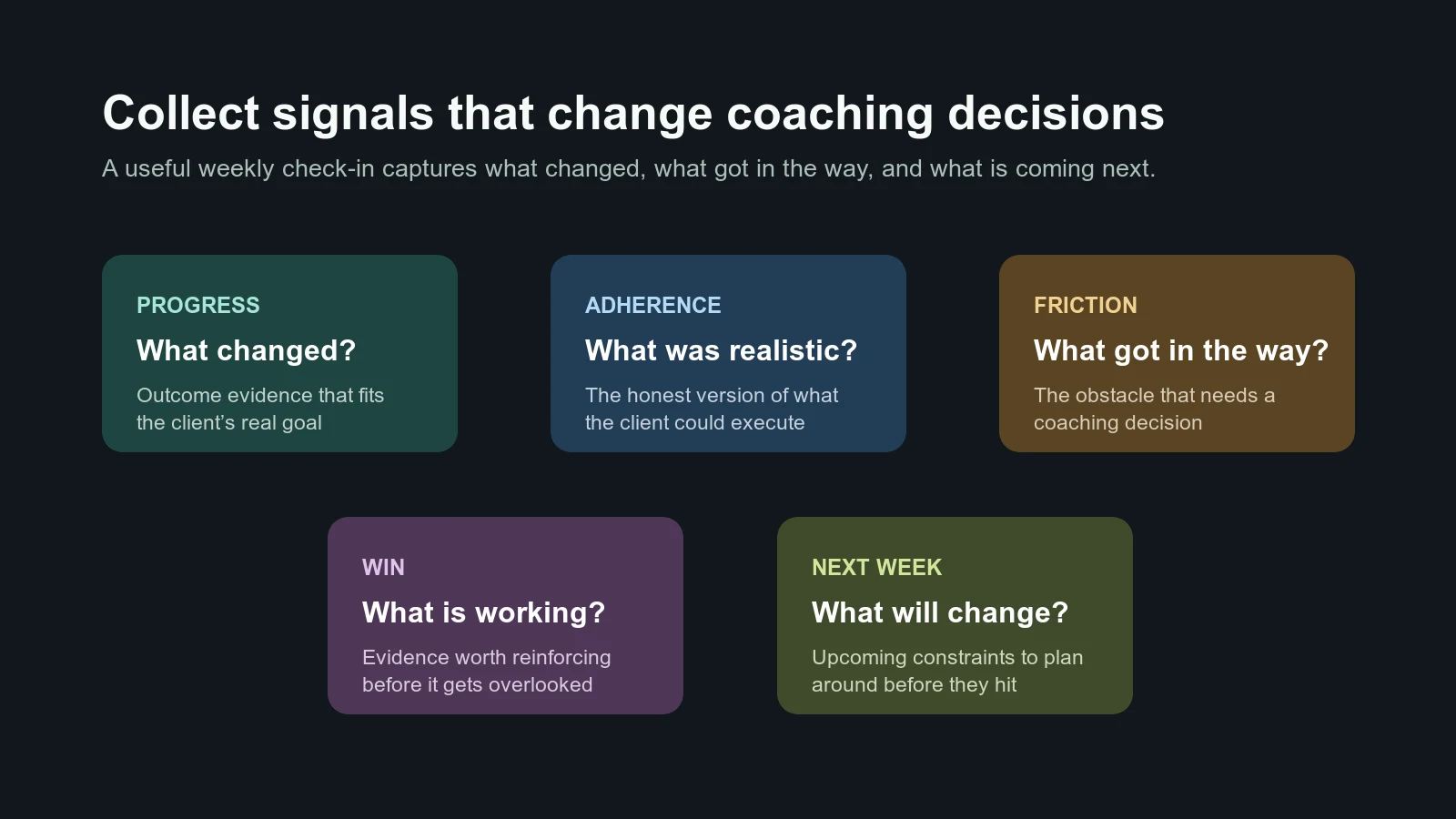
But most useful check-ins collect five kinds of signal.
1. Progress toward the outcome
Ask what has changed in the area you are actually coaching.
That could include performance, behavior consistency, confidence, energy, implementation, revenue activity, or another outcome that is appropriate to the client's goal and your scope of practice. Do not confuse a single data point with the entire result.
The useful question is not always "What is the number?" It is often "What changed, and what does that change tell us?"
2. Adherence in the real world
Clients do not need to perform for the form.
They need a structured way to say what they were actually able to do. This helps you distinguish a plan problem from a motivation problem, a travel week from a recurring constraint, and a one-off slip from a system that does not fit their life.
Ask for the honest version of adherence, not the version that earns a gold star.
3. Friction and obstacles
This is where a lot of coaching value lives.
The obstacle may be a schedule change, low confidence, unclear instructions, competing priorities, family pressure, injury concerns that need proper escalation, or a plan that was too ambitious for the week.
You do not need clients to diagnose themselves perfectly. You need to know what made the plan hard to execute so you can decide whether to adjust the plan or the support around it.
4. Wins and evidence of progress
Clients often remember the hard parts first.
Asking for one win gives you a chance to spot real progress, reinforce the behavior that created it, and keep the week from being framed only around what did not happen. That is especially useful when the main outcome moves slowly but the client is building the habits that make the result possible.
5. The next week's constraints
This is the question many coaches skip, and it is often the most useful.
What is different next week? Travel? A deadline? Kids home? A major event? A change in schedule? A decision they have been avoiding?
If you learn that before the week begins, you can build a realistic plan with the client instead of trying to rescue an unrealistic plan afterward.
The coach response should make a decision visible
Clients do not need a novel every week. They do need to feel that their update led to a real coaching decision.
A strong weekly response usually has four parts:
- Acknowledge something specific. Name a real win, effort, or challenge from their update.
- Reflect the signal that matters. Show the client that you noticed the pattern, not just the latest data point.
- Make the coaching adjustment. Continue, adjust, simplify, or add support.
- State the next focus. Give the client a simple target for the week ahead.
That is enough structure to make a response feel personal without turning every check-in into a custom essay.
Weak response:
Looks good. Keep it up this week.
Useful response shape:
You kept the core habit going even during a busy week, which matters more than forcing a perfect score. The late meetings are clearly the recurring constraint, so we are simplifying the weekday plan and keeping the weekend target. This week, focus on the two non-negotiables we agreed on, and let me know after Wednesday if the new schedule still is not workable.
The second version is not more motivational because it is longer. It is better because the client can see what you noticed and what changes as a result.
Build three review lanes: stable, adjust, and at risk
You do not need a complex score for every client. You do need a consistent way to decide where your attention goes.
| Review lane | What you are seeing | What the coach does |
|---|---|---|
| Stable | The client is engaged, the plan is realistic, and there are no repeating unresolved issues | Confirm progress and keep the next step clear |
| Adjust | The client is engaged but a constraint, plateau, or confusion is making the plan less useful | Make one targeted change and watch whether it resolves the pattern |
| At risk | Engagement is declining, missed check-ins are repeating, friction is unresolved, or the client is unclear about what happens next | Move beyond the standard response with a direct check-in, deeper review, or the right escalation path |
The labels do not need to be visible to clients. They are there to help you and your team stop treating every update with the same level of attention.
This is also where client communication boundaries matter. A good check-in system lets you give thoughtful weekly review without pretending that every message needs an immediate full answer. Pair it with client communication windows so clients know where deeper coaching happens, when they can expect a response, and how urgent issues are handled.
Keep the check-in context in one place
Most check-in systems fail from fragmentation, not a lack of software.
The client sends a form. Their last question is in Instagram DMs. Their progress photo is in a text thread. Your previous instruction is in a voice note. A VA knows that the client is traveling but did not record it anywhere. You spend the first five minutes of each review recreating the client's week from four tabs.
At low volume, you can hold that in your head. At scale, it becomes a quiet quality problem.
Choose one review location where the person handling the check-in can see:
- the current update
- the prior week's focus
- relevant program or plan notes
- unresolved questions
- important constraints and milestones
- the next action and owner
Your coaching tech stack audit is useful here. The goal is not to buy a new tool because a workflow feels messy. The goal is to decide which tool is the source of truth for the review, then stop making the team hunt for context elsewhere.
Give the team clear roles before the roster grows
If you have a VA, assistant coach, or operations support, the check-in system needs ownership rules.
For example:
- A VA can chase an incomplete form, confirm an appointment, organize notes, or flag a repeated missed check-in.
- An assistant coach may handle a defined category of routine review if that is within their role and competence.
- The coach should own the judgment-heavy response, plan changes, scope decisions, and sensitive situations.
Do not accidentally turn a VA into a coach because the inbox is busy. And do not make your assistant wait for permission on every administrative detail.
The coaching business SOP guide can help turn this into a one-page rule with a trigger, owner, inputs, decision points, and completion standard.
Use the weekly loop to protect retention, not police compliance
The weekly check-in is not a surveillance report.
If the only purpose is catching clients failing the plan, they will learn to hide the details that would let you help them. The coach loses the context, the client feels judged, and the system becomes less truthful every week.
The better question is: what would make the next seven days more workable?
That mindset still allows for honest accountability. It just directs accountability toward the next useful action instead of a vague sense of guilt.
For the wider retention conversation, read How to Keep Clients Longer. A weekly check-in is only one layer of client retention, but it is a practical place to catch friction before it becomes silence.
Audit your check-in system this week
Pull the last ten check-ins and look for evidence, not instincts.
Ask:
- Did every client know what mattered for the next week?
- Did the response reflect something specific from the update?
- Could you see the prior week's commitment without searching multiple apps?
- Did clients repeat the same obstacle without a real adjustment?
- Were missed check-ins owned and followed up?
- Did your team know when a client needed more than the standard response?
- Are you asking for information you never use?
If the answer is mostly no, do not rebuild your entire delivery stack. Start by defining one weekly decision, trimming the form to the signals that support it, and putting the current context in one review place.
The takeaway
The weekly check-in is not a formality after the real coaching work.
It is where the plan meets the client's actual life, and where you prove that the service can adapt without becoming chaotic.
When the loop is clear, clients know what to share, coaches know what to review, and every response leaves the client with a more workable next week. That is a much stronger system than collecting more data and hoping the right pattern jumps out.
CTA: Audit ten recent check-ins this week. Keep one question only if it changes a real coaching decision, then give every client a clear next-week focus before the next update arrives.
Frequently asked questions
What should an online coaching weekly check-in include?
A useful weekly check-in captures the change the client wants to see, how consistently they could follow the plan, the main obstacle or source of friction, one win, and what is likely to affect the next week. The exact questions should match the coaching offer and the client’s goal, not turn every client into a data-entry project.
How long should a weekly client check-in take for an online coach?
The right amount of time depends on the support level and client situation. A strong system keeps routine check-ins focused, then gives the coach room to spend more time on clients who need a meaningful adjustment, a harder conversation, or extra support.
Should online coaches use a check-in form?
A form can help when it creates one predictable place for client updates and makes week-to-week patterns easier to see. It becomes counterproductive when it asks for information the coach does not use, fragments the context across tools, or replaces a real response with an automatic acknowledgement.
How do I know which clients need more support this week?
Look for patterns rather than one isolated bad week: declining engagement, repeated obstacles, unclear next steps, unresolved questions, missed check-ins, or a growing gap between the plan and what the client can realistically do. A good system flags these signals before the client quietly disengages.
Ready to Try Intellicoach?
Built for online coaches with real DM volume who want to automate follow-ups and qualification without losing their voice.