
Instagram Highlights for Online Coaches: What to Put in Each One
Build Instagram Highlights that answer high-ticket coaching questions. Get five storyboards, a client-proof checklist, and a practical profile review worksheet.
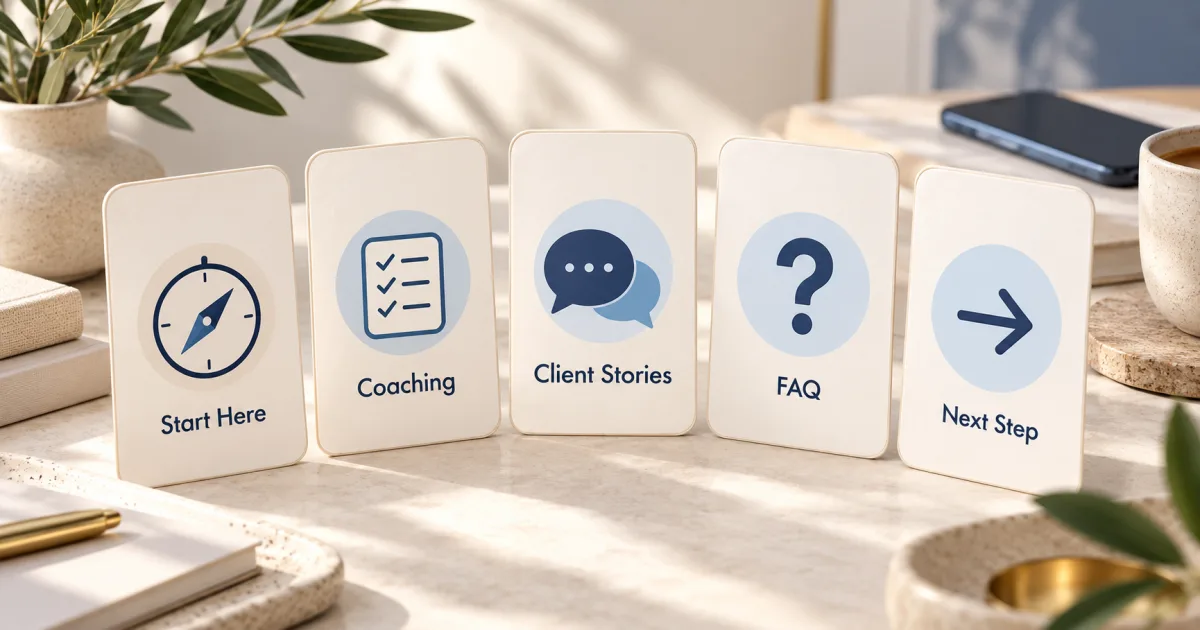
Instagram Highlights for coaches should answer five buying questions: Is this for me? What does coaching involve? What evidence can I trust? What might make it a poor fit? How do I take the next step? A useful starting set is Start Here, Coaching, Client Stories, FAQ, and Next Step.
Instagram Story Highlights are saved collections of Stories that remain available on your profile after the original Stories disappear. Instagram's Help Center explains that highlighted Stories remain until you remove them and keep the audience restrictions of the original Story.
If you already get coaching inquiries in DMs, Highlights can give prospects a place to find the basics before asking you something personal. They should not become a second content schedule or a warehouse of every Story you have ever posted.
If you are deciding who should receive restricted content rather than what to save on your profile, use our Close Friends guide for online coaches. Choose the audience deliberately before mixing prospect education with client-only reminders.
The practical goal is simple: make the first useful conversation easier, without pretending a profile view is a qualified lead.
What should online coaches put in Instagram Highlights?
Save the information someone needs to understand your coaching offer, assess fit, and ask an informed question. Build the collections around questions, then choose the labels and covers.
| Highlight | Prospect question | Material to save |
|---|---|---|
| Start Here | Is this coach relevant to me? | Audience, problem, approach, and who the offer is not for |
| Coaching | What would I actually receive? | Delivery format, feedback, client responsibilities, and support boundaries |
| Client Stories | What does the evidence really show? | Permission-approved experiences with context and accurate claims |
| FAQ | What could stop this being a fit? | Real questions about time, investment, prerequisites, and scope |
| Next Step | How do I ask about working together? | One current inquiry route and an honest explanation of what happens next |
These five collections are a planning recommendation, not an Instagram rule or a measured conversion formula. If your offer only needs four, combine FAQ and Coaching. If you serve two very different audiences, make that distinction explicit instead of mixing incompatible offers inside one long collection.
Start with questions you actually receive. Review a small, recent set of prospect conversations without exporting private details into public content. Write down repeated questions in your own words. Separate a general question such as “How do check-ins work?” from a personal question such as “Can your approach fit my shift pattern?” The first belongs in a Highlight. The second deserves a conversation.
For the surrounding bio, pins, and profile links, use our Instagram profile lead-capture guide. This article focuses on the saved Story library, not the whole profile.
How do you build each Highlight without making it too long?
Give every collection one job, open with that job, and remove frames that do not help answer it. As a drafting constraint, try four to six purposeful frames per collection. That is a manageable starting point, not an evidence-backed ideal length. Keep additional frames only when they add information a prospect needs.
The following storyboards are examples to adapt. Use only statements that are true for your coaching business; they are not customer testimonials or promises of outcomes.
Start Here: help the right prospect recognize themselves
Use this collection to explain relevance, not your complete life story.
- Audience: “I coach experienced professionals who want a strength routine they can sustain alongside travel and work.”
- Problem: Describe the specific situation your service addresses in plain language.
- Approach: Explain how you coach. For example, “We plan around the week you actually have, then review and adjust together.”
- Fit boundary: State a real limitation. “This is ongoing coaching, not a one-off workout download.”
- Direction: Tell the visitor where to learn about delivery or ask a question.
A business coach might replace the training example with the kind of business, growth stage, and decision they help with. A relationship coach should describe their scope without implying they provide a service or professional qualification they do not have.
Coaching: show the work behind the offer
This collection should make the service understandable before the sales call.
- Format: One-to-one, group, asynchronous, live, or a genuine combination.
- A typical week: Show a non-confidential example of a check-in, review, session, or plan adjustment.
- Your contribution: What feedback or decisions you provide and how often, using your actual service terms.
- The client's contribution: What participation, preparation, or practice you expect.
- Boundaries: Where support happens, how response windows work, and what is outside the service.
Use a demonstration or a blank example when a real client screen would expose private information. A walkthrough labeled “example check-in” can explain delivery without pretending to be a customer's result.
Avoid “unlimited access” unless you can explain what it means. A prospect needs to know whether that means messaging at any time, a particular response window, or truly live access. Those are different services.
Client Stories: make proof understandable, not just impressive
A useful client story includes the starting situation, the work, the observed change, and the limits of what the example proves. A screenshot saying “amazing coach” may be genuine, but it tells a prospect little about fit.
Build a story around:
- The client's relevant starting situation, shared with permission.
- What the client and coach actually worked on.
- The documented experience or result, with a truthful time period if one matters.
- Context needed to interpret the result, including material incentives or relationships where relevant.
- What a prospective client should understand about the example, without turning one person's outcome into a general promise.
If you do not have suitable approved proof, show your process instead. Do not manufacture a quote, create a fictional “client win,” or use an AI-generated person as though they received your coaching.
The FTC's endorsement guidance explains that specific-result testimonials can imply results other buyers should expect. A generic “results may vary” disclaimer does not fix that impression. For US-facing marketing, claims about typical outcomes need substantiation or a clear disclosure of generally expected performance in the circumstances shown. Material connections, including relevant incentives, also need clear disclosure. The FTC's social-media disclosure guidance says disclosures on Stories should be placed on the image where people can notice and read them.
This is a practical publishing checklist, not legal advice. When a claim involves weight loss, health, income, or another sensitive outcome, check the applicable rules before publishing it.
FAQ: answer the questions that change a buying decision
Use questions from your actual inquiries, rather than filler such as “Why choose us?”
Good candidates include:
- “How much time do I need to participate each week?”
- “What is the investment, and what does it include?”
- “Do I need previous experience or a particular starting point?”
- “What happens if my schedule changes?”
- “What does the first conversation cover?”
Put one question and its direct answer on a frame where possible. If the answer requires several conditions, explain the general rule and invite the visitor to discuss their circumstances. Do not shrink a paragraph of exceptions into unreadable text.
Price can belong here if it is current and accurate. If you publish a range, explain what changes the price. Avoid a low starting number that almost no relevant prospect could actually pay for the service shown.
Next Step: explain the action and the expectation
The final collection should offer one clear primary action and explain what happens after someone takes it. For a coach who qualifies in DMs, the action might be:
Message me “COACHING” and tell me what you want help with. I'll explain whether this service could be a fit and what the next step involves.
Adapt the promise to your real process. If a team member or assistant handles the first reply, do not promise a personal answer from the founder. If an inquiry may lead to a paid offer, do not frame it as a free audit with no sales discussion.
For an application-first offer, state what the application asks and whether submitting it immediately opens a calendar or starts a review. Our high-ticket coaching application guide covers the form itself.
Keep the invitation specific without turning it into a pressure tactic. A saved “two spaces left this Friday” frame becomes misleading when that Friday has passed. Evergreen wording is usually easier to maintain; genuine dated availability needs an expiry review.
What should you check before adding a testimonial or screenshot?
Also review discussion attached to a saved Story. Our Story comments versus replies guide explains comment visibility, separate message controls and choosing an appropriate surface for personal coaching questions.
Check permission, accuracy, context, privacy, and currency before saving client material to a public-facing Highlight. Removing a name is not the same as confirming that the content is suitable to share.
Keep a simple internal record for each proof item:
- Source: Where the original quote, image, or result came from.
- Permission: What the client approved, including the proposed public use and whether identifying details may appear.
- Accuracy: Whether edits preserve the meaning and any numerical claim can be supported.
- Context: Dates, participation, relevant conditions, and any disclosure needed to avoid a misleading impression.
- Privacy: Whether the frame exposes health details, personal circumstances, contact information, or another person's information.
- Review date: When you will check that the claim and offer context are still accurate.
This record is a practical safeguard, not a substitute for legal requirements. Permission to share a private message does not substantiate a performance claim, and substantiation does not automatically give you permission to share the message.
If you are still collecting proof, our testimonial-request guide covers that earlier step.
How do you add and test Instagram Highlights?
Prepare the content, add the eligible Stories through Instagram's Highlight controls, and test the result as a visitor. Use the current controls shown to your account rather than assuming every profile has an identical layout.
Instagram's current iPhone instructions describe opening your Story, tapping More, then Highlight and selecting the collection. The Help Center also describes editing an existing collection through Edit highlight. Use its device-specific tab for the interface you are using.
Before treating the collection as finished:
- Check the saved frames are readable on a phone, including without sound.
- Verify the collection name describes the content, not just an internal campaign name.
- Read it from beginning to end and remove expired offers or contradictory instructions.
- Test any linked destination or DM invitation with a separate appropriate account.
- Confirm that the intended audience can actually see it.
Saving a restricted-audience Story as a Highlight does not automatically make it public. Instagram says people allowed to see the original Story can also see its Highlights. If prospect-facing content was shared to the wrong audience, fix that deliberately rather than assuming the save action changed its visibility.
You do not need elaborate cover art. Clear labels and readable content are the priority. “Coaching” tells a stranger more than an unexplained abbreviation. Preview the label on the actual profile because long names may not display as you expect.
How do you know whether your Highlights are helping?
Look for more informed inquiries and fewer avoidable misunderstandings, not just views. A Highlight view alone cannot tell you whether someone wants, qualifies for, or will buy coaching.
Before making a change, record the recurring questions and fit problems you want the saved content to address. After updating the collections, review comparable prospect conversations and ask:
- Are people clearer about the format, investment, or next step?
- Which questions still need a personal answer?
- Are prospects arriving with an inaccurate expectation from an old frame?
- How many relevant inquiries progress to an appropriate call or another useful next step?
Use the native metrics actually available to your account, and record source information when the prospect volunteers it or the entry route identifies it. A message saying “I watched your Coaching Highlight” is useful evidence of that route. A generic keyword is not necessarily proof someone came from a Highlight if you use the same keyword everywhere.
Our lead-source tracking guide explains how to keep that distinction. The DM sales pipeline guide covers what happens after an inquiry becomes a real conversation.
Do not claim causation from a handful of messages. A promotion, different content, or a changed offer can affect inquiry quality at the same time. Use what you learn to improve the content, not to invent a conversion benchmark.
A copyable Highlight review worksheet
Review saved Stories when an offer changes, a link breaks, a disclosure changes, or a recurring question stays unanswered. A calendar reminder can help, but an arbitrary weekly update is not a reason to add more frames.
Copy this into your team's document for each collection:
Highlight name:
Prospect question it answers:
Frames that still help answer that question:
Frames to remove or replace:
Proof source and sharing permission, if applicable:
Claim or disclosure that needs checking:
Current offer and support terms checked against:
Primary next step:
Visitor test completed on:
Person responsible for the next review:
Event that should trigger a review:
If your setter keeps explaining a detail that the Highlight was meant to cover, first check whether the detail is actually understandable and visible. Then decide whether it is a general answer or a personal fit question. Adding another FAQ cannot resolve every individual's circumstances.
Highlights do their job when they make your service easier to understand. Keep the collections concise, the proof honest, and the next step current. If that next step already generates more DMs than your team can handle consistently, Intellicoach can help manage the conversation stage. It does not replace the work of making an accurate offer or publishing credible proof.
Frequently asked questions
What Instagram Highlights should an online coach have?
A useful starting set is Start Here, Coaching, Client Stories, FAQ, and Next Step. Each collection should answer a distinct prospect question: relevance, delivery, evidence, fit, or how to inquire. These are planning recommendations, not Instagram requirements or a proven conversion formula.
How many Instagram Highlights should a coach create?
Start with the fewest collections that cover the questions prospects repeatedly ask. Five is a workable planning structure, but there is no evidence-backed universal optimum for coaching accounts. Combine overlapping collections and remove ones that no longer help a visitor make a decision.
Does saving a Story to Highlights make it visible to everyone?
No. Instagram says the people allowed to see the original Story can also see its Highlights. Saving a Story as a Highlight does not automatically make restricted-audience content public. Test visibility from an appropriate outside account before relying on a Highlight for prospect education.
Should coaches put prices in Instagram Highlights?
Include current pricing or an honest investment range when it helps prospects assess fit and accurately reflects the offer. Explain what the price covers and keep it consistent with the application and sales conversation. Do not publish a misleading starting price or an expired promotion.
Should I automatically DM people who view a Highlight?
A Highlight view is attention, not a request for a sales conversation. Invite viewers to send a message or take a clear next step, then respond to that expressed intent. Do not treat a view as permission for an automated pitch or assume every viewer can be identified and contacted through your tools.
Ready to Try Intellicoach?
Built for online coaches with real DM volume who want to automate follow-ups and qualification without losing their voice.