
How to Answer 'How Much Is Coaching?' in Instagram DMs Without Dodging the Question
A practical framework for online coaches answering price questions in Instagram DMs with clarity, context, and the right next step for each lead.
When someone messages, "How much is coaching?" most coaches feel the same small jolt.
Do I give the number? Do I ask more questions first? Do I send the booking link? Do I explain the whole offer? Do I risk losing them if I answer too directly?
That hesitation is understandable. Price questions are high-intent, but they are also easy to mishandle when your team is answering a busy inbox.
The usual bad advice sits at two extremes:
- Never tell them the price until a call.
- Tell them the price, send a link, and hope they book.
Neither is a system.
For an online coaching business with real DM volume, the right move is a price-question rule: a clear way to answer honestly, preserve the context of the conversation, and choose the next action based on what the lead actually needs.
A price question is a request for clarity, not a trap
People ask about price for different reasons.
They may be checking whether they can realistically consider the offer. They may be comparing options. They may be trying to understand whether you sell a one-off program or hands-on support. They may already want help and need to know whether a call is worth the next hour of their week.
That means "how much?" is not automatically a price objection. It is not automatically a booking signal either.
It is a request for clarity.
HubSpot's guide to responding to pricing questions makes a useful broader sales point: buyers want a real answer, not a clever dodge. For coaching DMs, that does not mean forcing every conversation into a one-line quote. It means the lead should be able to understand whether the offer is plausibly right for them before they are asked to do more work.
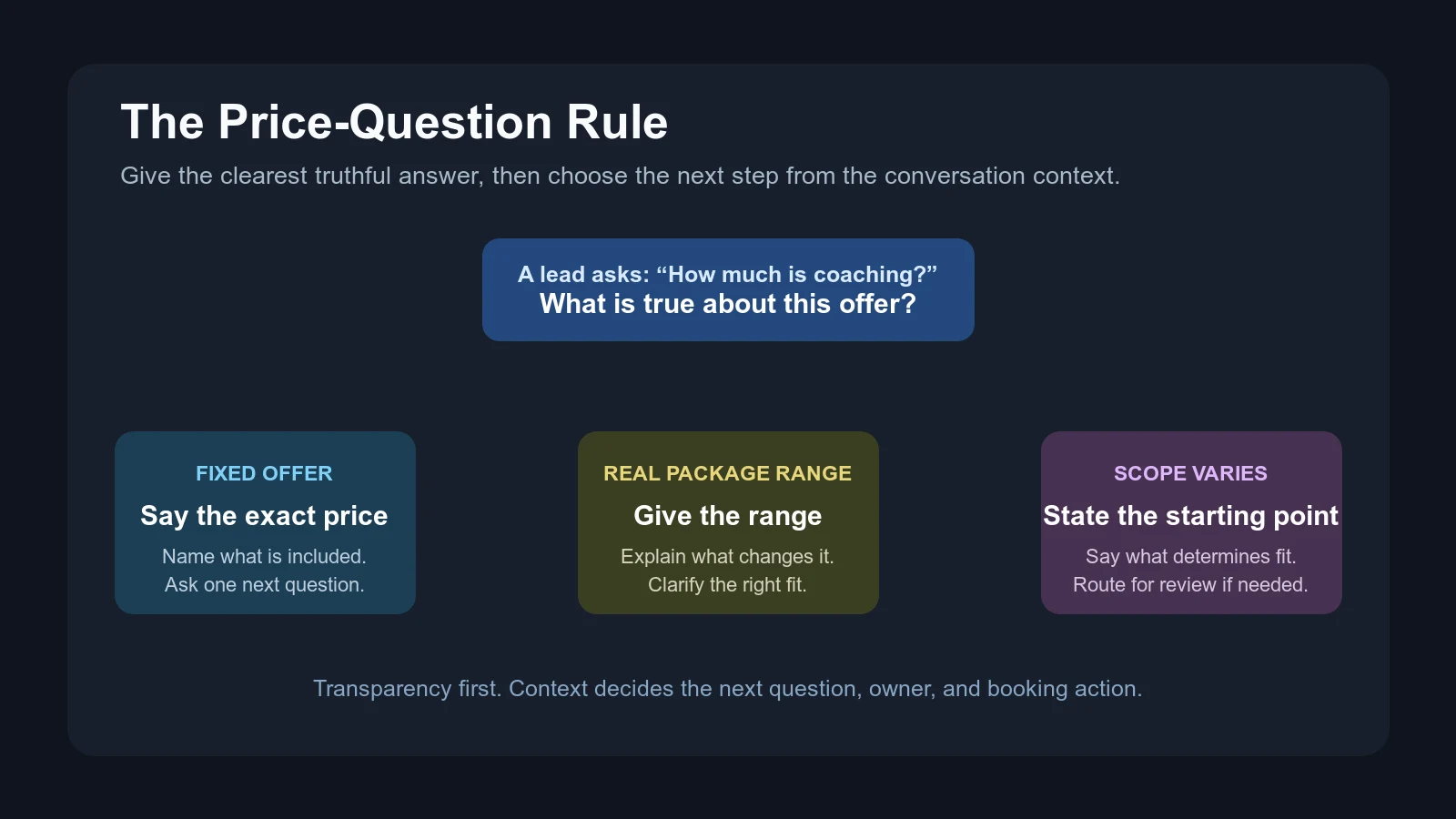
The decision tree below is the operating layer behind that principle.
First, look at what the lead has already told you
The biggest mistake is treating every price question as the same message.
Compare these four DMs:
- "How much is your coaching?"
- "I've been following your content, and I need help getting my nutrition consistent before my wedding. How much is 1:1?"
- "You said I might be a fit for the three-month option. What would that cost?"
- "I looked at the booking link, but before I schedule, can you tell me the investment?"
The words overlap. The conversation stage does not.
Before replying, check:
- where the lead came from
- what problem or goal they already named
- whether they understand the offer category
- whether your offer has a fixed price, a real range, or legitimate package differences
- whether a coach, setter, or AI owns the next reply
- whether the lead is asking about price, payment terms, or whether they are a fit
This is where an inbox without context falls apart. A setter sees a price question but does not know the lead was referred by a current client. AI sees "how much?" but does not know the person has already described their timeline. The coach assumes somebody else answered it.
Your lead routing rules should make this visible. A direct price question may be safe for a trained first response, but exceptions, sensitive context, bespoke delivery, and complex objections should have a defined human-review lane.
Choose the honest price format
There are three clean ways to answer. The correct one depends on how your offer is actually sold, not on which response feels most clever in the moment.
1. Give the exact price when the offer is fixed
If you sell one defined coaching package at one defined price, say the price.
Do not turn a simple question into a 20-minute obstacle course just because you want a call. If the lead needs to know whether the offer is in their world, hiding the number usually creates more friction than qualification.
You can still add one sentence on what is included and one useful next question. The point is that the number should be a real answer, not a reward for jumping through hoops.
2. Give a real range when packages or delivery genuinely differ
Use a range when there is a meaningful difference in what someone might receive:
- a group coaching option and a private coaching option
- different support levels
- different program lengths
- a service where the coach needs to confirm scope before recommending the right package
The range must be real. It should help the lead rule themselves in or out, not leave them more confused than they were before.
That means explaining what changes the number. For example: duration, access, level of personalization, or delivery format. You do not need to narrate every feature. You do need to make the range honest.
3. Give a starting point when the final recommendation depends on fit
There are situations where a full exact quote would be misleading. A business coach may offer a range based on team size and support level. A fitness coach may have a standard starting point but recommend a more involved option only after understanding the person's goal and constraints.
In those cases, a starting point is better than a vague "it depends."
Tell the lead what coaching starts at, name what determines the final recommendation, and then ask the one question that helps you clarify responsibly.
The rule is not "never say it depends." The rule is: never make 'it depends' the entire answer.
The four parts of a useful price reply
You do not need a 14-message script for this. You need a response shape that your coach, setter, and AI can all follow without losing your voice.
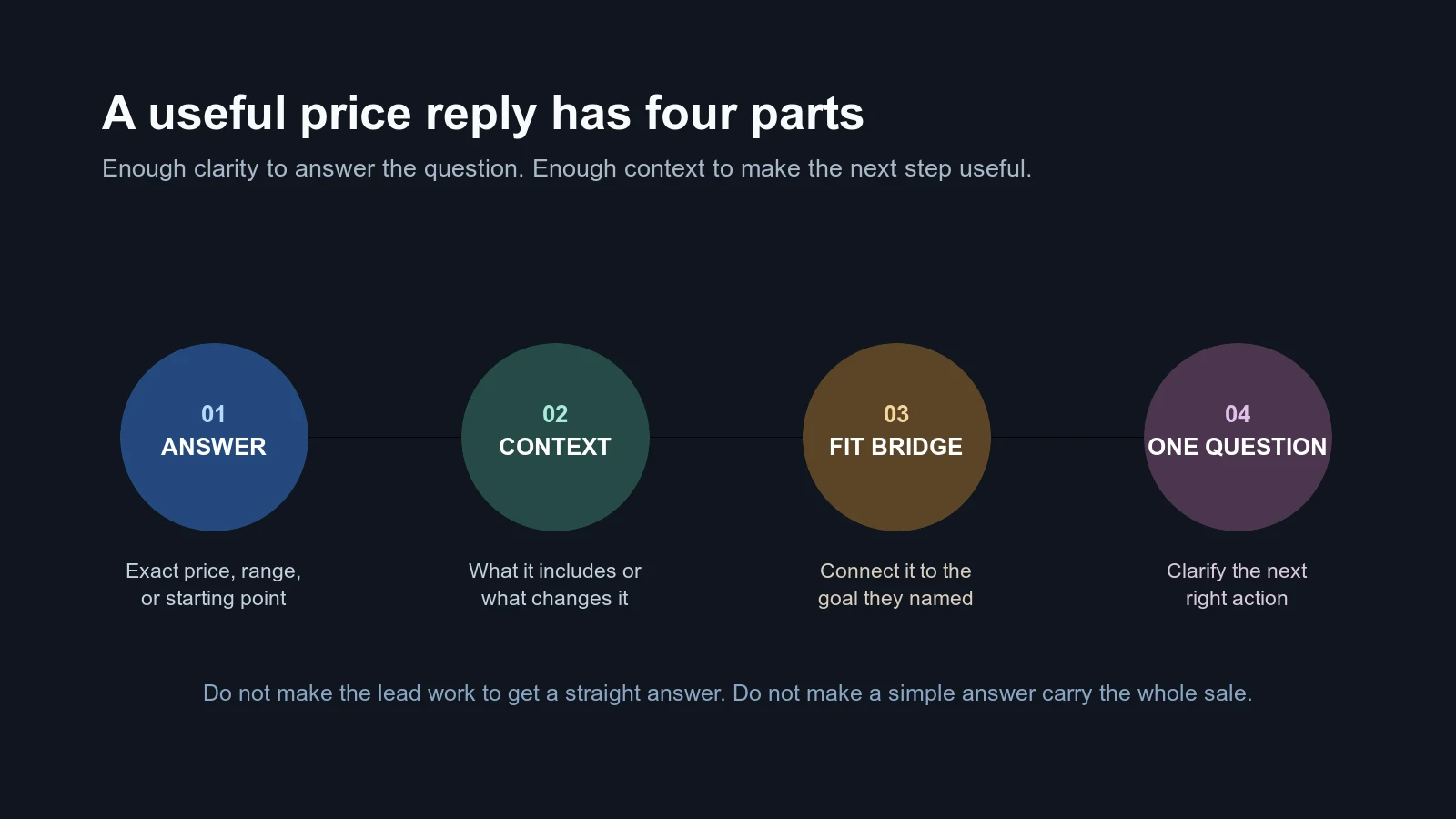
Part 1: Answer the number
Start with the clearest truthful form of the price: exact price, real range, or starting point.
Do not make the first line defensive. Do not frame it as a secret. And do not use confusing euphemisms that make the lead wonder whether you are avoiding the answer.
Part 2: Add delivery context
In one sentence, explain what the price includes or why the range changes.
For example, a coach might name the program length, level of access, check-in rhythm, or whether the offer is group versus 1:1. This is not a pitch deck. It is the minimum context that makes the number useful.
Part 3: Bridge back to their situation
Connect the response to what they actually asked for help with.
If the lead has not shared any context yet, the bridge is an invitation to tell you what they are working on. If they already named a goal, you can make the connection without re-interviewing them from zero.
Part 4: Ask one next question
The final question should reduce uncertainty, not pressure them into a call.
Depending on the conversation, it might clarify their goal, timing, support needs, or whether the range is workable. If they are already clearly qualified and the call is the right next step, then the booking link can be appropriate.
This is a big difference from sending a link every time somebody asks about price. The booking link rule explains the wider decision: a calendar link belongs after enough context exists to make the call useful, not as an automatic response to interest.
What not to do when someone asks about coaching cost
There are four replies that create more work for everyone.
Do not dodge with a vague question
"What is your budget?" can be a useful question later. As the first answer to a direct price question, it often feels like you ignored what they asked.
The person does not need a complete proposal in the DM. They do deserve a transparent starting point.
Do not send a price with no context
Dropping a number with nothing else can make the offer feel like a commodity, especially when the lead does not yet understand what type of support you provide.
Give the number. Then give enough delivery context to make it meaningful.
Do not over-explain or defend the price
A price question does not require an essay about why you are worth it.
Long messages can sound anxious, particularly in a quick DM. If the lead asks a more specific question after seeing the price, then you have something real to explore. Until then, stay direct and calm.
Do not confuse price with the real objection
Sometimes the lead is asking, "Can I afford this?" Sometimes they are asking, "Will this actually work for me?" Sometimes they are asking whether the offer format fits their life.
That is why the next question matters. The high-ticket buyer safety gap is a useful lens here: lowering or defending the price does not resolve uncertainty about fit, timing, or confidence in the process.
Build a price-question rule your team can actually use
The right answer should not depend on who happens to be online.
Write a short rule that covers:
| Decision | Define it for your business |
|---|---|
| Fixed offer price | The exact number and what is included |
| Valid price range | The lowest and highest real price, plus what changes it |
| Starting point | What you can state before deeper scope or fit review |
| Required context | What the team needs before recommending a specific package |
| Booking threshold | What must be true before a booking link can be sent |
| Human review triggers | Discounts, payment-plan requests, sensitive conversations, custom scope, or unclear fit |
| Follow-up owner | Who handles a lead that sees the price but does not reply |
This is an SOP, but not a giant one. It is a decision rule for one frequent moment in the inbox.
If you already have a setter, do not leave this rule in a folder they will never open. Put it where the live conversation happens. The setter scorecard can help you review whether the team is following it without turning every price question into a quality-control emergency.
Where AI helps and where it should pause
Price questions are a good example of why AI should be connected to your business rules, not given permission to improvise around money.
AI can help when it has a current, approved source of truth for:
- fixed prices and package names
- real ranges and what changes them
- current payment options
- what the offer includes
- the booking threshold
- escalation triggers
- approved voice examples
It can quickly give a context-aware first response, restore the lead's last stated goal, tag the question, and route the reply to the next owner.
It should pause when a lead asks for a special exception, a custom package, a discount, a payment arrangement outside the rules, or advice that becomes sensitive or high risk. In those situations, fast is not the same as correct.
The AI DM guardrails framework goes deeper on how to draw that line. For price questions, the principle is straightforward: automate clarity around approved terms; escalate judgment around exceptions.
Audit your last 20 price questions
The fastest way to improve this is not to write a new script in isolation. Pull the last 20 DMs where a lead asked about price and look for patterns.
Ask:
- Did the lead get a direct answer?
- Did they understand what the price covered?
- Did the response reflect the prior context?
- Was the next question useful, or was it just a link?
- Did the right person own the reply?
- Did the conversation move to a real next stage?
- When leads went quiet, was the reason recorded or guessed?
This is exactly the kind of recurring conversation moment a DM conversation quality audit should surface. You may find the problem is not the price itself. It may be inconsistent package language, a booking rule that fires too early, missing context, or a handoff gap between AI, setter, and coach.
The takeaway
"How much is coaching?" deserves a real answer.
Not a dodge. Not a long defense. Not an automatic calendar link.
The best response gives the person enough clarity to decide whether the conversation is worth continuing, then uses the context you already have to choose the right next question and owner.
That is how price conversations become part of a clean sales process instead of a different improv session every time they appear in the inbox.
CTA: Review the last 20 price-question DMs in your business and write one approved rule for the exact price, range, escalation, and booking decisions. If your team needs one place to keep those rules, live context, follow-up, and human review connected, see how Intellicoach helps online coaches run DM sales conversations with more control.
Frequently asked questions
Should an online coach tell someone the price in Instagram DMs?
Usually, yes. If the offer has a fixed price, say it clearly. If there are legitimate delivery or package differences, give an honest range and explain what changes it. A lead should not have to book a call simply to learn whether the offer is in the right ballpark.
How should I answer 'How much is coaching?' without sounding salesy?
Use a direct answer, briefly explain what is included or what determines the range, connect it to the problem the lead raised, and ask one useful next question. The goal is clarity first, then a relevant next step, not a long defense of the price.
Is a price question a buying signal?
It is a meaningful sign of interest, but it is not proof that someone is ready to book. A price question may be a fit check, a budget question, a comparison question, or a request for reassurance. The next step depends on the context already in the conversation.
When should a coach give a price range instead of an exact price?
Use a range when the offer genuinely changes by package, support level, duration, or scope. Do not use a range to hide a standard price. If a lead needs a tailored recommendation, give the honest starting point or range first, then clarify what would determine the exact fit.
Ready to Try Intellicoach?
Built for online coaches with real DM volume who want to automate follow-ups and qualification without losing their voice.